Gaya well asphyxiation incident claims four lives in Bihar
Source:The Hindu ↗
Why It Matters
Highlights the recurring hazards of confined space asphyxiation (often involving gases like methane or carbon monoxide) in rural areas, emphasizing the need for public awareness and safety protocols. It is relevant for BPSC's general science and state-specific hazard management sections.
Summary
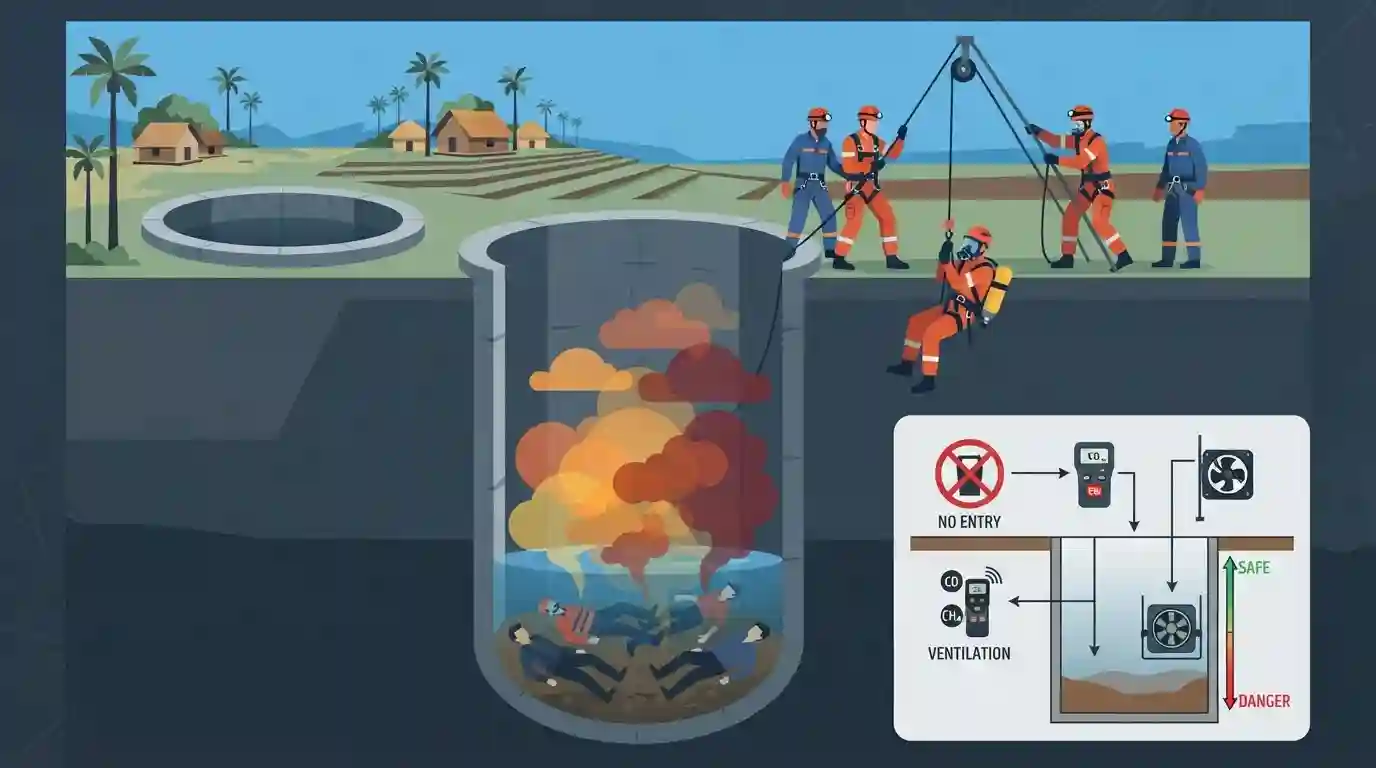
Four individuals died of asphyxiation due to the inhalation of toxic gas while inside a well in Bihar's Gaya Ji district. This tragic event underscores the hazards of confined spaces where dangerous gases like methane and carbon monoxide can accumulate, posing severe risks without proper ventilation or safety equipment.
Key Points
- Four people died of asphyxiation after inhaling toxic gases inside a well in Gaya Ji, Bihar.
- Such incidents usually occur due to the accumulation of toxic gases like methane, carbon monoxide, or hydrogen sulfide, resulting from the decomposition of organic matter in confined, unventilated spaces like old wells.
- The tragedy highlights the need for awareness and the use of proper safety equipment before entering deep wells or confined spaces for cleaning or maintenance.
Important Terms
Asphyxiation

A life-threatening condition caused by severe oxygen deprivation. In confined spaces like deep wells, it often occurs when heavier, toxic gases displace breathable air, leading to rapid unconsciousness or death.
UPSC context
GS Paper 3 (General Science). Relevant for understanding the physiological impacts of environmental and occupational hazards.
Confined Space Hazard
Risks associated with areas like old wells or sewers that have restricted access and poor ventilation. They are prone to trapping dangerous gases and lacking sufficient oxygen for survival.
UPSC context
GS Paper 3 (Disaster Management). Tests awareness of occupational safety guidelines and localized emergency response strategies.
Toxic Gases (Methane/Carbon Monoxide)
Hazardous, often odorless gases that accumulate in unventilated underground spaces due to organic decomposition or motor exhaust. Inhalation in closed spaces severely impairs oxygen transport, causing fatality.
UPSC context
GS Paper 3 (Environment). Covers the chemical properties of hazardous gases and their public health threats.
Ex Gratia Payment
Financial assistance provided voluntarily by the government to victims of tragedies or their next of kin—like the ₹4 lakh given in Gaya—without admitting any legal liability.
UPSC context
GS Paper 2 (Governance/Polity). Tests knowledge of executive welfare mechanisms and discretionary state disaster relief efforts.
Government of Bihar
The sub-national governing authority of the Indian state of Bihar. During local tragedies, it is responsible for enforcing safety regulations, mobilizing emergency responders, and administering state-level disaster relief.
UPSC context
GS Paper 2 (State Governance). Illustrates the constitutional role of the state executive in managing public safety.
Prelims Trap
Hydrogen Sulfide (H2S) can always be detected before fatal exposure due to its strong 'rotten egg' smell.
At high concentrations (above 100-150 ppm), H2S causes 'olfactory fatigue', paralyzing the olfactory nerve. Victims completely lose the ability to smell it before asphyxiating.
Static Concepts Connected
How does Carbon Monoxide (CO) cause fatal chemical asphyxiation?
- High Hemoglobin Affinity: CO binds to hemoglobin in human blood over 200 times more effectively than oxygen, forming carboxyhemoglobin.
- Cellular Starvation: This process blocks the blood's capacity to transport oxygen, leading to cellular hypoxia and chemical asphyxiation even if breathing continues.
What are the key pillars of the NAMASTE Scheme?
- Joint Implementation: It is a joint initiative of the Ministry of Social Justice and Empowerment (MoSJE) and the Ministry of Housing and Urban Affairs (MoHUA).
- Core Objective: It aims to achieve zero fatalities in sanitation work by ensuring 100% mechanization of sewer and septic tank cleaning across India.
Cross-Topic Patterns
Sewer Gas vs. Biogas Production
The same anaerobic methanogenic bacterial process that generates deadly methane and hydrogen sulfide in confined unventilated wells is harnessed positively in biogas plants for renewable energy.
Article 21 and Mechanized Sanitation
Fatalities in confined spaces like sewers and wells frequently invoke Article 21 (Right to Life with dignity) and form the crux of the NAMASTE scheme's push for 100% mechanized sanitation.

Expect a Prelims question mixing properties of sewer gases (H2S olfactory fatigue, CO hemoglobin binding) with the NAMASTE scheme details.
Linked PYQs · 2
Linked PYQs · 2
- 2020BPSC_PRELIMSGS1
The incomplete burning of petrol and diesel produces
- 2023BPSC_PRELIMSGS1
What is the current population of Gaya district of Bihar?
