Natural Farming Centres of Excellence Advance Sustainable Agriculture
Source:chinimandi ↗
Why It Matters
Natural farming and zero-budget agriculture are highly emphasized in government policies for sustainable rural development. Recognizing state-level initiatives, key districts involved, and associated bio-input techniques is vital for answering state-specific agriculture and economy questions in GPSC Prelims.
Summary
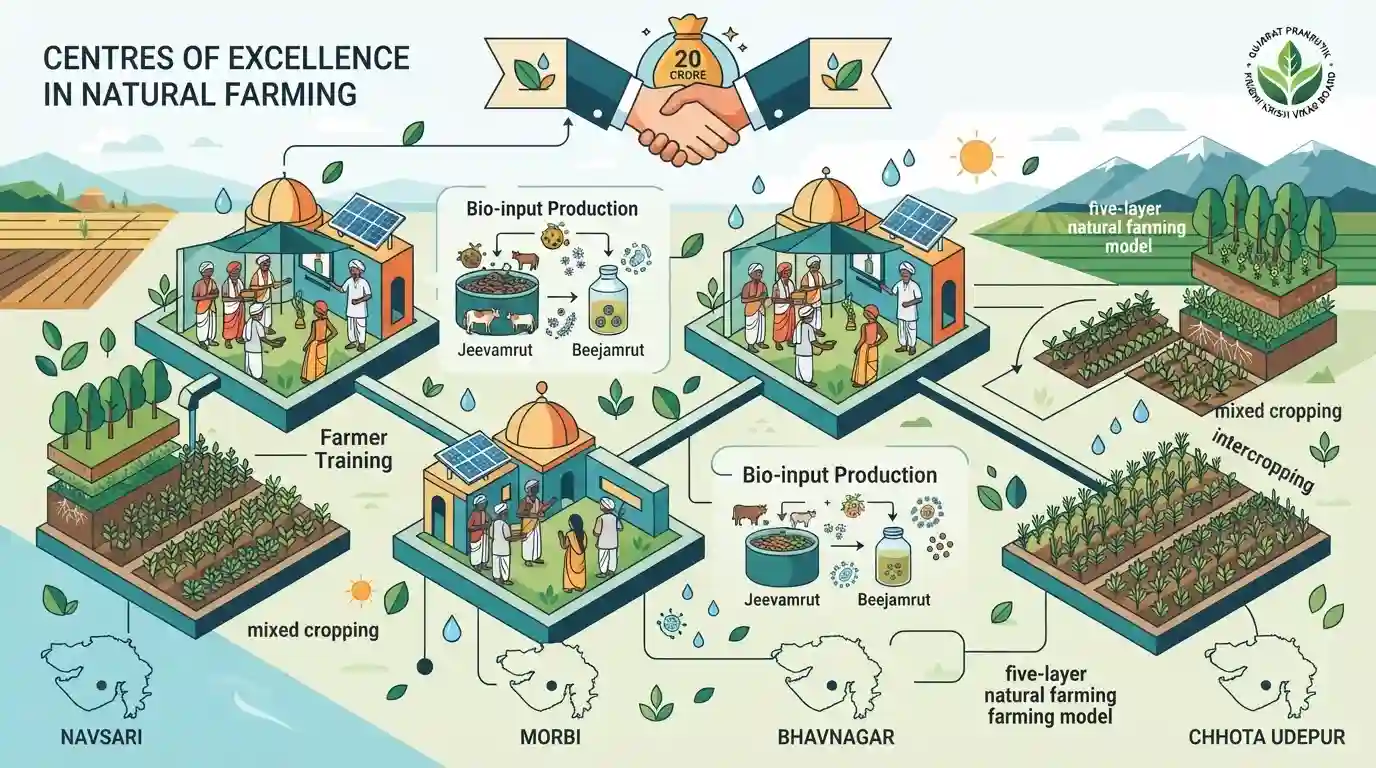
The Gujarat government has announced the establishment of four Centres of Excellence to advance natural farming in the state, with facilities planned for Navsari, Morbi, Bhavnagar, and Chhota Udepur. Backed by a ₹20 crore allocation for 2026-27, the initiative will be spearheaded by the Gujarat Prakrutik Krishi Vikas Board. The centres will act as hubs for training farmers in sustainable agriculture, focusing on the production of bio-inputs like Jeevamrut and Beejamrut, and showcasing advanced techniques such as the five-layer natural farming model, mixed cropping, and intercropping.
Key Points
- The Gujarat Government is setting up four Centres of Excellence in Navsari, Morbi, Bhavnagar, and Chhota Udepur districts to promote natural farming.
- A budget of ₹20 crore has been allocated for these centres for the financial year 2026-27.
- The Gujarat Prakrutik Krishi Vikas Board will implement the initiative to train farmers and boost sustainable agricultural practices.
- These centres will demonstrate the preparation and use of essential natural farming bio-inputs like Jeevamrut, Ghan Jeevamrut, Beejamrut, and Neemastra.
- The facilities will also provide practical demonstrations of the five-layer natural farming model, mixed cropping, and intercropping to optimize land use and crop resilience.
Important Terms
Gujarat Prakrutik Krishi Vikas Board

A state-level board in Gujarat responsible for implementing, promoting, and expanding natural farming practices, organizing farmer training programs, and managing the establishment of agricultural Centres of Excellence.
UPSC context
GS Paper III (Agriculture & Sustainable Farming); tests knowledge of state-led institutional frameworks promoting ecological agriculture.
Jeevamrut
A fermented liquid microbial inoculant made of cow dung, urine, jaggery, pulse flour, water, and soil. It enriches the soil with beneficial microbes, enhancing crop nutrition naturally.
UPSC context
GS Paper III (Agriculture/Subhash Palekar Natural Farming); essential for understanding organic soil-nutrient enhancers as chemical fertilizer alternatives.
Beejamrut
A natural, eco-friendly seed treatment formulation made of indigenous cow dung, cow urine, lime, and soil. It coats seeds to protect them from pathogens and pests while boosting germination.
UPSC context
GS Paper III (Agriculture); tests understanding of biological seed-treatment techniques, disease prevention, and cost-effective organic inputs.
Five-layer Natural Farming Model
A sustainable multi-tier agroforestry system where five compatible crops of varying heights (tall trees, shrubs, bushes, creepers, and roots) are grown together to maximize vertical space and biodiversity.
UPSC context
GS Paper III (Cropping Patterns & Sustainable Agriculture); tests knowledge of vertical farming, agroecology, and crop diversification.
Centres of Excellence in Agriculture
Specialized institutional hubs designed to demonstrate state-of-the-art farming technologies, conduct farmer training, produce sustainable inputs, and foster research in climate-resilient agricultural practices.
UPSC context
GS Paper III (Agricultural Extension/Technology Missions); tests understanding of modern extension services and institutional capacity-building.
Prelims Trap
Natural farming and Organic farming are technically identical, both relying on external organic inputs like vermicompost.
Organic farming allows external, certified organic composts/fertilizers. Natural farming strictly prohibits off-farm inputs, relying purely on on-farm, indigenous cow-dung and urine-based formulations.
Static Concepts Connected
What are the four pillars of Zero Budget Natural Farming (ZBNF)?
- Jeevamrut: A fermented microbial culture (cow dung, urine, jaggery, pulse flour) used to activate soil microorganisms and accelerate nutrient availability.
- Beejamrut: An indigenous microbial formulation used for treating seeds, seedlings, or planting material to prevent fungal and soil-borne diseases.
- Acchadan (Mulching): The practice of covering the topsoil with crop residues to conserve soil moisture, suppress weeds, and promote humus formation.
- Whapasa (Moisture): The creation of microclimate conditions in the soil where both water vapor and air are present, significantly reducing irrigation water requirements.
How do Mixed Cropping and Intercropping differ in practice?
- Spatial Arrangement: Mixed cropping grows two or more crops simultaneously with no distinct row arrangement, whereas intercropping uses a definite row pattern.
- Primary Objective: Mixed cropping aims primarily to minimize the risk of total crop failure under erratic weather, while intercropping seeks to maximize yield per unit area.
- Resource Optimization: Intercropping optimizes resource use (light, nutrients) by pairing crops with different heights or root depths, whereas mixed cropping involves direct random competition.
Cross-Topic Patterns
Natural farming + Dryland water security
Linking multi-layer cropping to micro-irrigation policies, showing how five-layer models naturally conserve soil moisture and reduce groundwater draft in water-stressed regions.
Sustainable agriculture + WTO subsidy boxes
Shifting from chemical fertilizers to on-farm natural inputs helps India reduce Amber Box subsidies while enhancing non-trade-distorting Green Box environmental support.

2026 Prelims will likely test the scientific distinction between ZBNF inputs (Jeevamrut) and standard organic farming bio-fertilizers.
Linked PYQs · 2
Linked PYQs · 2
- 2026GPSC_PRELIMSGS1
Consider the following statements regarding 'Nano Urea' recently promoted by the Government of India for agricultural use: 1. It replaces the need for Phosphorus and Potash fertilizers entirely, simplifying the fertilizer application process for farmers. 2. It has a higher nutrient use efficiency compared to conventional granular urea, leading to reduced soil degradation and water pollution. Which of the above statement(s) is/are correct?
- 2025GPSC_PRELIMSGS1
Which of the following statements are correct regarding the economy of Gujarat according to the Socio-Economic Review, 2024-2025 of Gujarat? 1. Gujarat has consistently contributed over 8% to India's GST collections, highlighting its economic vitality and strength. 2. During the year 2022-23, Gujarat stood first in handling total cargo among the states of India. 3. According to the results of Annual Survey of Industries (ASI) 2022-23, Gujarat is first in the country in Industrial Production and Fixed Capital.
