SIT Investigation into Subsidized Rice Diversion in MP
Source:newindianexpress ↗
Why It Matters
This case study demonstrates the intersection of agricultural economics, policy implementation (Biofuels vs. Food Security), and governance challenges in India. Understanding the mechanics of the Open Market Sale Scheme (OMSS), fortified rice, and the economic cost of foodgrain procurement is vital for state-level civil service examinations.
Summary
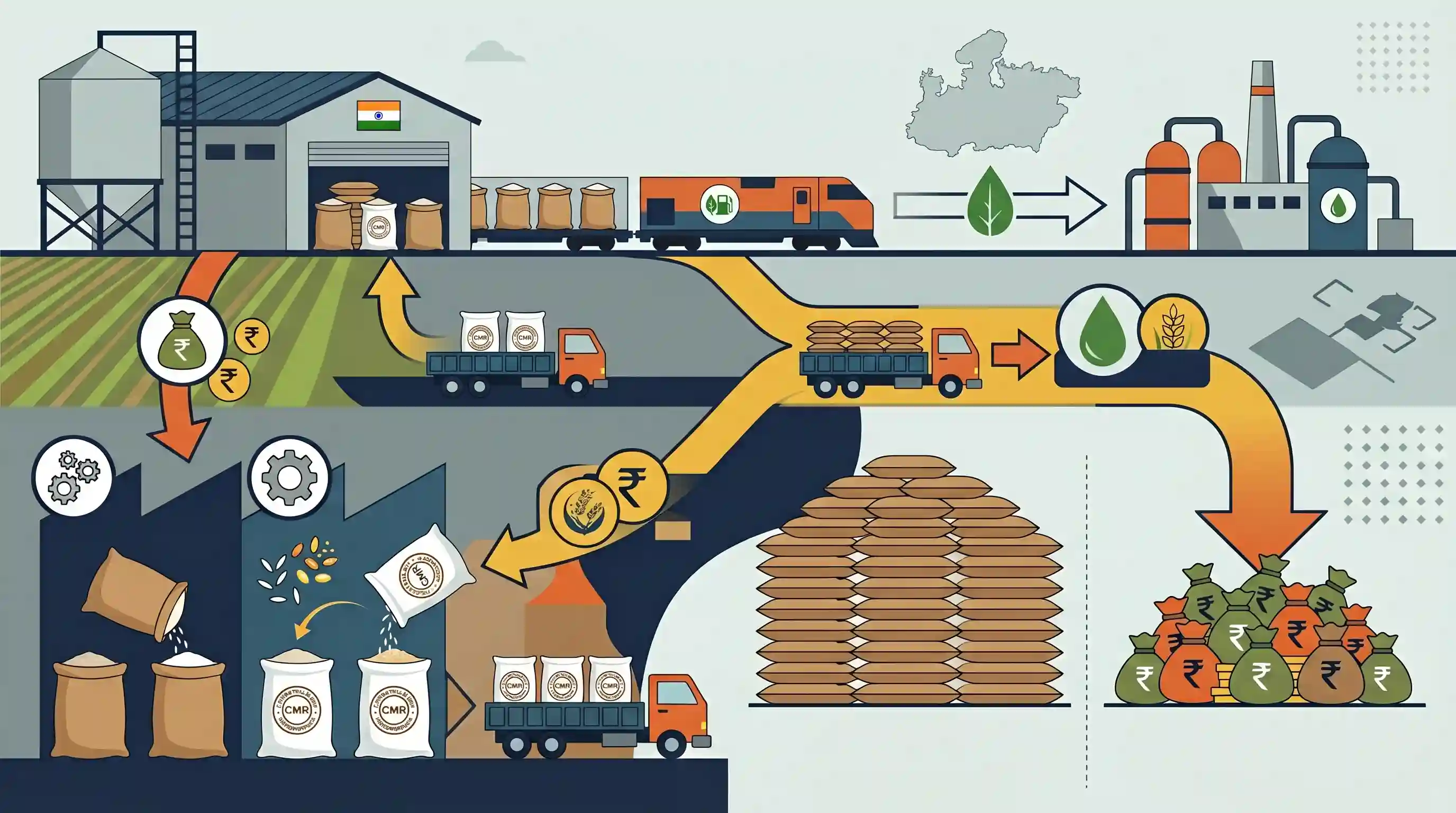
A Special Investigation Team (SIT) in Madhya Pradesh is probing an alleged multi-crore scam involving the diversion of subsidised Food Corporation of India (FCI) rice. The rice, allocated for ethanol production under India's Ethanol Blending Programme (EBP), was diverted from Chhindwara-bound consignments to private mills in Balaghat. Millers are suspected of repacking this subsidised rice—potentially including nutrient-enriched fortified rice meant for welfare schemes—and cycling it back into government warehouses as fresh Custom Milled Rice (CMR). The probe is looking into potential leakage of up to 5 lakh metric tonnes of rice valued at over Rs 1,000 crore.
Key Points
- A Special Investigation Team (SIT) in Madhya Pradesh is investigating a massive scam involving the diversion of Food Corporation of India (FCI) rice meant for ethanol plants to local rice mills in the Mahakoshal region (Balaghat, Chhindwara, Seoni).
- Subsidised rice sold through the Open Market Sale Scheme (OMSS) at Rs 2,320 per quintal (economic cost to FCI exceeds Rs 4,000 per quintal) was diverted to private rice mills instead of reaching designated ethanol plants.
- Suspected Modus Operandi: Private millers allegedly repacked this diverted rice and supplied it back to government warehouses as freshly produced Custom Milled Rice (CMR) under existing milling contracts.
- Concerns are raised that the diverted stock included fortified rice enriched with vitamins and minerals, which is meant for social security schemes tackling malnutrition and anaemia in vulnerable populations.
- The scale of the diversion is estimated to potentially reach 5 lakh metric tonnes of government rice worth over Rs 1,000 crore.
Important Terms
Ethanol Blending Programme (EBP)

A national initiative to blend ethanol (a renewable biofuel) with petrol to reduce crude oil imports, lower carbon emissions, and support farmers. India achieved its 20% blending target (E20) in 2025.
UPSC context
GS Paper III (Energy, Environment, Agriculture); tests biofuel policy, energy security transitions, and ethanol procurement.
Food Corporation of India (FCI)
A statutory body established under the Food Corporation Act, 1964, responsible for procuring foodgrains at minimum support prices, maintaining buffer stocks, and distributing them to ensure national food security.
UPSC context
GS Paper III (Food Security, PDS, Buffer Stocks); tests core institutional mechanisms of foodgrain storage and distribution.
Open Market Sale Scheme (OMSS)
A mechanism where the Food Corporation of India sells surplus foodgrains (mainly wheat and rice) from the central pool at predetermined prices through e-auctions to traders and bulk consumers to stabilize domestic prices.
UPSC context
GS Paper III (PDS, Buffer Stocks, Inflation); tests government interventions to regulate domestic food grain supply and control inflation.
Custom Milled Rice (CMR) scheme
A procurement framework where state government agencies buy paddy from farmers and deliver it to private millers, who process and return it as milled rice to the Food Corporation of India.
UPSC context
GS Paper III (Agriculture, Procurement, Food Security); tests supply chain efficiency, decentralized procurement, and vulnerabilities to recycling scams.
Food Fortification
The practice of deliberately increasing essential micronutrients (like iron, folic acid, and vitamin B12) in staple foods like rice or milk during processing to improve nutritional quality and combat malnutrition.
UPSC context
GS Paper II (Health, Social Justice) & GS Paper III (Agriculture, Food Security); tests policies combating anemia and hidden hunger.
Prelims Trap
Under India's biofuel policy, food grains fit for human consumption are strictly prohibited from being used as feedstocks for ethanol production.
Under the National Policy on Biofuels 2018, surplus food grains (like FCI rice) can indeed be diverted for ethanol production if approved by the National Biofuel Coordination Committee (NBCC).
Static Concepts Connected
How does the Custom Milled Rice (CMR) system work under Decentralised Procurement (DCP)?
- Direct Procurement: State government agencies procure paddy directly from farmers at Minimum Support Price (MSP) on behalf of the central pool.
- Milling Process: State agencies hand over the procured paddy to registered private millers for processing.
- Mandated Outturn: Millers must return a mandated ratio of processed rice (typically 67% outturn ratio for raw rice) back to state/FCI warehouses.
- System Efficiency: DCP reduces transit costs, avoids double handling, and matches local procurement with local public distribution needs.
What are the FSSAI standards and components for food fortification in India?
- Regulated Staples: FSSAI regulates fortification of five staples: rice, wheat flour, milk, edible oil, and double-fortified salt.
- Mandatory Micronutrients: Fortified rice must contain iron (28–42.5 mg), folic acid (75–125 mcg), and Vitamin B12 (0.75–1.25 mcg) per kilogram.
- Identification Logo: All fortified food packaging must carry the blue '+F' logo for identification.
- Health Advisory: Labels must warn that individuals with Thalassemia or Sickle Cell Anaemia should consume iron-fortified food only under medical advice.
Cross-Topic Patterns
Energy Security vs. Food Security
Diverting staple grains for biofuel (EBP) highlights the policy trade-off between achieving energy self-reliance and ensuring grain availability for welfare schemes like PM-GKAY.
Food Fortification and Leakage Vulnerability
The circular recycling of fortified rice back into government warehouses weakens target-specific interventions like POSHAN Abhiyaan aimed at eradicating micro-nutrient deficiencies.

The policy trade-offs between food security (PDS) and energy transition (E20 target) are highly likely to feature in GS-3 Mains.
Linked PYQs · 2
Linked PYQs · 2
- 2023MPPSC_PRELIMSGS1
Which of the following is not a National Nutrition Programme of the Government of India?
- 2025MPPSC_PRELIMSGS1
Since the date 23.12.2017, 'Ahar Anudan Yojana' is a yojana to get rid of malnutrition of which tribal community?
