Pimpri Chinchwad Municipal Corporation Balwadi Learning Improvement
Source:Indian Express ↗
Why It Matters
It provides a practical and successful case study of a municipal corporation driving pedagogical reforms in primary education. This demonstrates decentralized governance delivering tangible improvements in foundational learning, which is a key priority under the National Education Policy (NEP) 2020.
Summary
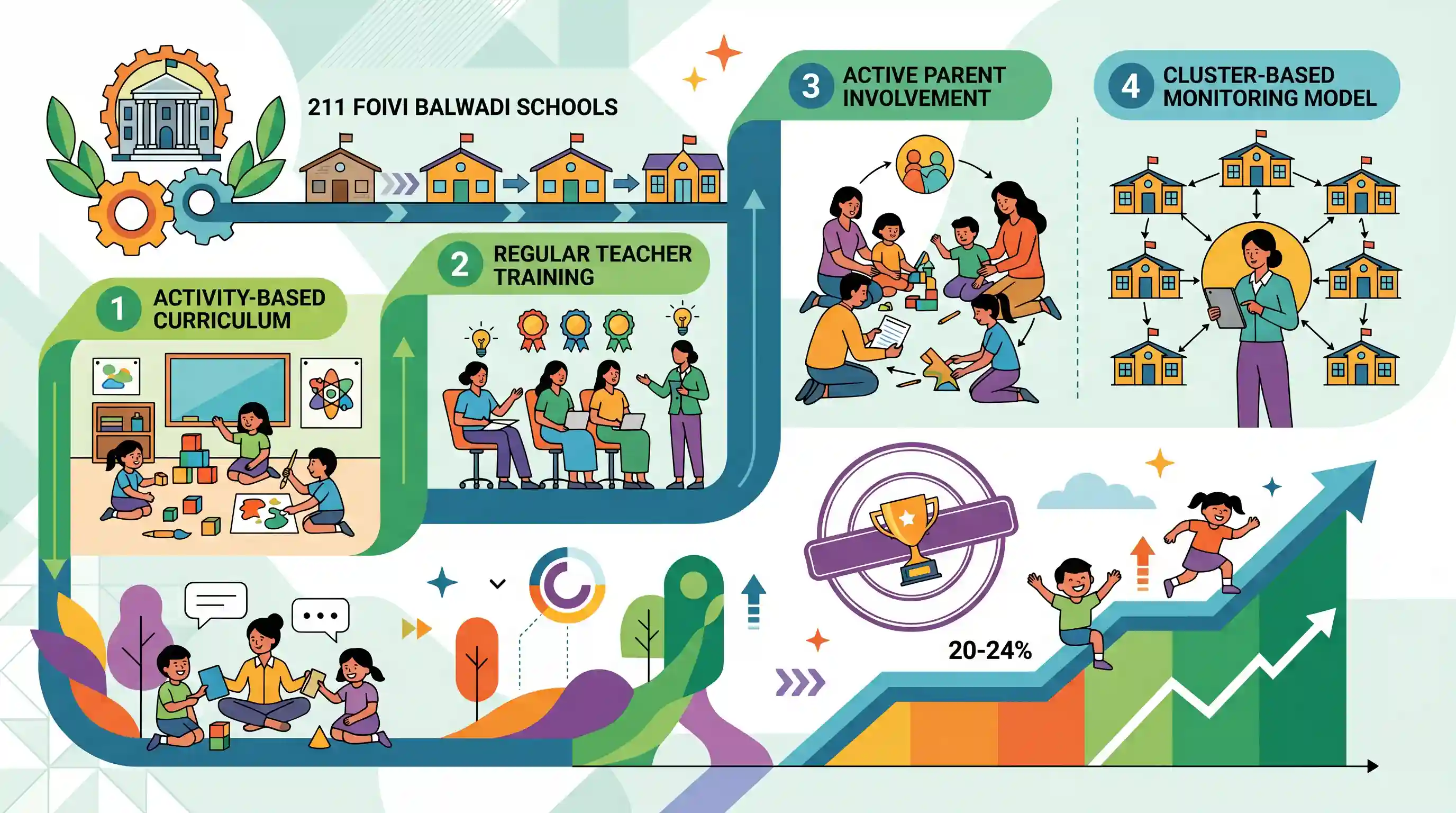
The Pimpri Chinchwad Municipal Corporation (PCMC) successfully transformed its 211 Balwadis (pre-primary schools) through a focused Early Childhood Care and Education (ECCE) strategy. The initiative achieved a 20-24% improvement in foundational learning over three years. It features an activity-based curriculum, regular teacher training, active parent involvement, and a cluster-based monitoring model with master trainers and supervisors. The model serves as an effective case study for local bodies playing a pivotal role in early education and implementing inclusive, play-based pedagogical practices.
Key Points
- PCMC transformed 211 Balwadis using a focused Early Childhood Care and Education (ECCE) strategy, benefiting over 6,000 children.
- Foundational learning skills among children improved by 20-24% over a span of three years.
- The strategy involved redesigning the curriculum into activity-based and play-based modules.
- A cluster-based model with master trainers and supervisors was implemented to facilitate regular teacher training and maintain standardized pedagogy.
- The initiative successfully demonstrated the active role local municipal bodies can play in delivering quality primary education and improving community engagement.
Important Terms
Early Childhood Care and Education (ECCE)

Holistic care and education for children aged 0-8 years, focusing on physical, cognitive, and socio-emotional development during critical early brain growth stages.
UPSC context
GS Paper 2 (Social Justice/Education); vital for human capital and achieving Sustainable Development Goal (SDG) 4.2.
Local Self-Government (LSG)
A constitutional third tier of governance (Municipalities and Panchayats) responsible for managing local affairs, including primary education and public health.
UPSC context
GS Paper 2 (Polity/Governance); tests understanding of democratic decentralization and the 74th Constitutional Amendment Act.
Pimpri Chinchwad Municipal Corporation (PCMC)
An urban local body in Maharashtra that manages civic administration; recently recognized for innovative activity-based learning and e-governance initiatives.
UPSC context
GS Paper 2 (Governance); serves as a case study for municipal leadership in implementing national education strategies.
Balwadi
A traditional Indian pre-primary school (literally 'children’s garden') providing informal education, play-based learning, and nutrition to children aged 3–6.
UPSC context
GS Paper 2 (Social Sector); relevant for grassroots education delivery and the ICDS-linked Anganwadi-Balwadi model.
Foundational Learning (FLN)
Basic reading, writing, and arithmetic skills (literacy and numeracy) that NEP 2020 mandates children should master by the end of Grade 3.
UPSC context
GS Paper 2 (Education); a core priority of the NIPUN Bharat Mission and NEP 2020 reforms.
National Education Policy (NEP) 2020
India's 2020 policy framework that restructured the school system to a 5+3+3+4 model, emphasizing early childhood education and skill-based learning.
UPSC context
GS Paper 2 (Education Policy); fundamental for questions on structural reforms and inclusive pedagogical shifts.
Prelims Trap
ECCE is exclusively managed by the Ministry of Women and Child Development via Anganwadis.
NEP 2020 integrates ECCE into the formal Ministry of Education framework. Additionally, the 12th Schedule constitutionally empowers Urban Local Bodies to manage educational aspects.
Static Concepts Connected
How do the 73rd and 74th Amendments empower local bodies in education?
- 11th Schedule (Panchayats): Devolves powers for education, including primary and secondary schools, adult/non-formal education, and technical training.
- 12th Schedule (Municipalities): Entrusts urban local bodies with the promotion of cultural, educational, and aesthetic aspects.
- Decentralized administration: Allows local governments to utilize master trainers and localized cluster monitoring to scale pedagogical innovations.
What is the framework for Early Childhood Care and Education (ECCE) under NEP 2020?
- 5+3+3+4 Structure: Integrates children aged 3-8 into the 'Foundational Stage', bringing early pre-schooling formally into the education system.
- NIPUN Bharat: A targeted mission aiming to achieve universal Foundational Literacy and Numeracy (FLN) by Grade 3 (2026-27).
- Play-based Pedagogy: Replaces rote learning with flexible, multi-faceted, and activity-based learning modules suited for early cognitive development.
Cross-Topic Patterns
Decentralization driving social outcomes
Successes in municipal balwadis highlight how devolving educational administration to Urban Local Bodies (74th Amendment) improves localized monitoring, community participation, and pedagogical alignment.
FLN as the bedrock of demography
Without achieving Foundational Literacy and Numeracy (NIPUN Bharat), India's demographic dividend risks turning into a demographic burden due to unemployable youth and early school dropouts.

Expect a Mains question linking ULB devolution (74th CAA) to grassroots social outcomes like primary healthcare or foundational literacy.
Linked PYQs · 2
Linked PYQs · 2
- 2024MainsGS2
Analyse the role of local bodies in providing good governance at local level and bring out the pros and cons merging the rural local bodies with the urban local bodies.
- 2016MainsGS2
Professor Amartya Sen has advocated important reforms in the realms of primary education and primary health care. What are your suggestions to improve their status and performance?
