Ex-situ Wildlife Conservation and Biological Park Project
Source:The Hindu ↗
Why It Matters
The Kozhikode Biological Park serves as a contemporary case study for ex-situ conservation methods and wildlife rehabilitation in India. It exemplifies evolving state policies aimed at mitigating human-animal conflict—a critical issue under the GS-3 syllabus for Environment and Biodiversity—by adopting humane management strategies and specialized veterinary care rather than mere displacement.
Summary
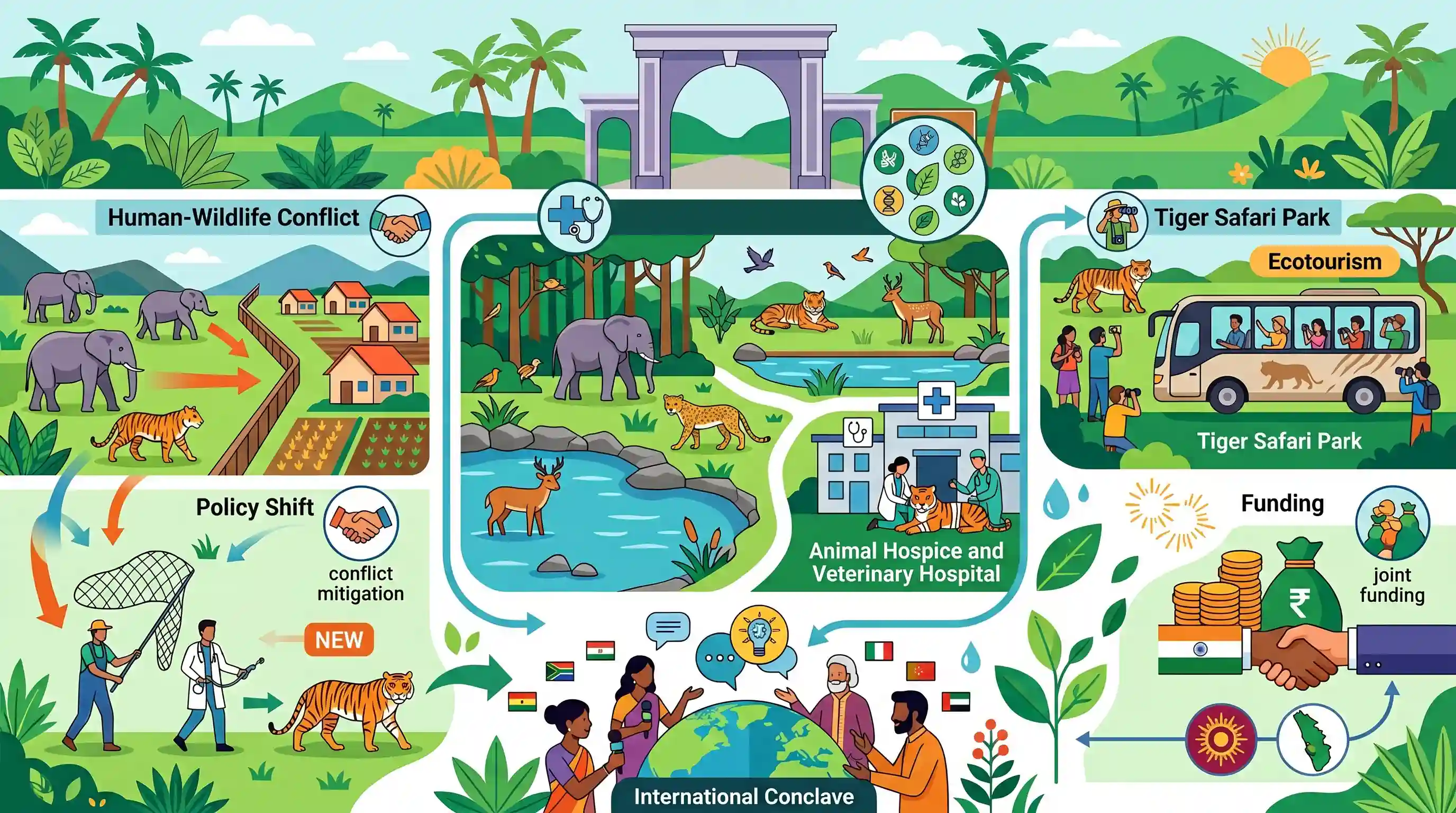
Kerala has commenced the Kozhikode Biological Park project at Muthukad, designed as a modern conservation facility where animals live in simulated natural habitats without traditional caging. An accompanying animal hospice and veterinary hospital are also planned. A subsequent phase will introduce a tiger safari park at Perambra Estate. Jointly funded by the Central and State governments at over ₹100 crore, the project highlights Kerala's shift in wildlife policy—prioritizing the protection and care of wild animals that wander into human settlements over driving them back. This initiative coincides with an international conclave on human-wildlife conflict mitigation being hosted by the state.
Key Points
- The foundation stone for the Kozhikode Biological Park was laid at Muthukad near Perambra in Kerala, aiming to promote regional wildlife conservation and ecotourism.
- The park is designed as a modern ex-situ conservation model where animals are not confined to traditional cages, but rather kept in environments mimicking their natural habitats.
- An animal hospice centre and a veterinary hospital are also being established 5 km away from the site.
- The second phase of the project envisions a tiger safari park at the Perambra Estate, taking advantage of its temperate climate, streams, and sandy mounds.
- Kerala has adopted a new wildlife policy focusing on the protection and rehabilitation of wild animals that stray into human habitations, as opposed to forcefully driving them back into the forest.
- The state is concurrently hosting an international conclave with representatives from 24 countries to discuss solutions for human-wildlife conflicts.
Important Terms
Ex-situ Conservation

The preservation of components of biological diversity outside their natural habitats, such as in zoos, biological parks, or gene banks, to protect endangered species.
UPSC context
GS Paper III (Environment). Tests understanding of conservation strategies beyond National Parks and Sanctuaries (In-situ).
Human-Wildlife Conflict
Negative interactions between humans and wild animals, leading to crop damage, livestock loss, or human casualties, often driven by habitat fragmentation and competition for resources.
UPSC context
GS Paper III (Environment & Disaster Management). Vital for discussing man-animal interface and mitigation policies.
National Tiger Conservation Authority (NTCA)
A statutory body under the Ministry of Environment, Forest and Climate Change, established in 2005 to oversee tiger conservation and approve projects like safari parks.
UPSC context
GS Paper III (Environment). Tests knowledge of statutory bodies and tiger protection frameworks in India.
State-Specific Disaster
A classification by a State Government allowing the use of State Disaster Response Funds (SDRF) for localized calamities not covered under national guidelines, such as Kerala's HWC.
UPSC context
GS Paper III (Disaster Management). Important for federal relations and disaster financing mechanisms.
Animal Hospice
A specialized facility designed for the long-term palliative care, medical treatment, and rehabilitation of old, injured, or permanently incapacitated wild animals that cannot survive in the wild.
UPSC context
GS Paper III (Environment/Ethics). Pertains to wildlife welfare and ethical conservation practices.
In-situ Conservation
The conservation of species within their natural habitats, such as National Parks and Biosphere Reserves, allowing for natural evolution and ecological interaction.
UPSC context
GS Paper III (Environment). Foundational concept for biodiversity conservation questions.
Prelims Trap
"Biological parks are notified as in-situ protected areas under the Wildlife (Protection) Act, 1972."
Biological parks are ex-situ conservation facilities (akin to zoos), not in-situ protected areas like National Parks or Sanctuaries.
Static Concepts Connected
What distinguishes Ex-situ from In-situ wildlife conservation?
- In-situ: Conservation within the species' natural ecosystems (e.g., National Parks, Wildlife Sanctuaries, Tiger Reserves).
- Ex-situ: Conservation outside natural habitats (e.g., Zoological Parks, Botanical Gardens, Seed Banks, Hospices).
- Strategic Objective: Ex-situ often focuses on captive breeding, palliative care, and education, acting as a genetic insurance policy against extinction.
How does the Wildlife (Protection) Act handle 'problem' wild animals?
- Section 11 (WPA): The Chief Wildlife Warden can permit hunting/capturing of Schedule I animals only if they become a direct threat to human life or are terminally diseased/disabled.
- Vermin Declaration: Under Section 62, the Centre can declare certain wild animals (excluding Schedule I) as vermin for a specific period and area, removing protections.
- SOPs for Rescue: NTCA guidelines mandate capturing, tranquilizing, and relocating conflict animals (like tigers/leopards) to rescue centers rather than immediate elimination.
Cross-Topic Patterns
HWC + Western Ghats Ecology
Kerala's new rehabilitation policy directly responds to escalating conflicts driven by fragmented corridors, changing land-use patterns, and agricultural encroachment in the fragile Western Ghats.
One Health + Geriatric Wildlife Care
Establishing wildlife hospices introduces specialized veterinary and palliative care into state conservation efforts, elevating the One Health framework and animal welfare in traditional wildlife management.

Mains 2026 may ask to evaluate shifts from 'culling/repelling' to 'rehabilitation/hospice' in tackling Human-Wildlife Conflict in India.
Linked PYQs · 2
Linked PYQs · 2
- 2011PrelimsGS1
Which one of the following is not a site for in-situ method of conservation of flora?
- 2014PrelimsGS1
The most important strategy for the conservation of biodiversity together with traditional human life is the establishment of
