Badrinath Temple Donation Case: Former Officer Arrested for Fraud
Source:dailypioneer ↗
Why It Matters
Financial irregularities in the management of major pilgrimage sites like Badrinath affect public trust and highlight governance challenges in statutory bodies such as the Badrinath-Kedarnath Temple Committee (BKTC). This ties into GS2 topics on governance, accountability, and the administration of trusts in Uttarakhand.
Summary
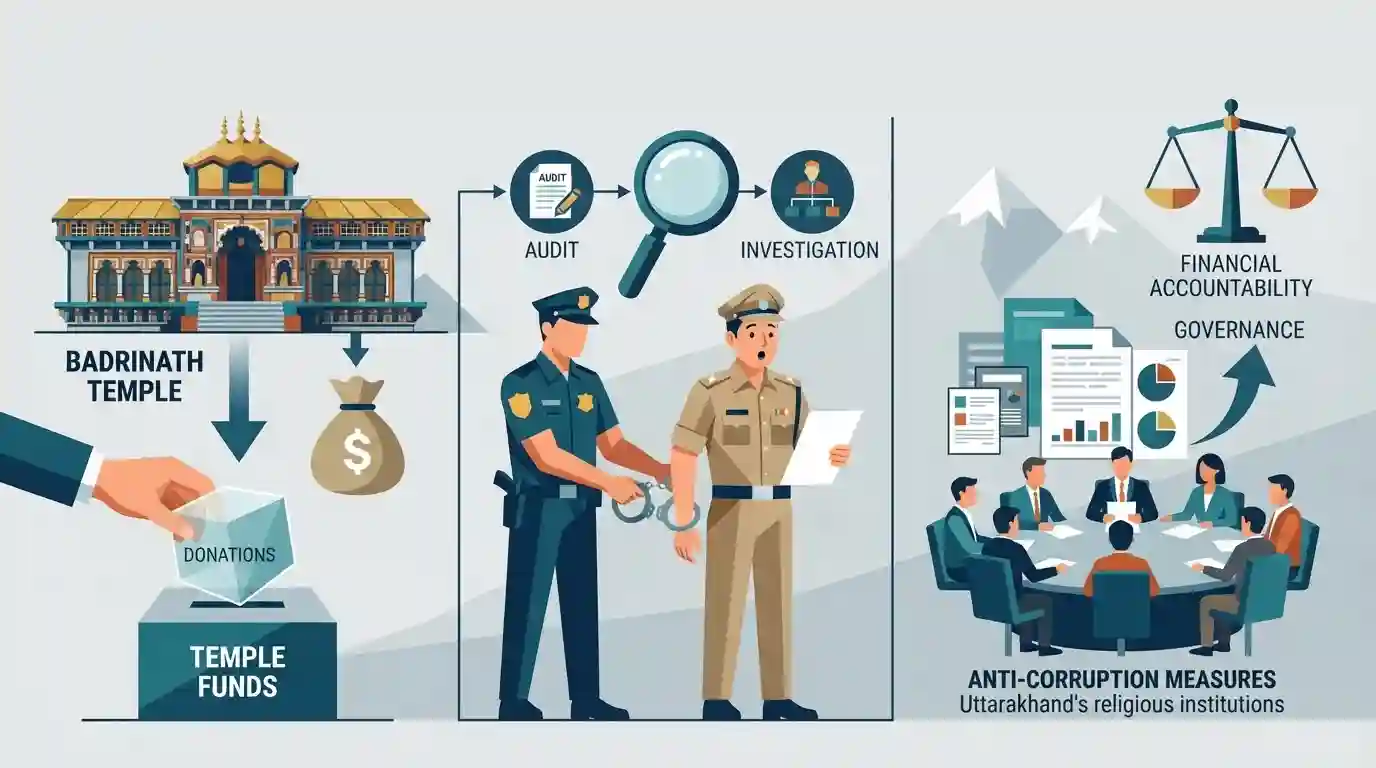
A former officer of the Badrinath temple has been arrested over allegations of misappropriating donations at the prominent shrine. The arrest underscores the ongoing efforts by law enforcement to address corruption and enforce financial accountability within religious institutions and statutory temple committees in Uttarakhand.
Key Points
- A former Badrinath temple officer was arrested in connection with the misappropriation of donation funds at the shrine.
- The case highlights concerns regarding the financial management, transparency, and accountability of temple administration boards in Uttarakhand.
- Law enforcement agencies are focusing on rooting out corruption within statutory religious governance bodies to maintain public trust.
Important Terms
Badrinath-Kedarnath Temple Committee (BKTC)

A statutory body constituted under the Shri Badrinath-Kedarnath Temples Act, 1939, responsible for managing the sacred Badrinath and Kedarnath shrines and their endowments in Uttarakhand.
UPSC context
GS Paper II (Governance) & GS Paper I (Indian Heritage); tests state administration of religious institutions and heritage management.
Special Investigation Team (SIT)
A specialized, ad-hoc investigative body constituted by law enforcement or judicial order to conduct focused, unbiased probes into high-profile, complex, or sensitive criminal cases.
UPSC context
GS Paper II (Criminal Justice, Police Reforms); tests understanding of specialized investigation mechanisms and accountability in law enforcement.
Shri Badrinath and Shri Kedarnath Temples Act, 1939
A legislative act passed to govern the administration of Badrinath and Kedarnath temples, establishing a government-nominated committee to oversee temple finances, rituals, and pilgrim welfare.
UPSC context
GS Paper II (Statutory Provisions, Freedom of Religion); tests the balance between state regulation and religious freedom under Article 26.
Bharatiya Nyaya Sanhita (BNS)
The primary penal code of India, enacted to replace the colonial-era Indian Penal Code (IPC), streamlining criminal offences, punishments, and modernizing Indian criminal jurisprudence.
UPSC context
GS Paper II (Judicial Reforms, Criminal Laws); tests understanding of legislative changes and modernization of India's criminal justice system.
Prelims Trap
Administrative employees of statutory temple boards are exempt from being prosecuted as 'public servants' under the Prevention of Corruption Act.
Under Section 2(c) of the PCA 1988, anyone serving a statutory board—including temple management committees created by state acts—falls under the definition of a public servant.
Static Concepts Connected
Who qualifies as a 'public servant' under the Prevention of Corruption Act, 1988?
- Broad definition: Section 2(c) covers anyone in the service/pay of the Government, local authorities, or statutory corporations.
- Statutory boards: Employees of state-regulated temple boards performing public duties are legally classified as public servants.
- Exclusion limits: Purely private religious practitioners or priests without statutory administrative roles are typically excluded from this definition.
What is Section 17A of the Prevention of Corruption Act?
- Prior approval: Requires investigating agencies to obtain government sanction before initiating inquiries into public servants' official decisions.
- Scope limit: Sanction is only needed for decisions taken in the discharge of official duties, not for personal criminal acts.
- Trap exception: No prior approval is necessary if a public servant is caught red-handed accepting an illegal gratification.
Cross-Topic Patterns
Secular regulation vs. Article 26 rights
Balances the state's power to administer secular aspects of religious institutions under Article 25(2)(a) against a denomination's right to manage its affairs under Article 26.
Anti-corruption laws and public trusts
Examines how statutory temple administrations intersect with state Lokayukta jurisdictions and the broader push to bring public-benefit trusts under public-accountability tools like RTI.

The definition of 'public servant' under PCA and the constitutional limits of state-managed temples will likely be tested together in 2026.
Linked PYQs · 2
Linked PYQs · 2
- 2025UKPSC_PRELIMSGS1
As per Uttarakhand Budget 2025-26, the amount allocated for Char Dham Road network improvement is
- 2024UKPSC_PRELIMSGS1
Which of the following statements related to Prevention of Money Laundering Act (PMLA) is not true ?
