Sentencing of Former Pakistan Spy Chief Faiz Hameed
Source:The Hindu ↗
Why It Matters
The internal dynamics and stability of Pakistan's military and intelligence apparatus directly impact India's security environment. Power struggles within the ISI and Pakistan Army can influence the country's foreign policy, its support for cross-border terrorism, and its involvement in Afghanistan, necessitating close monitoring by Indian policymakers.
Summary
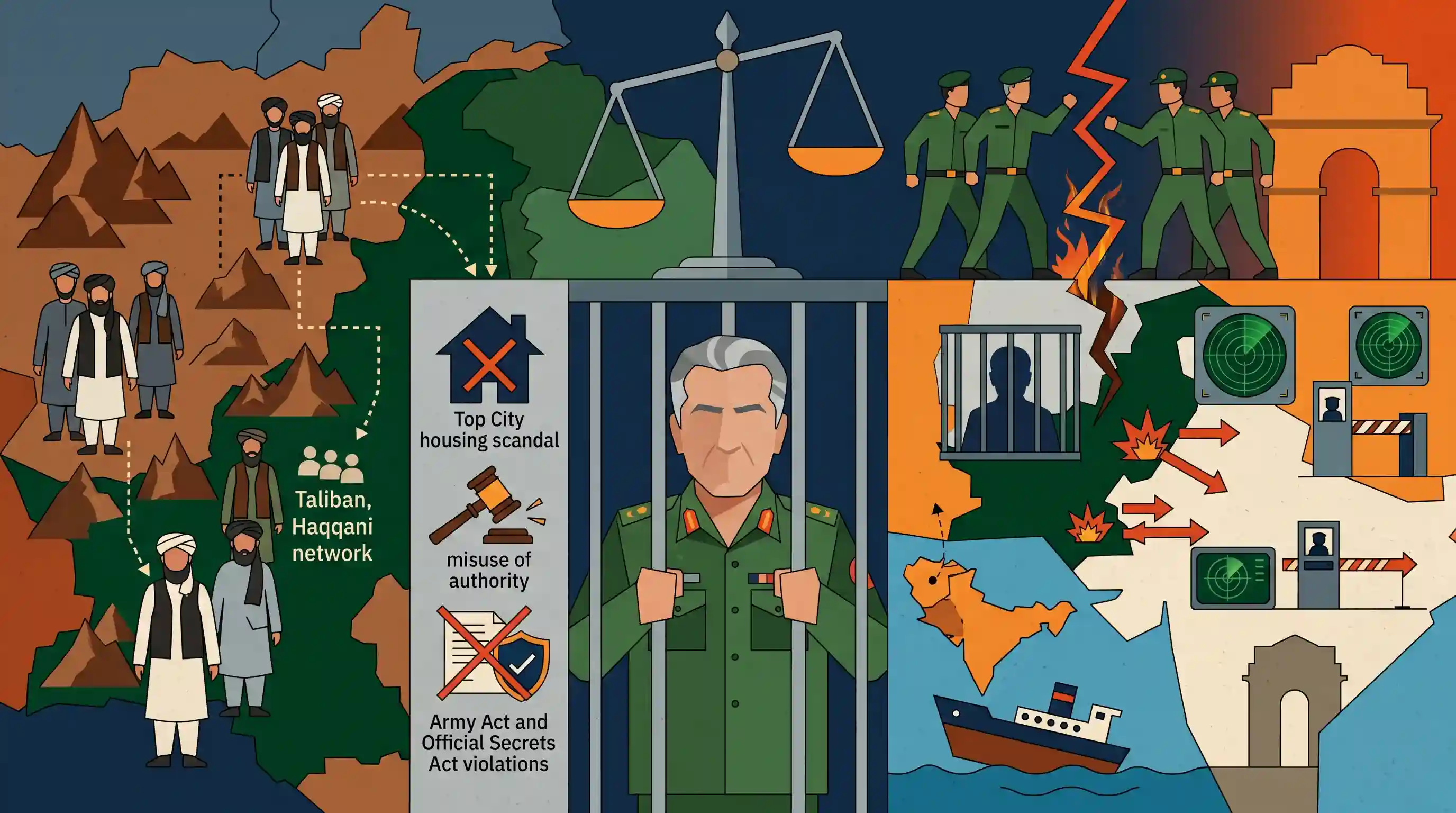
Former Director General of Pakistan's Inter-Services Intelligence (ISI), Faiz Hameed, has been sentenced to 14 years in prison by a military court. The charges stem from the Top City housing society scandal, misuse of authority, and violations of the Army Act and Official Secrets Act. The conviction of such a high-ranking former intelligence chief is unprecedented and underscores the intense ongoing friction between the current military leadership and factions aligned with jailed former Prime Minister Imran Khan. Hameed, once a powerful figure with close ties to the Afghan Taliban and the Haqqani network, was perceived as having heavily interfered in domestic politics. For India, internal turbulence within Pakistan's 'deep state' and military establishment carries significant security and diplomatic implications, particularly regarding cross-border terrorism and regional stability in South Asia.
Key Points
- Former Pakistan spy chief Lt. Gen. Faiz Hameed was sentenced to 14 years in prison by a military court on charges including misuse of authority and violation of state secrets.
- The unprecedented sentencing of a former ISI director general highlights deep-seated factionalism and internal power struggles within the Pakistani military establishment.
- Hameed was known as a close ally of jailed former Prime Minister Imran Khan and had engaged in political activities contrary to military discipline.
- During his tenure, Hameed wielded significant influence over the Afghan Taliban, playing a key role in shaping the Haqqani network's position following the 2021 Taliban takeover of Kabul.
Important Terms
Inter-Services Intelligence (ISI)

Pakistan's premier intelligence agency responsible for national security information and covert operations. It significantly influences both domestic politics and regional foreign policy.
UPSC context
GS Paper 2 (Neighborhood relations) and GS Paper 3 (Security). Tests understanding of "state actors" influencing India’s security.
Deep State
An influential, unelected network of military and intelligence officials that operates independently of the civilian government to dictate national policy and security strategy.
UPSC context
GS Paper 2 (International Relations). Relevant for analyzing civil-military relations in neighboring countries and their impact on Indian diplomacy.
Afghan Taliban
An Islamist political-military organization that returned to power in Afghanistan in 2021. Their governance has major implications for regional stability and India's security.
UPSC context
GS Paper 2 (International Relations). Tests knowledge of regional geopolitical shifts and their consequences for India’s "Extended Neighborhood" policy.
Haqqani Network
A semi-autonomous, combat-ready wing of the Taliban, notorious for complex attacks and historical ties to Pakistan's intelligence establishment.
UPSC context
GS Paper 3 (Internal Security). Significant regarding state-sponsored non-state actors and specific threats to Indian diplomatic assets.
Official Secrets Act
A legal framework designed to protect sensitive national security information and prosecute espionage or unauthorized disclosure of state secrets.
UPSC context
GS Paper 2 (Governance/Polity). Tests understanding of the legal tools used to protect sovereignty versus the right to information.
Prelims Trap
The "deep state" refers exclusively to non-state armed actors or terrorist outfits.
In IR, "deep state" refers to entrenched government institutions (military, intelligence) operating independently of elected leadership, not the external terrorist proxies themselves.
Static Concepts Connected
How do State and Non-State actors interact in proxy warfare?
- State actors: Official sovereign entities (e.g., ISI) that deploy and fund proxy groups to achieve strategic foreign policy goals while maintaining plausible deniability on the global stage.
- Non-state actors: Armed groups or terrorist networks (e.g., Haqqani network) that operate as proxies, executing asymmetric warfare and cross-border strikes on behalf of state sponsors.
What defines the structural dominance of Pakistan's 'Deep State'?
- Foreign Policy Monopoly: The military-intelligence nexus dictates national security and relations with India/Afghanistan, routinely sabotaging bilateral civilian peace initiatives to maintain its relevance.
- Milbus Economy: The armed forces operate as a massive economic conglomerate (Milbus), controlling major domestic industries, real estate, and resources, severely reducing civilian financial autonomy.
Cross-Topic Patterns
Deep State proxies & FATF scrutiny
The integration of non-state actors into Pakistan's security doctrine frequently triggers FATF grey-listing, directly undermining their macroeconomic stability and complicating IMF bailout negotiations.
Haqqanis vs India's Afghan diplomacy
The Haqqani network's dominance within the Taliban regime, historically brokered by the ISI, remains the primary hurdle for India's strategic and soft-power footprint in Kabul.

Expect a GS3 Mains question evaluating how internal factionalism within a hostile neighbor's "deep state" escalates asymmetric threats.
Linked PYQs · 3
Linked PYQs · 3
- 2021MainsGS3
Analyse the multidimensional challenges posed by external state and non-state actors, to the internal security of India. Also discuss measures required to be taken to combat these threats.
- 2016MainsGS2
Increasing cross-border terrorist attacks in India and growing interference in the internal affairs of several member-states by Pakistan are not conducive for the future of SAARC (South Asian Association for Regional Cooperation)." Explain with suitable examples.
- 2015MainsGS2
Terrorist activities and mutual distrust have clouded India-Pakistan relations. To what extent the use of soft power like sports and cultural exchanges could help generate goodwill between the two countries? Discuss with suitable examples.
