Nepal Pro Monarchy Protests and Political Instability
Source:Indian Express ↗
Why It Matters
Nepal's internal political stability is crucial for India's national security and strategic interests due to their open border and deep historical ties. Understanding Nepal's ongoing constitutional and democratic challenges helps candidates analyze broader geopolitical dynamics and bilateral relations in the South Asian region.
Summary
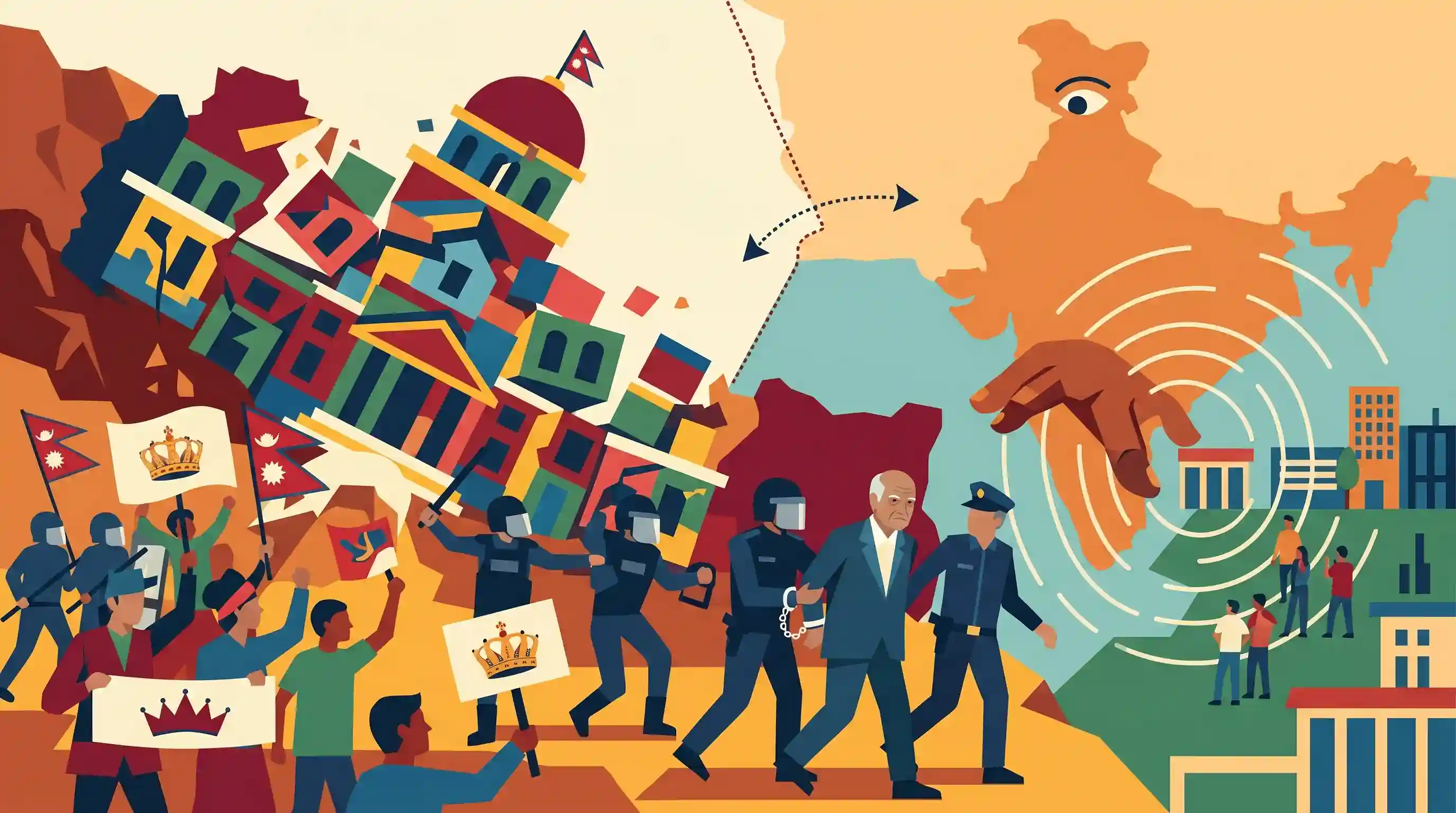
Pro-monarchy protests in Nepal have escalated, demanding the restoration of the Hindu monarchy that was abolished in 2008 in favor of a federal democratic republic. The unrest entered its fourth day, resulting in the arrest of a former Deputy Prime Minister amid a broader government crackdown. The ongoing demonstrations reflect persistent political instability and ideological divides in the country, which regularly experiences sudden changes in coalition governments. Such internal turbulence holds significant implications for regional security, particularly for India, which shares an open border and close strategic ties with Nepal.
Key Points
- Pro-monarchy protests have intensified in Nepal, demanding the restoration of the Hindu monarchy that was abolished in 2008.
- A former Deputy Prime Minister was arrested as the government attempts to control the "indefinite" protests entering their fourth day.
- The demonstrations highlight deep-rooted political instability and ideological fractures within Nepal's transition to a federal democratic republic.
- Political turmoil in Nepal has strategic implications for India, given their shared open borders, cultural ties, and geopolitical dynamics involving China.
Important Terms
Rastriya Prajatantra Party (RPP)

A right-wing, pro-monarchy political party in Nepal advocating for the restoration of the Hindu monarchy and the abolition of the country's current federal structure.
UPSC context
GS Paper II (International Relations). Key actor in Nepal's internal politics affecting India's neighborhood stability and strategic interests.
Federal Democratic Republic
Nepal's current system of governance established in 2008, featuring a three-tier structure (federal, provincial, and local) and a ceremonial President with an executive Prime Minister.
UPSC context
GS Paper II (Polity & International Relations). Tests understanding of Nepal's transition from monarchy to democracy and its constitutional challenges.
1950 Treaty of Peace and Friendship
A foundational bilateral agreement granting citizens of both nations reciprocal rights to residence, work, and property, while establishing the legal basis for their 'special relationship.'
UPSC context
GS Paper II (International Relations). Crucial for questions on India-Nepal ties, border management, and demands for treaty revision.
Jana Andolan II
The 2006 mass uprising in Nepal that forced King Gyanendra to reinstate Parliament, leading to the 2008 abolition of the monarchy and the current republican setup.
UPSC context
GS Paper II (International Relations). Historical milestone explaining the democratic evolution of India's strategically vital neighbor.
Constitutional Hindu Monarchy
A proposed political system where a monarch serves as a ceremonial head of state under a constitution, with Nepal specifically seeking the restoration of its Hindu identity.
UPSC context
GS Paper II (Polity). Related to the ideological divide in Nepal and the influence of religious identity on regional politics.
Open Border
The 1,751 km long boundary between India and Nepal that allows free movement of people without passports, fostering deep socio-economic 'Roti-Beti' ties.
UPSC context
GS Paper III (Internal Security). High-priority topic involving border management, trafficking, and security risks during political instability.
Prelims Trap
"Nepal shares an open border with Assam and is guarded by the Border Security Force (BSF)."
False. Nepal borders Uttarakhand, UP, Bihar, West Bengal, and Sikkim (not Assam). The border is guarded by the Sashastra Seema Bal (SSB), not the BSF.
Static Concepts Connected
What are the core provisions of the 1950 India-Nepal Treaty?
- Open Border: Allows free movement of people across the border without passports or visas, facilitating deep cultural ties.
- National Treatment: Grants reciprocal rights in residence, property ownership, trade, and commerce to citizens of both nations.
- Security Consultation: Requires mutual consultation and prohibits both nations from tolerating threats to each other's security.
How is the India-Nepal border managed and secured?
- Guarding Force: The Sashastra Seema Bal (SSB) under the Ministry of Home Affairs is the designated guarding force for the 1,850 km border.
- Porous Vulnerability: While facilitating the 'Roti-Beti' relationship, the porous border necessitates specialized intelligence gathering against cross-border smuggling networks.
Cross-Topic Patterns
Buffer state instability & Border Security
Chronic political instability in Nepal weakens cross-border law enforcement, amplifying GS-3 threats like FICN smuggling, human trafficking, and insurgent infiltration along the open border.
Regime changes & The China Factor
Frequent shifts in Kathmandu's coalitions allow China to advance its BRI infrastructure, altering the strategic balance and testing India's 'Neighborhood First' policy.

A multi-statement Prelims question testing the states bordering Nepal, the SSB's mandate, and clauses of the 1950 Treaty is highly likely.
Linked PYQs · 1
Linked PYQs · 1
- 2012MainsGS2
Discuss the contentious issues that have caused the prolonged constitutional logjam in Nepal.
