Digital portals and rules hamper crop procurement in Haryana
Source:The Hindu ↗
Why It Matters
This issue highlights the unintended consequences and limitations of implementing e-governance and digital portals in agriculture. It serves as a practical case study for GS Paper 3 on how poorly designed e-technology interventions can inadvertently exclude farmers from MSP benefits and lead to market distress rather than facilitating ease of doing business.
Summary
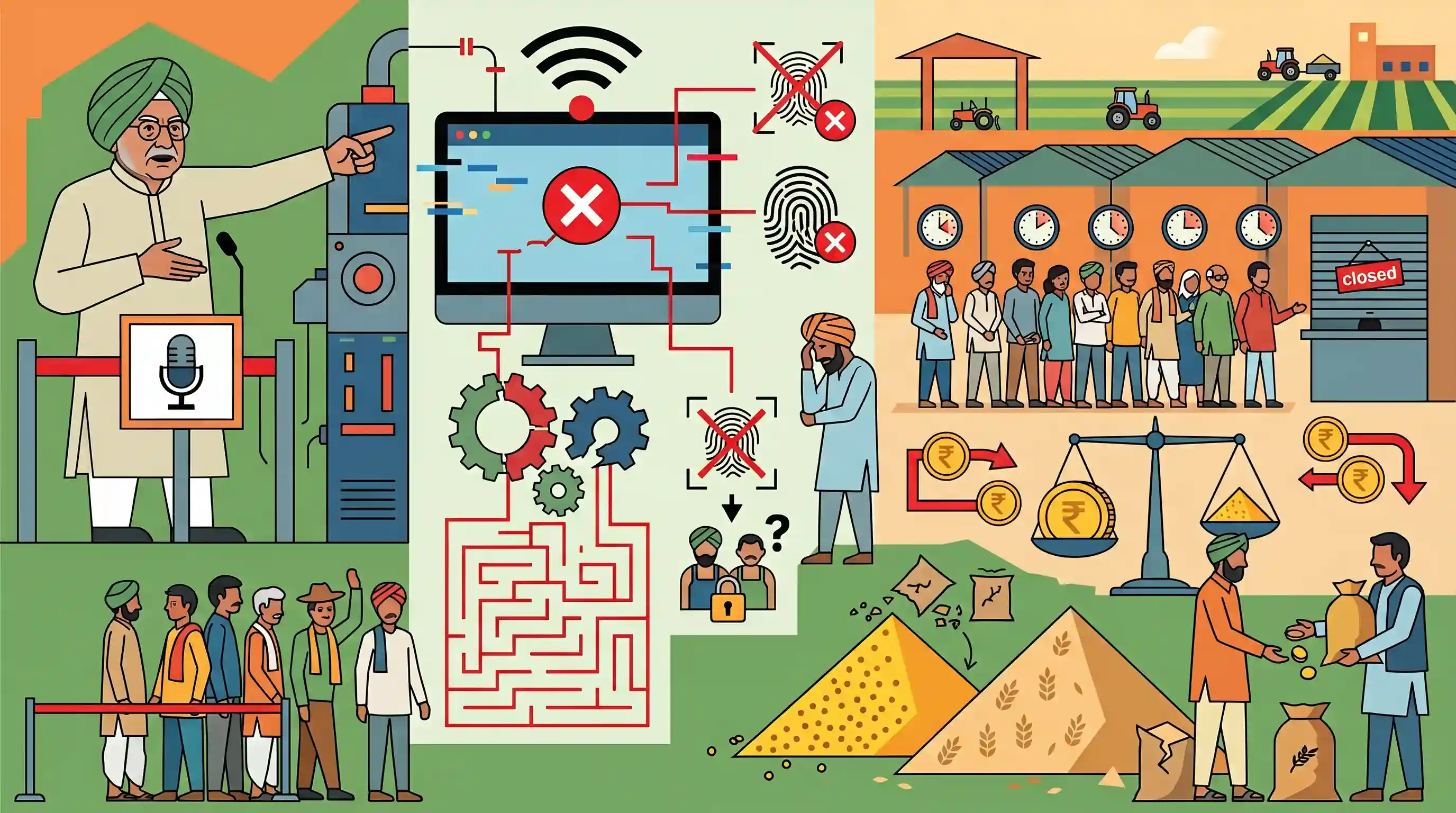
Former Haryana Chief Minister Bhupinder Singh Hooda has strongly criticized the state government for its failure to procure farmers' crops, blaming the delay on arbitrary new regulations and a dysfunctional online portal. Farmers are facing immense difficulties selling their mustard and wheat at the Minimum Support Price (MSP) due to technical issues with the 'Meri Fasal, Mera Byora' portal and restrictive new rules involving biometric scans and guarantor requirements. Consequently, farmers are forced into distress sales below the MSP amid an ongoing shortage of gunny bags and delayed payments at mandis.
Key Points
- Procurement of mustard and wheat in Haryana has been severely delayed, with only 4% of the expected mustard crop procured so far.
- Farmers are struggling to register on the state's 'Meri Fasal, Mera Byora' portal due to technical glitches, server crashes, and slow internet.
- Arbitrary new rules for procurement, such as requiring biometric authentication, tractor registration numbers, and a guarantor, have created significant hurdles.
- Because of these digital and administrative bottlenecks, along with a lack of gunny bags and delayed payments, many farmers are forced to sell their crops below the Minimum Support Price (MSP).
Important Terms
Minimum Support Price (MSP)

A guaranteed floor price set by the Government of India to ensure remunerative returns to farmers and prevent losses during market price fluctuations.
UPSC context
GS3: Agriculture. Vital for understanding farm subsidies, price volatility, and government procurement policies.
Meri Fasal Mera Byora (MFMB)
A digital portal launched by the Haryana government to streamline crop registration, procurement, and direct benefit transfers (DBT) to farmers.
UPSC context
GS3: E-technology in the aid of farmers. A case study for digital agricultural marketing and e-governance.
Parivar Pehchan Patra (PPP)
A unique eight-digit identity number issued by the Haryana government to families to facilitate the paperless and transparent delivery of welfare services.
UPSC context
GS2: E-governance. Relevant for discussions on beneficiary identification, data privacy, and digital service delivery models.
Distress Sale
The urgent sale of agricultural produce at prices below the market value or MSP, typically caused by immediate cash needs or procurement delays.
UPSC context
GS3: Agriculture marketing. A key term for discussing the failures of price support systems and market infrastructure.
APMC Mandi System
The central regulatory framework in India where agricultural trade occurs through state-notified markets, often criticized for inefficiencies and middleman dominance.
UPSC context
GS3: Agriculture Marketing. Essential for understanding crop procurement bottlenecks and the impact of state-level regulations.
Prelims Trap
Registration on state e-portals legally guarantees the procurement of notified crops at the Minimum Support Price (MSP).
MSP is an administrative policy directive, not a legally enforceable statutory right, regardless of successful registration on state or central e-governance portals.
Static Concepts Connected
What are the main limitations of e-governance in farm procurement?
- Digital Divide: Poor rural internet infrastructure and frequent server crashes prevent timely self-registration by farmers during harvest seasons.
- Exclusion Errors: Mandatory technical linkages like biometrics and identity-matching often fail, denying genuine farmers their agricultural entitlements.
- Over-regulation: Arbitrary rules like demanding tractor registration numbers or local guarantors increase bureaucratic friction and systemic hurdles.
What leads to 'distress sale' in Indian agriculture despite the declaration of MSP?
- Procurement Delays: State agencies failing to initiate timely procurement forces farmers needing immediate cash to sell cheaply to private traders.
- Logistical Failures: Acute shortages of gunny bags, warehousing space, and transport completely paralyze physical mandi operations even when portals function.
- Delayed Payments: When government agencies fail to clear financial dues on time, indebted farmers turn to private buyers for immediate liquidity.
Cross-Topic Patterns
Digital exclusion across welfare schemes
Technical glitches in farm procurement portals mirror Aadhaar-authentication failures in PDS rations, linking GS-3 agricultural marketing with GS-2 governance vulnerability and welfare exclusion.
Physical vs. Digital Ag-Infrastructure
Digital platforms (like state portals or e-NAM) fail without adequate physical backends like gunny bags and warehousing, highlighting persistent supply chain gaps.

Expect a 2026 GS-3 Mains question evaluating whether e-technology in agriculture empowers farmers or creates new bureaucratic bottlenecks.
Linked PYQs · 3
Linked PYQs · 3
- 2018MainsGS3
What do you mean by Minimum Support Price (MSP)? How will MSP rescue the farmers from the low income trap?
- 2017MainsGS3
How do subsidies affect the cropping pattern, crop diversity and economy of farmers? What is the significance of crop insurance, minimum support price and food processing for small and marginal farmers?
- 2023MainsGS3
How does e-Technology help farmers in production and marketing of agricultural produce? Explain it.
