Simultaneous Polls Do Not Violate Basic Structure, Says Former CJI
Source:The Hindu ↗
Why It Matters
The debate around simultaneous elections directly intersects with core constitutional concepts like federalism, parliamentary accountability, and the basic structure doctrine. Understanding the varying legal perspectives on the Constitution (129th Amendment) Bill, 2024 is crucial for GS-II (Polity), especially concerning electoral reforms and the powers of the Election Commission.
Summary
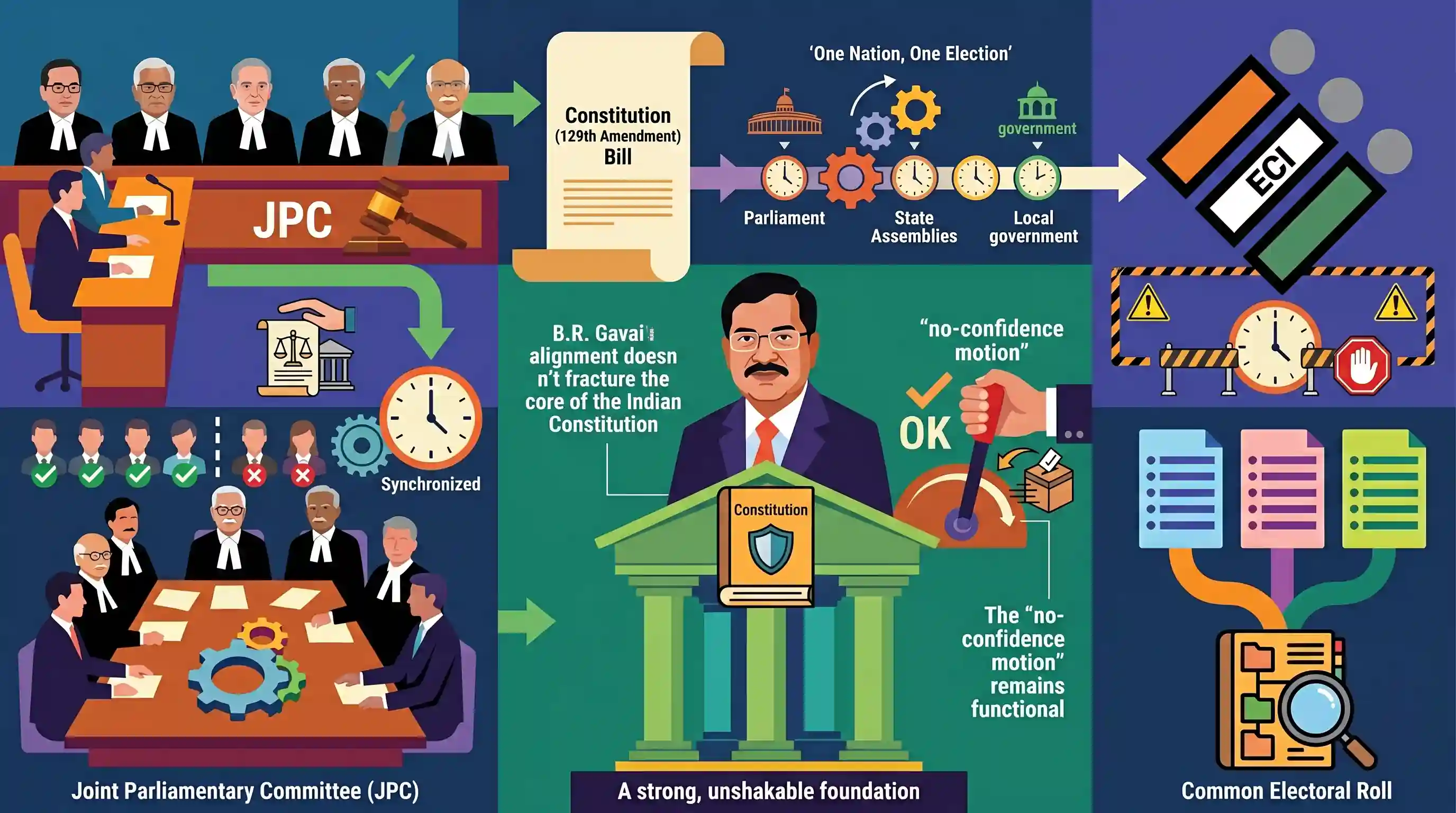
Former Chief Justice of India B.R. Gavai told a Joint Parliamentary Committee that the proposed 'One Nation, One Election' system does not violate the Constitution's basic structure or federal framework. Testifying on the Constitution (129th Amendment) Bill, 2024, Gavai stated that simultaneous elections merely alter the manner of polling and preserve accountability mechanisms like the no-confidence motion. The JPC has consulted six former CJIs, with four supporting the bill's constitutionality and two raising concerns. However, all former CJIs cautioned against granting the Election Commission unrestricted power to schedule state elections. The panel also deliberated on introducing a common electoral roll across all tiers of government.
Key Points
- Former CJI B.R. Gavai informed a Parliamentary Joint Committee (JPC) that simultaneous elections do not violate the basic structure of the Constitution or its federal framework.
- He argued that synchronised elections only alter the manner of polling and maintain government accountability through intact instruments like the no-confidence motion.
- Out of six former CJIs consulted, four supported the bill regarding its compliance with the basic structure, while two raised concerns invoking the Kesavananda Bharati judgment.
- All consulted former CJIs questioned the unrestricted power proposed for the Election Commission in deciding the schedule of state elections.
- The JPC also discussed creating a common electoral roll for panchayat, municipal, Assembly, and national elections to reduce administrative burden.
Important Terms
Constitution (One Hundred and Twenty-Ninth Amendment) Bill, 2024

A legislative proposal to synchronise Lok Sabha and State Legislative Assembly elections by amending Articles 83, 172, and 327, and inserting Article 82A to facilitate simultaneous polling.
UPSC context
GS Paper 2: Constitutional Amendments; tests understanding of legislative procedures for electoral reforms.
Joint Parliamentary Committee (JPC)
An ad-hoc, bipartisan body comprising members from both Lok Sabha and Rajya Sabha (typically in a 2:1 ratio) formed to scrutinize complex bills or investigate issues of public importance.
UPSC context
GS Paper 2: Parliament and State Legislatures; tests knowledge of parliamentary oversight and committee systems.
Basic Structure Doctrine
A judicial principle established in the Kesavananda Bharati case (1973) prohibiting Parliament from using its amending power to alter essential features of the Constitution, such as federalism and democracy.
UPSC context
GS Paper 2: Indian Constitution—Significant Provisions; fundamental concept for judicial review and constitutional limits.
One Nation, One Election (Simultaneous Elections)
A policy proposal aimed at synchronizing the electoral cycles of the Lok Sabha and all State Legislative Assemblies to reduce election expenditure and prevent persistent policy paralysis.
UPSC context
GS Paper 2: Electoral Reforms; evaluates the balance between administrative efficiency and federal autonomy.
Common Electoral Roll
A proposed single list of eligible voters for use in Lok Sabha, State Assembly, and local body elections to eliminate duplication of effort between the ECI and State Election Commissions.
UPSC context
GS Paper 2: Governance; examines administrative reforms and the coordination between central and state constitutional authorities.
Election Commission of India (ECI)
An autonomous constitutional body established under Article 324, responsible for the superintendence, direction, and control of elections to Parliament, State Legislatures, and high constitutional offices.
UPSC context
GS Paper 2: Constitutional Bodies; core requirement for understanding Indian democratic administration.
Prelims Trap
Under ONOE, an Assembly elected after a mid-term dissolution will serve a full five-year term.
The 129th Amendment Bill mandates a "remainder term." Newly elected houses post-mid-term dissolution will only serve the unexpired period to maintain synchronization.
Static Concepts Connected
What constitutional articles govern the tenure of the Lok Sabha and State Assemblies?
- Article 83(2): Specifies the Lok Sabha's normal term is 5 years from its first meeting, unless dissolved earlier.
- Article 172(1): Mirrors the Lok Sabha provision for State Legislative Assemblies, fixing a 5-year term subject to earlier dissolution.
- Amendment Need: ONOE requires amending these articles to allow curtailed "remainder" terms for mid-term elections to sync with the national cycle.
How are electoral rolls currently managed for the three tiers of government?
- ECI (Article 324): Prepares and manages electoral rolls for Parliament and State Legislature elections.
- SECs (Art 243K/243ZA): State Election Commissions independently prepare separate electoral rolls for Panchayats and Municipalities.
- Common Roll: ONOE proposes a single electoral roll across all tiers, requiring constitutional amendments to align ECI and SEC databases.
Cross-Topic Patterns
ONOE and Post-2026 Delimitation
The implementation timeline for simultaneous elections coincides with the lifting of the freeze on constituency delimitation in 2026, creating complex overlapping debates around regional representation and federalism.
Federalism vs. ECI Discretion
Warnings from former CJIs regarding the ECI's 'unfettered discretion' to defer state elections connect to broader syllabus themes of institutional overreach and the federalism safeguards in the Bommai judgment.

A 2026 Prelims multi-statement question will likely test the 129th Amendment's 'remainder term' alongside Articles 83 and 172.
Linked PYQs · 4
Linked PYQs · 4
- 2017MainsGS2
Simultaneous election to the Lok Sabha and the State Assemblies will limit the amount of time and money spent in electioneering but it will reduce the government's accountability to the people." Discuss.
- 2024MainsGS2
Examine the need for electoral reforms as suggested by various committees with particular reference to "one nation one election" principle.
- 2019MainsGS2
“Parliament's power to amend the Constitution is a limited power and it cannot be enlarged into absolute power." In the light of this statement explain whether Parliament under Article 368 of the Constitution can destroy the Basic Structure of the Constitution by expanding its amending power?
- 2017MainsGS2
To enhance the quality of democracy in India the Election Commission of India has proposed electoral reforms in 2016. What are the suggested reforms and how far are they significant to make democracy successful?
