Electoral Roll Revision Fallout and Citizen Rights
Source:Indian Express ↗
Why It Matters
This issue highlights the tension between maintaining accurate electoral rolls and ensuring universal adult suffrage. It is critical for UPSC aspirants studying the powers of the ECI, the challenges of electoral reforms, and the barriers to justice for marginalized communities.
Summary
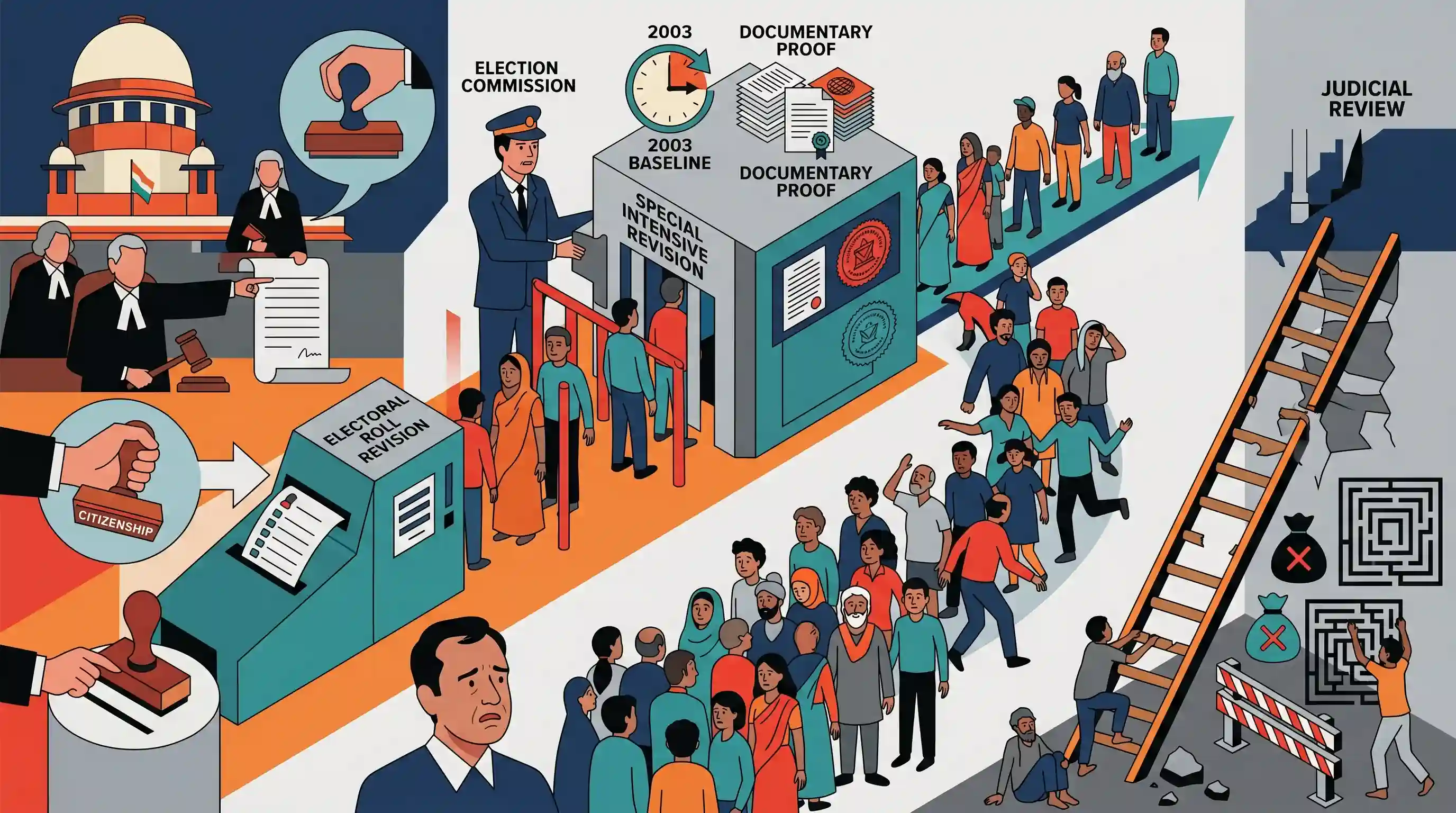
Former Chief Election Commissioner S. Y. Quraishi analyzes the recent Supreme Court judgment upholding the Election Commission's Special Intensive Revision (SIR) of electoral rolls. While the Court rightly restricted the ECI from making final citizenship declarations to prevent a backdoor NRC, Quraishi warns of severe ground-level fallout. By setting a 2003 baseline and relying heavily on documentary proof, the SIR process threatens to disenfranchise millions of marginalized citizens, women, and youth who have been enrolled over decades. Furthermore, the judicial review offered as a remedy for wrongful deletions is practically inaccessible to the poor, posing a significant challenge to the constitutional right to vote.
Key Points
- The Supreme Court upheld the ECI's decision to undertake Special Intensive Revision (SIR) of electoral rolls under Section 21(3) of the RPA and Article 324.
- The Court cautioned that the ECI's authority is limited to inclusion/exclusion from electoral rolls, ensuring SIR does not become a backdoor citizenship test or NRC.
- Former CEC S. Y. Quraishi criticized the ground-level execution of SIR, which used the 2003 electoral roll as a baseline, thereby disregarding subsequent enrollments and disproportionately impacting women, youth, and marginalized groups.
- The requirement of strict documentary proof for voting rights risks disenfranchising poor citizens, for whom the SC's remedy of 'judicial review' remains highly inaccessible.
Important Terms
Special Intensive Revision (SIR)

A rigorous, house-to-house verification exercise by the ECI to update electoral rolls, removing duplicate, deceased, or ineligible entries through fresh enumeration and documentary proof.
UPSC context
GS-II (Electoral Reforms); tests understanding of the ECI's administrative powers to ensure the "one elector, one entry" mandate.
Article 324
The constitutional provision vesting the superintendence, direction, and control of all elections to Parliament and State Legislatures, including electoral roll preparation, in the ECI.
UPSC context
GS-II (Constitutional Bodies); fundamental for understanding the plenary powers of the ECI and the mandate for free and fair elections.
Representation of the People Act, 1950
The primary statute governing the qualification of voters, delimitation of constituencies, and the preparation and revision of electoral rolls (notably under Section 21).
UPSC context
GS-II (Statutory Laws); essential for distinguishing between registration laws (1950 Act) and the conduct of elections (1951 Act).
Citizenship Act, 1955
The law governing the acquisition and determination of Indian citizenship; the Supreme Court ruled that ECI decisions on voter eligibility do not override this Act.
UPSC context
GS-II (Citizenship); critical for questions on the legal separation between the right to vote and formal citizenship status.
Election Commission of India (ECI)
The autonomous constitutional body tasked with administering Union and State elections, maintaining the electoral roll, and ensuring the integrity of democratic processes.
UPSC context
GS-II (Constitutional Bodies); frequently tested regarding its independence, functions, and role in managing modern electoral challenges.
Association for Democratic Reforms (ADR)
The non-profit organization that petitioned the Supreme Court, highlighting risks of mass disenfranchisement during the SIR process and advocating for transparent voter verification.
UPSC context
GS-II (Civil Society/Governance); relevant for the role of NGOs in seeking judicial review of executive and constitutional actions.
Prelims Trap
The Election Commission of India has the authority to make final citizenship declarations during electoral roll revisions.
The Supreme Court explicitly clarified that while the ECI prepares electoral rolls, it cannot act as a competent authority to make binding, final citizenship declarations.
Static Concepts Connected
What is the constitutional and legal basis of the Right to Vote in India?
- Constitutional mandate: Article 326 provides for universal adult suffrage for elections to the Lok Sabha and State Legislative Assemblies.
- Statutory right: It is legally operationalized and governed by Section 62 of the Representation of the People Act, 1951.
- Not fundamental: The Supreme Court has repeatedly established that the right to vote is not a fundamental right, but a statutory one subject to legal limitations.
What are the key powers of the Election Commission under Article 324?
- Superintendence & Control: Article 324 vests the power of superintendence, direction, and control of parliamentary and state elections in the ECI.
- Electoral Rolls: It specifically mandates the ECI with the preparation and revision of electoral rolls for these elections.
- Residuary powers: The Supreme Court has ruled that Article 324 provides residuary powers to the ECI to act where enacted laws are silent to ensure free and fair elections.
Cross-Topic Patterns
Electoral Rolls vs. Citizenship Registers
The tension between RPA voter inclusion and Citizenship Act rules highlights a recurring governance theme: administrative processes like electoral revisions inadvertently acting as backdoor citizenship tests.
Documentary barriers and social exclusion
Just as Aadhaar authentication issues excluded beneficiaries from PDS, strict documentary demands for electoral roll revisions disproportionately disenfranchise internal migrants, the urban poor, and women.

Expect a 2026 prelims question contrasting ECI's powers under RPA 1950 (electoral rolls) with citizenship determination authorities.
Linked PYQs · 4
Linked PYQs · 4
- 2017PrelimsGS1
Right to vote and to be elected in India is a
- 2022MainsGS2
Discuss the role of the Election Commission of India in the light of the evolution of the Model Code of Conduct.
- 2022MainsGS2
Discuss the procedures to decide the disputes arising out of the election of a Member of the Parliament or State Legislature under The Representation of the People Act, 1951. What are the grounds on which the election of any returned candidate may be declared void ? What remedy is available to the aggrieved party against the decision ? Refer to the case laws.
- 2020MainsGS2
There is a need for simplification of procedure for disqualification of persons found guilty of corrupt practices under the Representation of Peoples Act". Comment.
