India Foreign Exchange Reserves Surge Driven by Gold Reserves Growth
Source:The Hindu ↗
Why It Matters
Understanding the composition of India's foreign exchange reserves (Foreign Currency Assets, Gold, SDRs, and IMF Reserve Tranche) is a foundational concept for UPSC Prelims. Robust forex reserves are critical for macroeconomic stability, managing currency volatility, and covering import bills.
Summary
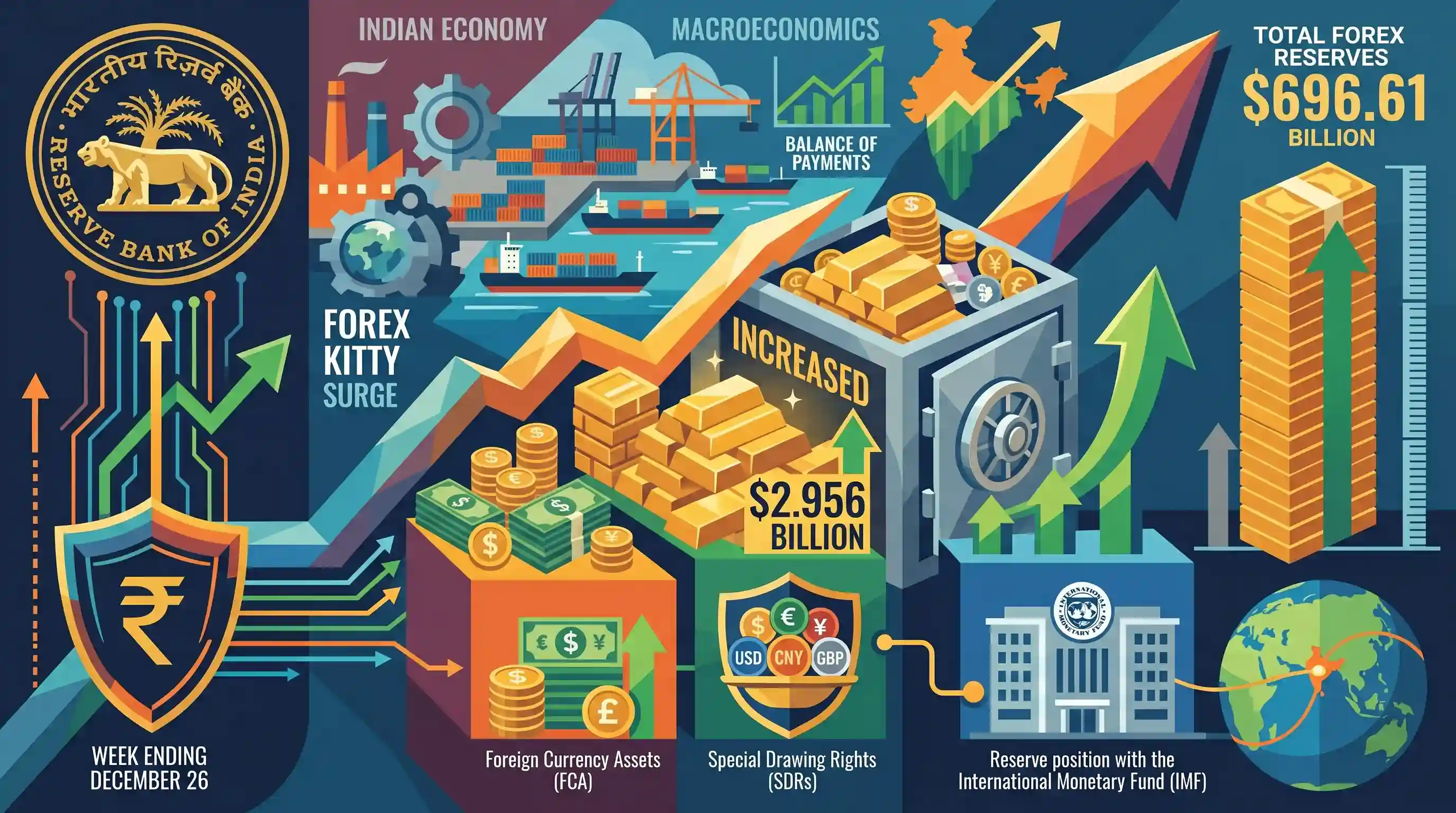
According to data released by the Reserve Bank of India (RBI), India's foreign exchange reserves surged by $3.293 billion to $696.61 billion for the week ending December 26. The increase was driven primarily by a notable rise in gold reserves, which jumped by $2.956 billion. Other components of the forex kitty, including Foreign Currency Assets (FCA), Special Drawing Rights (SDRs), and the reserve position with the International Monetary Fund (IMF), also saw positive growth.
Key Points
- India\'s foreign exchange reserves increased by $3.293 billion to reach $696.61 billion for the week ending December 26.
- Foreign Currency Assets (FCA), the largest component of the reserves, grew by $184 million to $559.612 billion.
- Gold reserves witnessed a significant jump, rising by $2.956 billion to $113.32 billion.
- Special Drawing Rights (SDRs) increased by $60 million to $18.803 billion.
- India\'s reserve position with the International Monetary Fund (IMF) was up by $93 million to $4.875 billion.
Important Terms
Foreign Exchange (Forex) Reserves

Assets held by a central bank in foreign currencies (like USD, Euro) and gold to manage exchange rates, pay imports, and provide a buffer against external economic shocks.
UPSC context
GS Paper III: Indian Economy and related issues. Crucial for understanding Balance of Payments (BoP) and currency stability.
Foreign Currency Assets (FCA)
The largest component of India's forex reserves, consisting of assets like US Treasury bills and foreign currency deposits, valued in USD but including other major currencies.
UPSC context
GS Paper III: External Sector. Often tested in Prelims regarding components of India's forex kitty.
Special Drawing Rights (SDRs)
An international reserve asset created by the IMF in 1969 to supplement member countries' official reserves; its value is based on a basket of five major currencies.
UPSC context
GS Paper II & III: International Institutions and Economy. Important for questions on global liquidity and IMF reforms.
Reserve Position in the IMF (RTP)
A portion of a member country's quota with the IMF that can be accessed immediately and unconditionally to meet balance of payments needs.
UPSC context
GS Paper III: Economy. Tested as a technical component of India's official foreign exchange reserves.
International Monetary Fund (IMF)
An international organization that promotes global monetary cooperation, financial stability, and trade, while providing temporary financial assistance to countries with balance of payments crises.
UPSC context
GS Paper II: Important International Institutions. Frequent topic regarding global governance and economic crises.
Reserve Bank of India (RBI)
India's central bank and regulatory body, responsible for issuing currency, managing forex reserves, and implementing monetary policy to ensure financial stability.
UPSC context
GS Paper III: Indian Economy. Central to banking, inflation control, and external sector management.
Prelims Trap
"Foreign Currency Assets (FCA) in India's forex reserves are held exclusively in US Dollars."
FCA comprises multiple global currencies (Euro, Pound, Yen). It is only *expressed* in US Dollars for official reporting. Non-dollar currency movements heavily impact the total FCA value.
Static Concepts Connected
What are the four components of India's Foreign Exchange Reserves?
- FCA: Foreign Currency Assets form the largest chunk. They are held in multiple global currencies but are uniformly expressed in US dollars for accounting.
- Gold Reserves: Physical gold held by the RBI, acting as a critical safe-haven backing asset during periods of global fiat volatility.
- Special Drawing Rights: 'Paper gold' or artificial currency created by the IMF, allocated to member countries in proportion to their IMF quotas.
- Reserve Tranche Position: The unconditional, interest-free line of credit available to India within its IMF quota, accessible without any service fees.
What constitutes the IMF's Special Drawing Rights (SDR) basket?
- Core Concept: SDR is not a physical currency, but an international reserve asset representing a potential claim on freely usable currencies of IMF members.
- Basket Currencies: The basket comprises five major currencies: US Dollar, Euro, Chinese Renminbi, Japanese Yen, and British Pound Sterling.
- Periodic Review: The IMF reviews the SDR basket every five years, or earlier if warranted, to ensure it reflects the relative importance of currencies in global trading.
Cross-Topic Patterns
Forex buffer vs. Import Cover
Rising forex reserves act as a macroeconomic buffer, evaluated via "import cover" and short-term external debt ratios to gauge India's overall balance of payments resilience.
RBI gold accumulation & De-dollarization
The significant jump in gold reserves reflects a broader emerging-market central bank trend of diversifying away from US Treasuries, directly tying into the global de-dollarization narrative.

Expect a 2026 Prelims question testing the exact differences between IMF's Reserve Tranche Position, SDR components, and FCA valuation.
Linked PYQs · 3
Linked PYQs · 3
- 2013PrelimsGS1
Which one of the following groups of items is included in India's foreign-exchange reserves?
- 2016PrelimsGS1
Recently, which one of the following currencies has been proposed to be added to the basket of IMF's SDR?
- 2010PrelimsGS1
Which of the following is/are treated as artificial currency?
