Record Weekly Expansion of India Foreign Exchange Reserves
Source:The Hindu ↗
हे का महत्त्वाचे आहे
Understanding the components of India's foreign exchange reserves (FCA, Gold, SDRs, and IMF Reserve Tranche) is a fundamental part of the UPSC Economics syllabus. The health of forex reserves is crucial for assessing India's external debt management, currency stability, and capacity to handle global financial volatility.
सारांश
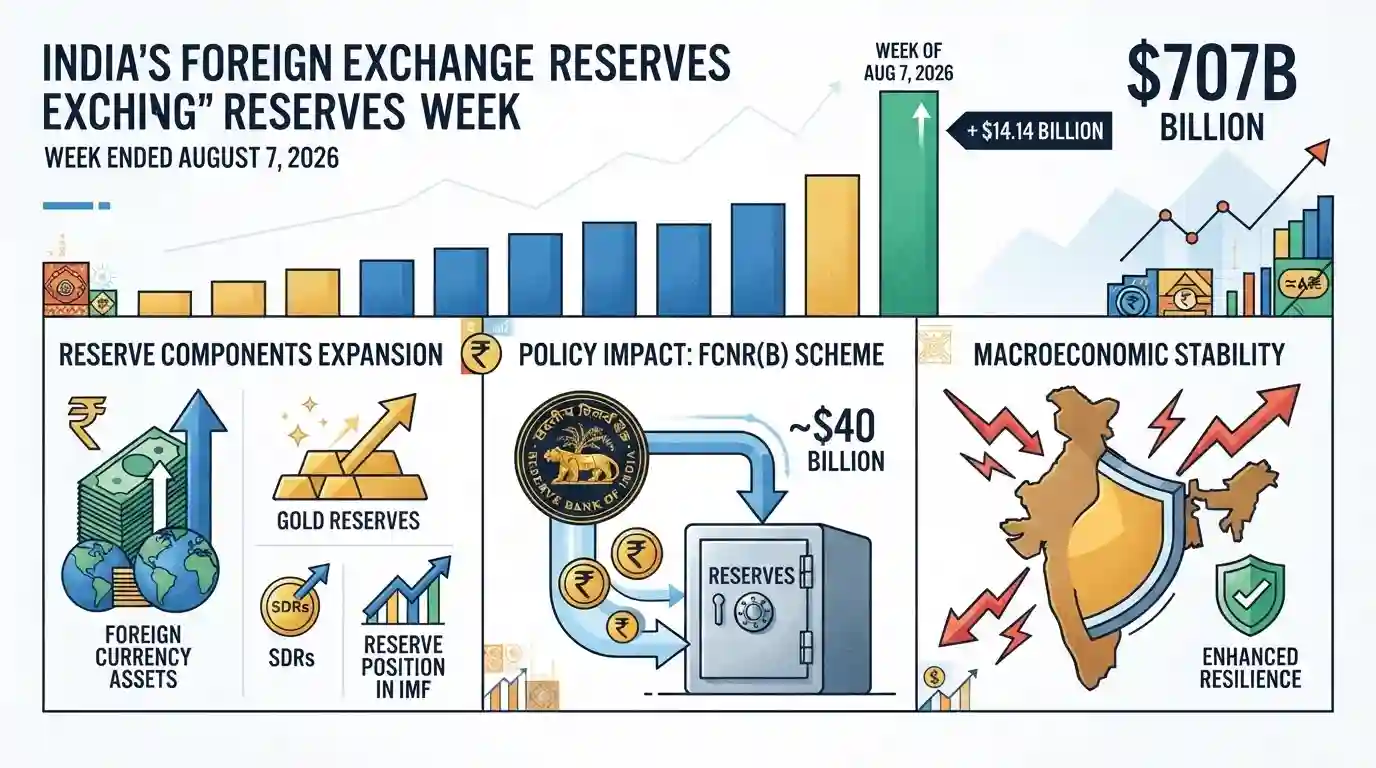
India's foreign exchange reserves saw one of their largest weekly expansions, jumping by $14.14 billion to reach $707 billion for the week ended August 7, 2026. This growth was driven by increases across all reserve components, particularly Foreign Currency Assets (FCA) and gold reserves. The RBI's recent launch of the FCNR(B) scheme also played a key role by attracting approximately $40 billion in new forex inflows, bolstering the nation's macroeconomic stability against external shocks.
मुख्य मुद्दे
- India's foreign exchange reserves surged by $14.136 billion to reach $707.002 billion during the week ended August 7, 2026.
- Foreign Currency Assets (FCA), the largest component of the reserves, increased by $9.946 billion to $574.625 billion.
- Gold reserves experienced a significant increase of $3.995 billion, bringing their total value to $108.738 billion.
- The Special Drawing Rights (SDRs) rose by $79 million, and India's reserve position with the IMF increased by $116 million.
- A series of measures launched by the RBI and government in July, notably the FCNR(B) scheme, have successfully attracted around $40 billion in forex inflows.
महत्त्वाच्या संज्ञा
Foreign Currency Non-Resident (Bank) or FCNR(B) scheme

A term deposit scheme allowing Non-Resident Indians (NRIs) and Overseas Citizens of India (OCIs) to maintain savings in foreign currency with Indian banks, protecting depositors against domestic currency depreciation.
UPSC context
GS Paper III (Indian Economy). Relevant for capital account transactions, NRI deposits, and external sector stability.
Foreign Exchange Reserves
External assets held by a country's monetary authority—composed of Foreign Currency Assets, gold reserves, Special Drawing Rights, and the IMF Reserve Tranche Position—to manage exchange rates and absorb shocks.
UPSC context
GS Paper III. High-frequency Prelims topic on reserve components, and Mains topic on exchange rate volatility.
Foreign Currency Assets (FCA)
The largest component of India's forex reserves, comprising multi-currency investments like foreign government securities, deposits with foreign central/commercial banks, and debt instruments denominated in non-rupee currencies.
UPSC context
GS Paper III. Focuses on asset diversification, exchange-rate interventions, and external balance sheets.
Reserve Bank of India (RBI)
India's central bank and monetary authority, responsible for formulating monetary policy, regulating the banking system, controlling currency issuance, and serving as the custodian of India's foreign exchange reserves.
UPSC context
GS Paper III. Foundational for topics involving monetary policy transmission, exchange rate management, and banking reforms.
International Monetary Fund (IMF)
An international financial institution of 190 member countries working to foster global monetary cooperation, secure financial stability, facilitate international trade, and support countries facing balance-of-payments difficulties.
UPSC context
GS Paper II & III. Evaluates international institutions, quota reforms, and reserve assets like Special Drawing Rights.
पूर्वपरीक्षा सापळा
Under the FCNR(B) scheme, exchange rate risk is borne directly by the Reserve Bank of India to protect domestic commercial banks.
Under the FCNR(B) scheme, the foreign exchange rate risk is entirely borne by the commercial banks holding the deposits, not by the RBI or the Government of India (which was the case under the old, phased-out FCNR(A) scheme).
संबंधित स्थिर संकल्पना
What are the constituents and custodian frameworks of India's Foreign Exchange Reserves?
- Four Components: Comprises Foreign Currency Assets (FCAs - largest), Gold, Special Drawing Rights (SDRs), and Reserve Tranche Position (RTP) in the IMF.
- Legal Custodian: RBI acts as custodian under the RBI Act, 1934, and manages foreign exchange under the Foreign Exchange Management Act (FEMA), 1999.
How does the FCNR(B) account differ structurally from NRE and NRO accounts?
- Currency Denomination: FCNR(B) is held strictly in designated foreign currencies (e.g., USD), whereas NRE and NRO are held in Indian Rupees (INR).
- Exchange Risk: FCNR(B) depositors face no rupee depreciation risk as banks bear it, unlike NRE depositors who face conversion risks.
- Taxability: Interest earned on FCNR(B) and NRE is tax-free in India, whereas NRO interest is subject to domestic income tax.
आंतर-विषय नमुने
Forex accumulation vs domestic inflation dynamics
RBI's USD buying to build reserves increases domestic rupee liquidity, requiring sterilization through open market operations to prevent inflationary pressures.
FCNR(B) deposits and external debt vulnerability
Large FCNR(B) inflows bolster short-term reserves but increase India's external debt liabilities, complicating capital account management during global monetary tightening.

Prelims 2026 may test FCNR(B) vs NRE/NRO accounts on exchange-risk bearing, tax status, and impact on external debt components.
संबंधित PYQ · 2
संबंधित PYQ · 2
- 2013PrelimsGS1
Which one of the following groups of items is included in India's foreign-exchange reserves?
- 2016PrelimsGS1
Recently, which one of the following currencies has been proposed to be added to the basket of IMF's SDR?
