Bhil Tribe of Rajasthan Forests Maternal Healthcare and Legal Rights
Source:the-indian-tribal ↗
Why It Matters
The article integrates static topics of Rajasthan's geography (tribal demographics of southern Rajasthan) and polity (Fifth Schedule, PESA) with current socio-economic challenges, making it highly relevant for RPSC RAS Prelims questions on demographics, constitutional provisions, and tribal welfare.
Summary
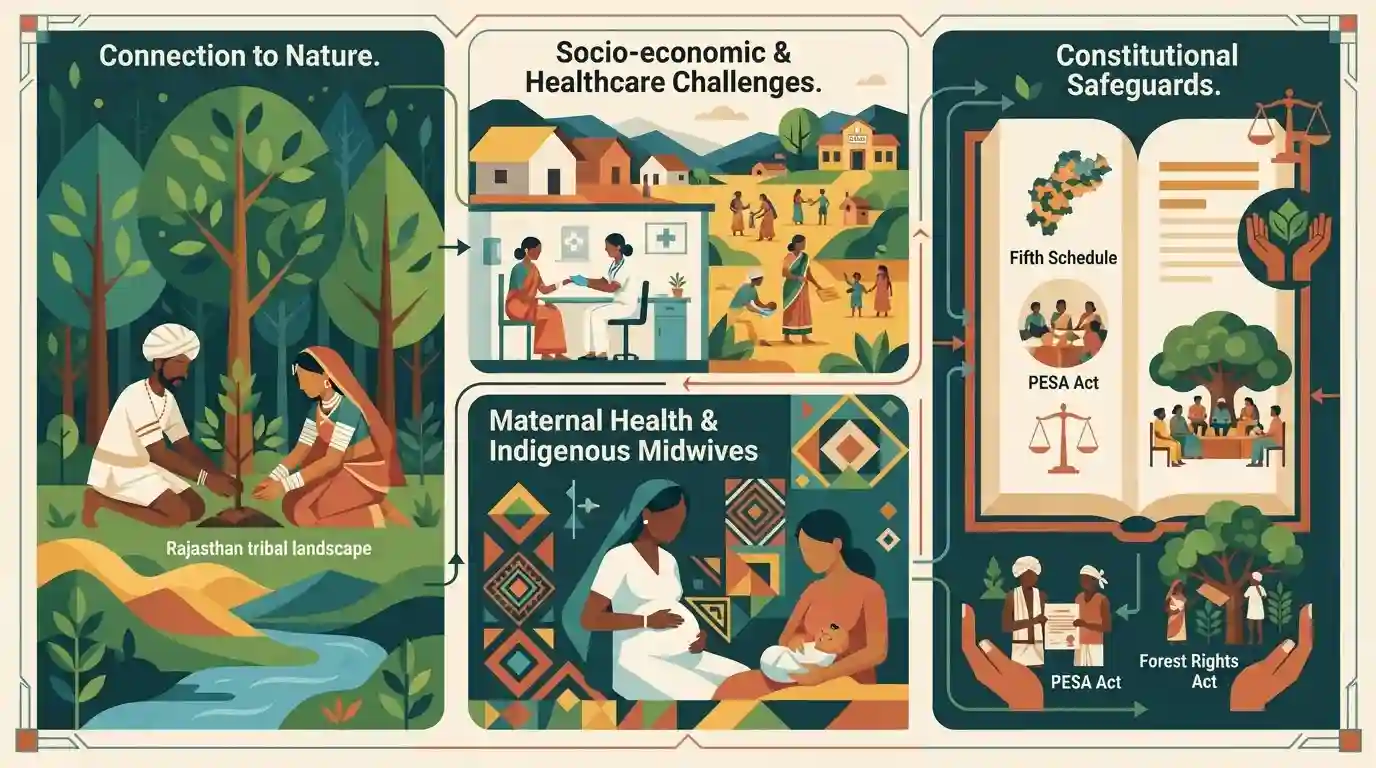
The article highlights the profound connection between the Bhil tribe of Rajasthan and their natural environment, particularly the Aravalli forests. It explores the persisting socio-economic and healthcare challenges in tribal-dominated districts like Dungarpur and Banswara, emphasizing the indispensable role of indigenous midwives in maternal healthcare. Additionally, it underscores the importance of constitutional and legal safeguards—such as the Fifth Schedule, PESA Act, and Forest Rights Act—in protecting the land rights, culture, and self-governance of Scheduled Tribes in Rajasthan.
Key Points
- The Bhil tribe of Rajasthan maintains a deep symbiotic relationship with the Aravalli forests, relying on them for sustenance, traditional medicine, and minor forest produce.
- Despite improvements in maternal mortality and literacy in Rajasthan, tribal districts like Dungarpur face stark socio-economic disparities, reflected in low Human Development Index (HDI) scores and high post-neonatal mortality rates.
- Indigenous midwives remain a trusted source of maternal healthcare in remote tribal areas; integrating their traditional knowledge with modern medical training could enhance health outcomes.
- The rights, culture, and self-governance of these tribal communities are safeguarded by robust constitutional mechanisms, notably the Fifth Schedule, Article 244, PESA Act (1996), and Forest Rights Act (2006).
Important Terms
Panchayats (Extension to Scheduled Areas) Act, 1996

1996 law extending Part IX (Panchayats) of the Constitution to Fifth Schedule Areas. It empowers Gram Sabhas to manage minor forest produce, land acquisition consultation, and dispute resolution to ensure tribal self-governance.
UPSC context
High-yield Polity/Governance topic (GS II). Tests understanding of decentralized tribal self-governance and Gram Sabha powers.
Forest Rights Act, 2006
2006 law formally recognizing individual and community land/resource rights of Scheduled Tribes and traditional forest dwellers. It reversed historical injustices from colonial forest policies and empowers Gram Sabhas in the claims process.
UPSC context
Key GS II & III topic (Social Justice/Environment). Tests tribal land rights, conservation balance, and Gram Sabha authority.
Fifth Schedule
Constitutional provision under Article 244(1) for the administration of Scheduled Areas and Scheduled Tribes in states outside the Northeast. It allows the Governor to modify laws and creates Tribes Advisory Councils.
UPSC context
Core Polity topic (GS II). Tests the special administrative framework for tribal protection and Governor's discretionary powers.
Aspirational Districts Programme
An NITI Aayog initiative launched in 2018 to rapidly transform India's 112 most under-developed districts through real-time data monitoring, convergence of schemes, and competitive federalism, without new budgetary allocations.
UPSC context
Important Governance topic (GS II/III). Tests data-driven policy, outcome-based monitoring, and cooperative/competitive federalism.
Article 15
Fundamental Right under Part III that prohibits the State from discriminating against citizens on grounds only of religion, race, caste, sex, or place of birth, while permitting special provisions for disadvantaged groups.
UPSC context
Fundamental Polity concept (GS II). Tests the Right to Equality and the constitutional basis for affirmative action/reservations.
Article 46
Directive Principle (Part IV) directing the State to promote the educational and economic interests of weaker sections, particularly SCs and STs, and protect them from social injustice and all forms of exploitation.
UPSC context
Core Polity/Social Justice topic (GS II). Tests the DPSPs and the philosophical foundation of affirmative action policies.
Article 19(5)
Clause permitting the State to impose reasonable restrictions on the fundamental rights of movement (19(1)(d)) and residence (19(1)(e)) in the interest of the general public or for the protection of Scheduled Tribes.
UPSC context
Crucial Polity nuance (GS II). Tests the balance between individual freedoms and the protection of vulnerable tribal communities/cultures.
Prelims Trap
"The Governor of a State has the exclusive power to declare or alter the boundaries of a Scheduled Area."
Aspirants confuse the Governor's role (submitting annual administrative reports) with the President's exclusive constitutional authority to declare or alter Scheduled Areas under the Fifth Schedule.
Static Concepts Connected
What is the role of the Gram Sabha under PESA (1996) and FRA (2006)?
- PESA 1996: Grants Gram Sabhas ownership of minor forest produce and mandates their prior consultation before land acquisition or resettlement in Scheduled Areas.
- FRA 2006: Makes Gram Sabhas the statutory authority to initiate the process of determining the nature and extent of individual or community forest rights.
Which fundamental rights and DPSPs directly protect Scheduled Tribes?
- Article 19(5): Allows the State to impose reasonable restrictions on the fundamental rights of movement and residence to protect the interests of any Scheduled Tribe.
- Articles 15 & 16: Enables the State to make special provisions and reservations in educational institutions and public employment for the advancement of STs.
- Article 46: A DPSP directing the State to promote the educational and economic interests of weaker sections, particularly STs, and protect them from social injustice.
Cross-Topic Patterns
Mainstreaming Traditional Medicine
The reliance on indigenous midwives links to UPSC's focus on the WHO Global Centre for Traditional Medicine and the integration of AYUSH into rural public healthcare frameworks.
Aspirational Districts & Demographics
Tribal-majority districts like Dungarpur and Banswara frequently overlap with NITI Aayog's Aspirational Districts Programme, connecting demographic mapping directly to spatial governance schemes.

Expect a multi-statement Prelims question comparing the statutory powers of the Gram Sabha under PESA, FRA, and the Biological Diversity Act.
Linked PYQs · 2
Linked PYQs · 2
- 2016RPSC_PRELIMSGS1
The PESA (Panchayats Extension to Scheduled Areas) Act, 1966, is not applicable to which of the following groups of states?
- 2021RPSC_PRELIMSGS1
In Rajasthan, the Scheduled Tribe population has the second highest percentage (2011)
