Western Ghats Forest Fires and Community Based Conservation Strategies
Source:The Hindu ↗
Why It Matters
Forest fires represent an increasing intersection of anthropogenic practices and climate change impacts. Understanding local, community-driven conservation strategies and the shift toward proactive disaster management is crucial for the UPSC syllabus regarding ecological security and sustainable development.
Summary
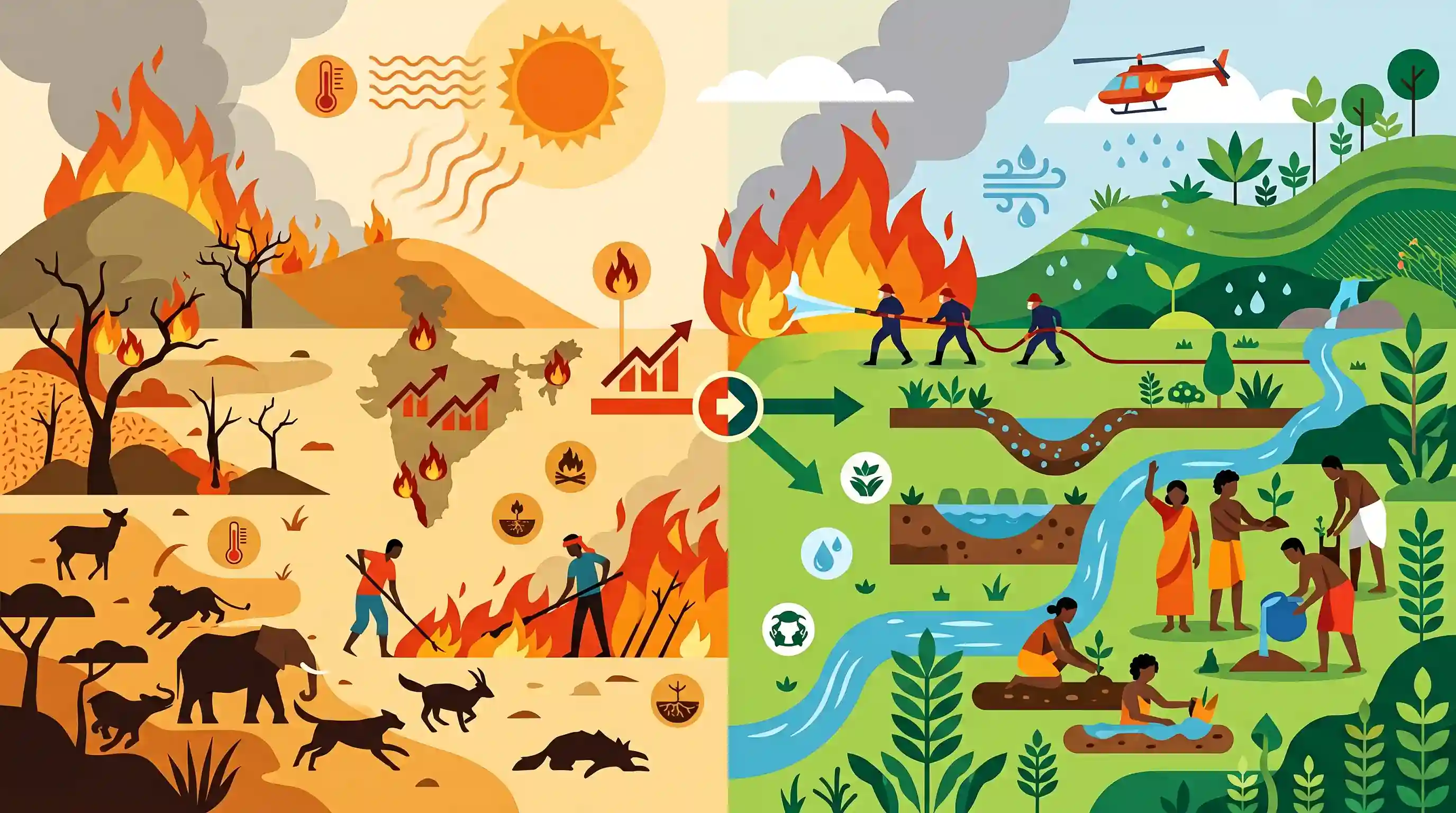
The article highlights the escalating crisis of forest fires in the Western Ghats, particularly around Kodaikanal, which mirrors a broader 80% surge across India. Driven by a combination of human activities like slash-and-burn agriculture and the extreme heatwaves brought on by climate change, these fires are devastating local biodiversity. The author underscores the urgent need to shift from reactive firefighting to proactive, community-integrated mitigation. Emphasizing grassroots solutions, the piece advocates for leveraging permaculture techniques to restore moist micro-climates and empowering local indigenous communities as the frontline defense against ecological degradation.
Key Points
- India has seen an alarming increase of over 80% in forest fires recently, worsened by extreme heat waves and dry spells linked to climate change.
- Many fires are anthropogenic in origin, resulting from practices like slash-and-burn agriculture (jhum cultivation) and intentionally burning dry grass to stimulate fresh growth for livestock.
- A dangerous feedback loop is emerging where climate change intensifies forest fires, and the resulting loss of green cover further exacerbates localized warming and ecological degradation.
- Sustainable localized mitigation efforts, such as creating moist micro-climates through permaculture and relying on the indigenous knowledge of local tribal communities, offer effective strategies for fire management and prevention.
Prelims Trap
Forest fires in India are predominantly caused by natural phenomena such as extreme heatwaves and lightning.
Over 90% of forest fires in India are anthropogenic, driven by practices like slash-and-burn agriculture, NTFP collection, and livestock grazing, not natural causes.
Static Concepts Connected
Which regions in India are most vulnerable to forest fires?
- Himalayan region: Highly vulnerable due to abundant dry pine forests (Chir pine) which shed highly flammable needles during the summer.
- Central India: Dry deciduous forests (e.g., Odisha, Chhattisgarh) shed leaves in the dry season, creating heavy fuel loads often ignited for NTFP collection.
- Western Ghats: Usually moist, but increasingly vulnerable during prolonged dry spells and heatwaves, threatening critical, endemic biodiversity hotspots.
What is the Joint Forest Management (JFM) approach?
- Partnership model: A collaborative governance model between local village communities and state forest departments to protect and manage degraded forests.
- Benefit sharing: Communities get access to Non-Timber Forest Products (NTFPs) and a share of timber revenue in exchange for preventing fires and poaching.
- Policy backing: Rooted in the National Forest Policy of 1988, it emphasizes decentralized, proactive community-based disaster management over reactive state policing.
Cross-Topic Patterns
Forest fires and Himalayan cryosphere
Biomass burning from forest fires releases black carbon. This travels to high-altitude regions, reducing the albedo of glaciers and accelerating the melting of the cryosphere.
Permaculture as disaster mitigation
Techniques like mulching and swales not only improve soil moisture for agriculture but act as biological firebreaks by sustaining moist micro-climates during extreme heatwaves.
FRA 2006 and community fire management
Recognizing Community Forest Resource (CFR) rights under the Forest Rights Act (FRA) 2006 empowers tribals to legitimately use traditional ecological knowledge for proactive fire management.

Expect a multi-statement question interlinking anthropogenic forest fires, black carbon emission, and the ecological role of permaculture.
Linked PYQs · 2
Linked PYQs · 2
- 2020MainsGS3
Discuss the recent measures initiated in disaster management by the Government of India departing from the earlier reactive approach.
- 2011PrelimsGS1
Three of the following criteria have contributed to the recognition of Western Ghats-Sri Lanka and Indo-Burma regions as hotspots of biodiversity: 1. Species richness 2. Vegetation density 3. Endemism 4. Ethno-botanical importance 5. Threat perception 6. Adaptation of flora and fauna to warm and humid conditions Which three of the above are correct criteria in this context?
