Grizzled Giant Squirrel Habitat and Eastern Ghats Biodiversity
Source:The Hindu ↗
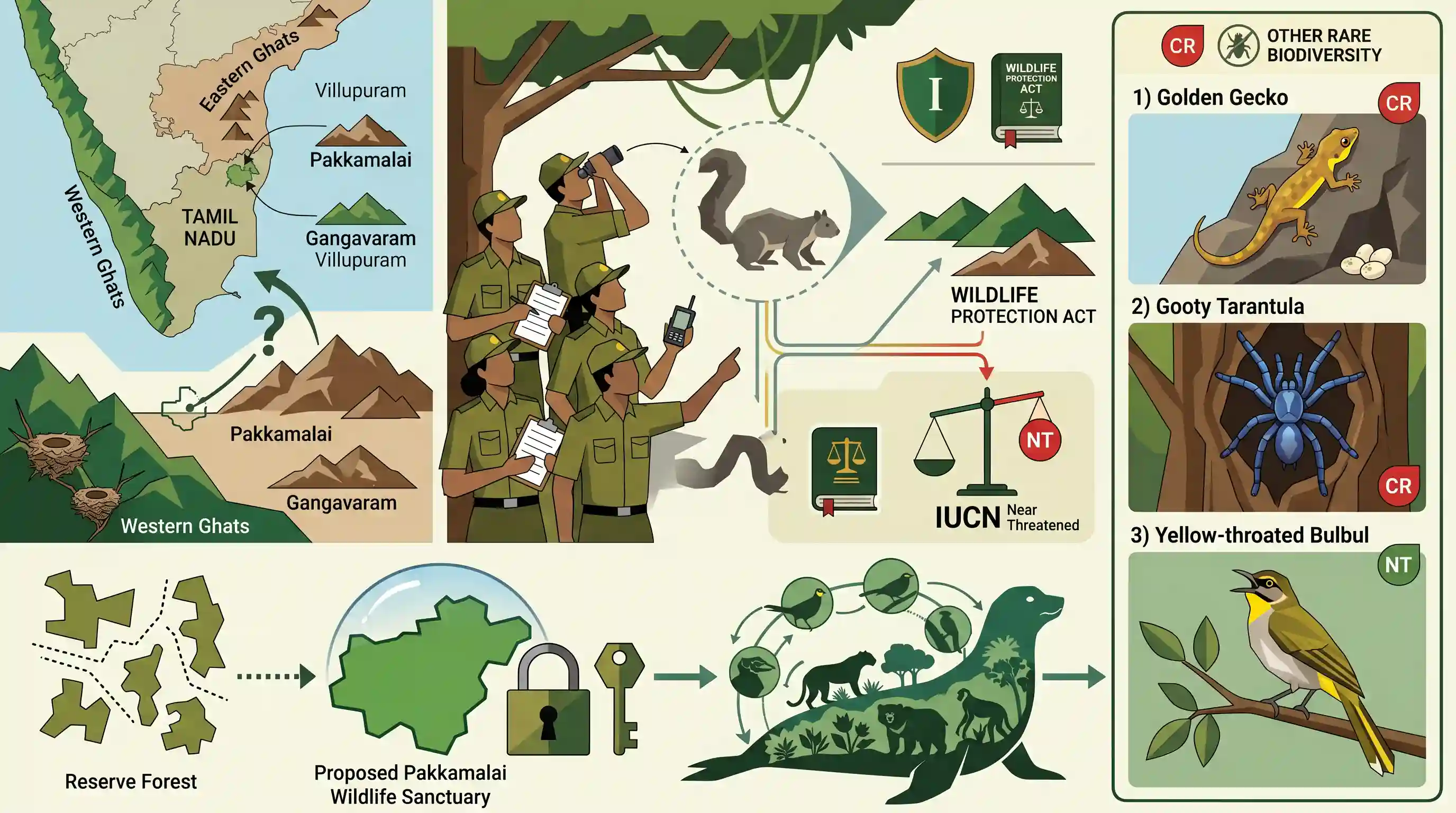
Why It Matters
UPSC frequently asks about the conservation status and geographical distribution of endemic or rare species (e.g., Gooty tarantula, giant squirrel) and the ecological features of the Eastern and Western Ghats.
Summary
The Tamil Nadu Forest Department is set to conduct a population study of the grizzled giant squirrel in the Pakkamalai and Gangavaram hills of Villupuram district. Normally found in the Western Ghats, the squirrel's presence in the Eastern Ghats highlights the area's unique ecological value. The species is highly protected under the Wildlife Protection Act, 1972 (Schedule I) and listed as Near Threatened by the IUCN. The region is also home to other rare species, such as the critically endangered golden gecko, Gooty tarantula, and yellow-throated bulbul, leading to growing calls to declare Pakkamalai a wildlife sanctuary to ensure comprehensive habitat protection.
Key Points
- The Tamil Nadu Forest Department is planning a population study of the grizzled giant squirrel in the Pakkamalai and Gangavaram hills in the Eastern Ghats.
- The grizzled giant squirrel is typically endemic to the Western Ghats but has established a population in these specific Eastern Ghats regions.
- The species is listed as Near Threatened by the IUCN, in Schedule II of CITES, and in Schedule I of the Wildlife Protection Act, 1972.
- The Pakkamalai region hosts significant biodiversity, including the critically endangered golden gecko, Gooty tarantula, and yellow-throated bulbul, prompting demands to declare it a wildlife sanctuary.
Important Terms
Grizzled Giant Squirrel

The smallest giant squirrel species, primarily arboreal and crepuscular, found in fragmented riparian forests of Southern India and Sri Lanka. It is a key seed disperser in its ecosystem.
UPSC context
GS Paper 3: Biodiversity; specifically species in news, their habitat, and conservation status for Prelims.
Wildlife Protection Act, 1972
India's primary legal framework for wildlife conservation. Following the 2022 amendment, it rationalized six schedules into four, enhancing protection levels and aligning with international CITES obligations.
UPSC context
GS Paper 2 & 3: Environmental legislation and conservation. Tested via amendments, schedules, and statutory bodies like NTCA.
Eastern Ghats
A discontinuous chain of mountains along India's eastern coast, running from Odisha to Tamil Nadu. They host unique biodiversity, including tropical dry evergreen forests and several endemic species.
UPSC context
GS Paper 1 & 3: Geography and Environment. Focus on differences from Western Ghats and specific biodiversity hotspots.
Schedule I (WPA)
The highest level of legal protection under the Wildlife Protection Act, 1972. Species in this schedule (e.g., Tiger, Grizzled Giant Squirrel) carry the harshest penalties for poaching or trade.
UPSC context
GS Paper 3: Conservation. Essential for Prelims to distinguish between different levels of legal protection for species.
Golden Gecko
A large, nocturnal lizard endemic to the rocky scrub forests of India's Eastern Ghats. It is listed as Critically Endangered due to habitat loss from mining and quarrying.
UPSC context
GS Paper 3: Species conservation. Represents the vulnerability of Eastern Ghats' unique herpetofauna to commercial exploitation.
IUCN Red List
The global authority on the status of the natural world, known for its 'Red List' which categorizes species by extinction risk (e.g., Critically Endangered, Vulnerable).
UPSC context
GS Paper 3: Environment. Frequently tested in Prelims regarding the status of specific Indian flora and fauna.
CITES
An international treaty (effective in India since 1976) ensuring that international trade in wild animals and plants does not threaten their survival. It is now integrated into India's WPA.
UPSC context
GS Paper 3: International treaties and environmental governance. Relevant for trade regulations and global conservation cooperation.
Prelims Trap
"The Grizzled Giant Squirrel is strictly endemic to the Western Ghats."
While primarily found in the Western Ghats (and Sri Lanka), isolated but established populations exist in the Eastern Ghats (Pakkamalai hills), making "strictly endemic" factually incorrect.
Static Concepts Connected
What are the three giant squirrel species found in India and their habitats?
- Malabar Giant Squirrel: Endemic to deciduous and moist evergreen forests of peninsular India; state animal of Maharashtra.
- Grizzled Giant Squirrel: Found in the Western Ghats, isolated pockets of the Eastern Ghats (like Pakkamalai), and Sri Lanka. Known for its distinct white/grey flecked fur.
- Malayan Giant Squirrel: Found in Northeast India's evergreen and semi-evergreen forests, with a range extending deeply into Southeast Asia.
What are the key ecological characteristics of the Gooty Tarantula?
- Arboreal nature: Unlike typical ground-dwelling tarantulas, it is a metallic-blue, tree-dwelling (arboreal) spider found in deciduous forests.
- Micro-endemism: It is strictly endemic to a highly restricted, degraded forest area of the Eastern Ghats in Andhra Pradesh.
- Conservation Status: Listed as Critically Endangered by the IUCN due to severe habitat loss (logging/firewood collection) and rampant smuggling for the exotic pet trade.
Cross-Topic Patterns
Eastern Ghats conservation blind-spot
Unlike the heavily protected Western Ghats, Eastern Ghats habitats face severe quarrying threats, disproportionately impacting endemic rock-dwelling species like the Yellow-throated Bulbul and Indian Golden Gecko.
WPA 2022 Schedule reorganization
Lesser-known fauna like the Gooty Tarantula and Golden Gecko feature prominently in the newly consolidated Schedule I of the amended Wildlife Protection Act (2022), ensuring maximum legal protection against poaching.

Expect a "Species vs Natural Habitat" pairs question in 2026 matching Grizzled Giant Squirrel, Gooty Tarantula, and Yellow-throated Bulbul.
Linked PYQs · 3
Linked PYQs · 3
- 2025PrelimsGS1
Regarding Peacock tarantula (Gooty tarantula), consider the following statements : I. It is an omnivorous crustacean. II. Its natural habitat in India is only limited to some forest areas. III. In its natural habitat, it is an arboreal species. Which of the statements given above is/are correct?
- 2017PrelimsGS1
From the ecological point of view, which one of the following assumes importance in being a good link between the Eastern Ghats and the Western Ghats?
- 2019PrelimsGS1
Consider the following pairs: Wildlife Naturally found in 1. Blue-finned Mahseer : Cauvery River 2. Irrawaddy Dolphin : Chambal River 3. Rusty-spotted Cat : Eastern Ghats Which of the pairs given above are correctly matched?
