Tamil Nadu Forest Department launches study on Madras hedgehog
Source:The Hindu ↗
Why It Matters
The conservation of lesser-known species highlights India's broadening approach to biodiversity preservation. For UPSC aspirants, recognizing the habitats (such as scrub forests), activity patterns (like nocturnality), and conservation status of specific fauna is frequently tested in Prelims, while community-led conservation strategies fall under GS3 Environmental management.
Summary
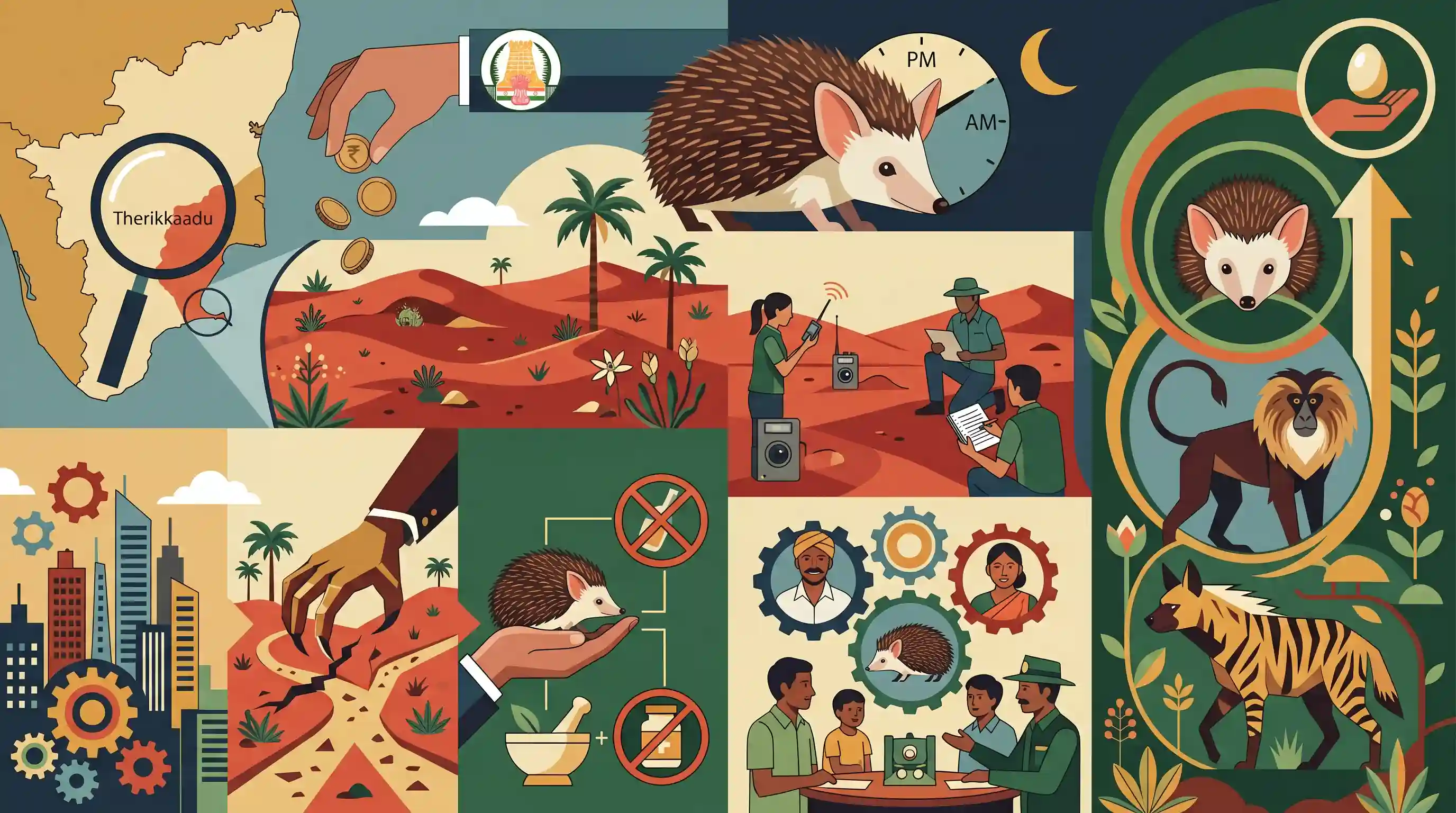
The Tamil Nadu Forest Department has launched a conservation study focused on the Madras hedgehog in the Therikkaadu region, as part of a state-funded initiative to protect lesser-known endangered species. Endangered by rapid urbanization and poaching for supposed medicinal value, these nocturnal mammals inhabit semi-arid and scrubby landscapes. The project emphasizes both scientific surveys and community-led conservation to secure the future of the species along with others like the lion-tailed macaque and striped hyena.
Key Points
- The Tamil Nadu Forest Department has initiated a study on the Madras Hedgehog (Paraechinus nudiventris) in the Therikkaadu region of Thoothukudi district.
- This research is part of a ₹1 crore State government initiative dedicated to conserving four lesser-known endangered species: the Madras hedgehog, striped hyena, lion-tailed macaque, and hump-headed mahseer.
- The Madras hedgehog is a nocturnal mammal predominantly found in the semi-arid, scrubby, and dry landscapes of Tamil Nadu, Andhra Pradesh, and Kerala.
- The species is primarily threatened by rapid urbanisation, habitat loss, and poaching driven by false beliefs regarding its medicinal properties.
- Conservation efforts include extensive nocturnal field surveys across thorn scrubs, community engagement via village forest committees, and grassroots awareness campaigns involving farmers and students.
Important Terms
Madras hedgehog

A nocturnal, insectivorous mammal (Paraechinus nudiventris) endemic to South India. It is threatened by habitat loss and myths regarding its medicinal value.
UPSC context
Species in news; Biodiversity and Conservation (GS Paper III). Reclassification from 'Least Concern' to 'Threatened' is proposed.
Therikkaadu
A unique red sand dune ecosystem in southern Tamil Nadu, formed by wind-blown deposits rich in iron oxides like garnet and ilmenite.
UPSC context
Geography (GS Paper I) and Environment (GS Paper III). Represents a rare coastal desert-scrub mosaic.
Village Forest Committees
Community-level bodies formed under Joint Forest Management (JFM) to involve local residents in forest protection, management, and restoration.
UPSC context
Governance and Environment (GS Paper II/III). Tests community-led conservation and decentralized forest management models.
Advanced Institute for Wildlife Conservation (AIWC)
A specialized research wing of the Tamil Nadu Forest Department responsible for scientific wildlife monitoring, genetic studies, and conservation planning.
UPSC context
Institutional framework for conservation (GS Paper III). Spearheads scientific studies on lesser-known species.
Radio telemetry
A wildlife tracking technique using radio signals to monitor animal movement, habitat use, and behavior without human interference.
UPSC context
Science and Technology/Environment (GS Paper III). Modern tool for ecological research and species-specific action plans.
Endemic species
A species found naturally only in a specific, restricted geographical area and nowhere else in the world.
UPSC context
Biodiversity (GS Paper III). Endemicity increases vulnerability to habitat changes and extinction risks.
Prelims Trap
The Madras hedgehog is classified as an 'Endangered' species under the IUCN Red List.
News articles often use 'endangered' colloquially to denote local decline. The Madras hedgehog is actually listed as 'Least Concern' on the IUCN Red List.
Static Concepts Connected
What are the geographical characteristics and origins of 'Theris' in Tamil Nadu?
- Red Sand Dunes: Unique semi-arid dune formations primarily found in coastal districts like Thoothukudi, characterized by highly localized red soils.
- Iron Oxide Coating: The distinct red hue originates from hematite (iron oxide) coating the quartz sand grains.
- Marine Origins: They were formed through the prolonged wind erosion and weathering of ancient Quaternary marine deposits.
What is the conservation status of other key species in this Tamil Nadu initiative?
- Hump-headed Mahseer: A 'Critically Endangered' freshwater fish, strictly endemic to the Cauvery river basin.
- Lion-tailed Macaque: An 'Endangered' diurnal primate, endemic to the fragmented tropical rainforests of the Western Ghats.
- Striped Hyena: Listed as 'Near Threatened' globally, but receives the highest legal protection under Schedule I (WPA, 1972).
Cross-Topic Patterns
Fauna tied to specific river basins
The Hump-headed mahseer's critical status is tied exclusively to the Cauvery basin, mirroring UPSC's trend of pairing endemic aquatic fauna with specific river systems (e.g., Gharial/Chambal).
Micro-habitats and geographical formations
Species mapped to highly localized micro-habitats (like the Madras hedgehog in Therikkadu's red sand dunes) frequently feature in Prelims as 'Fauna to Region' matching pairs.

Matching lesser-known fauna to specific micro-habitats (Therikkadu dunes) and river basins (Cauvery) is highly probable in Prelims 2026.
Linked PYQs · 3
Linked PYQs · 3
- 2023PrelimsGS1
Consider the following fauna: 1. Lion-tailed Macaque 2. Malabar Civet 3. Sambar Deer How many of the above are generally nocturnal or most active after sunset?
- 2012PrelimsGS1
Which one of the following groups of animals belongs to the category of endangered species?
- 2017PrelimsGS1
In India, if a species of tortoise is declared protected under Schedule I of the Wildlife (Protection) Act, 1972, what does it imply?
