Forest Conservation Faces Growing Hurdles Amid Wildlife Conflicts
Source:The Hindu ↗
Why It Matters
This article illustrates the complex intersection of disaster management, grassroots-level conservation challenges, and the unintended consequences of regulatory ease-of-doing-business laws (like self-declarations for tree felling) on fragile ecosystems. It provides excellent case studies for GS3 answers on landslide mitigation, Western Ghats protection (Gadgil/Kasturirangan context), and environmental governance.
Summary
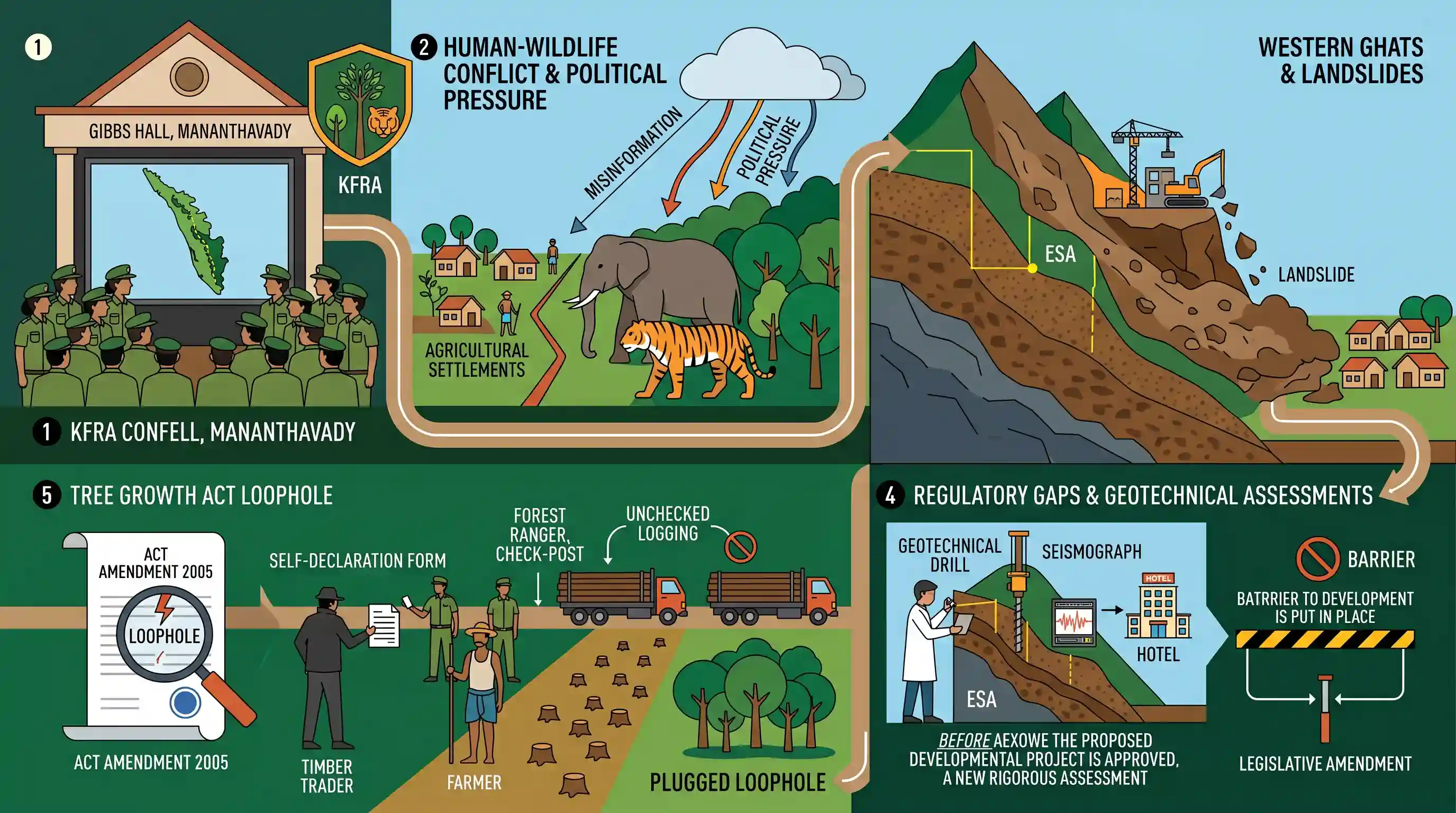
During its Northern Circle conference in Mananthavady, the Kerala Forest Rangers Association (KFRA) highlighted key challenges confronting forestry, including politically motivated resistance amid human-wildlife conflict, ecological threats in the landslide-prone Western Ghats, and regulatory gaps. The association urged for rigorous geotechnical assessments before allowing development in Ecologically Sensitive Areas (ESAs). Furthermore, they called for legislative amendments to plug loopholes in the Kerala Promotion of Tree Growth in Non-Forest Areas (Amendment) Act, 2005, which is currently being exploited by traders to carry out unchecked logging under the guise of farmer-friendly self-declarations.
Key Points
- Forest and wildlife conservation in Kerala faces intensifying challenges from politically motivated pressure and misinformation surrounding human-wildlife conflicts.
- In the wake of severe disasters like the Puthumala, Mundakkai-Chooralmala, and Kalladi landslides in Wayanad, the KFRA advocated that any development within Ecologically Sensitive Areas (ESAs) of the Western Ghats must be preceded by detailed geotechnical and scientific studies (evaluating soil water absorption, drainage patterns, and piping potential).
- The Kerala Promotion of Tree Growth in Non-Forest Areas (Amendment) Act, 2005, is reportedly being misused by timber traders who bypass field verification using self-declaration provisions to transport immature trees bought cheaply from farmers.
- The unchecked felling of shade trees in Wayanad's plantations negatively affects coffee and pepper cultivation, local microclimates, water security, and the tourism sector, prompting calls for legislative amendments and farmer awareness programs.
Important Terms
Ecologically Sensitive Areas (ESAs)

Ecologically fragile zones notified under the Environment (Protection) Act, 1986, where industrial development and polluting activities are restricted to protect biodiversity and sustain critical natural habitats.
UPSC context
GS Paper III (Environment & Disaster Management). Relevant for Western Ghats conservation committees (Gadgil/Kasturirangan) and sustainable development balances.
Western Ghats Ecology
The exceptionally biodiverse and geomorphically unique mountain range on India's western coast, designated as a UNESCO World Heritage Site and one of the world's hottest biodiversity hotspots.
UPSC context
GS Paper I & III (Geography and Environment). Explores monsoon regulation, endemic species, biological corridors, and committee-led conservation frameworks.
Human-Wildlife Conflict
Negative interactions between humans and wild animals resulting in loss of life, livelihoods, or property, exacerbated by forest fragmentation and developmental encroachment.
UPSC context
GS Paper III (Environment). Key for understanding biodiversity protection, forest edge effects, and community-led coexistence models in India.
Kerala Promotion of Tree Growth in Non-Forest Areas (Amendment) Act, 2005
State legislation encouraging timber and tree cultivation on non-forest lands in Kerala, currently under scrutiny for regulatory loopholes that permit unchecked commercial logging under self-declarations.
UPSC context
GS Paper III (Environment & Biodiversity). Tests understanding of forestry legislation, sustainable resource management, and state environmental policies.
Kerala Forest Rangers Association (KFRA)
A registered professional body representing Range Forest Officers in Kerala, advocating for science-based forest conservation, sustainable development, and protection of forest staff.
UPSC context
GS Paper III (Environment). Demonstrates regional stakeholder perspective on forest governance, policy advocacy, and ground-level administrative challenges.
Prelims Trap
Ecologically Sensitive Areas (ESAs) are statutory zones designated and managed under the Wildlife (Protection) Act, 1972.
ESAs and ESZs are declared by the Central Government under Section 3(2)(v) of the Environment (Protection) Act, 1986, not the Wildlife (Protection) Act.
Static Concepts Connected
What is 'soil piping' and how does it cause landslides?
- Subsurface hydraulic erosion: Water infiltrates clay-rich subsurface soil, washing away fine particles and forming underground tunnels and void networks.
- Pore-water pressure: During intense monsoons, these empty tunnels fill with water, building extremely high internal pore-water pressure.
- Structural liquefaction: The overburden soil loses its shear strength, behaves like a fluid, and causes rapid slope collapse and landslides.
How do Gadgil and Kasturirangan report recommendations differ?
- Spatial coverage: Gadgil designated 100% of the Western Ghats as ecologically sensitive; Kasturirangan restricted it to 37% natural landscape.
- Governance model: Gadgil advocated a bottom-up approach empowering local Gram Sabhas; Kasturirangan recommended a top-down, techno-regulatory framework.
- Zoning method: Gadgil classified the region into three graded ESZs; Kasturirangan bifurcated it into Natural (protected) and Cultural (exempt) zones.
Cross-Topic Patterns
Agroforestry laws vs timber cartels
Liberalized tree-felling policies intended to support farmers can be exploited by timber cartels, leading to rapid deforestation in ecologically fragile hill tracts.
Microclimates and plantation viability
Loss of native multi-tier shade trees alters local microclimates, damaging delicate cash crops like coffee and pepper while exacerbating landslide risks during monsoon extremes.

Prelims 2026 may test the legal basis of ESAs under the EPA 1986 alongside the geomorphology of soil piping and clay-heavy landslides.
Linked PYQs · 4
Linked PYQs · 4
- 2016PrelimsGS1
'Gadgil Committee Report' and 'Kasturirangan Committee Report', sometimes seen in the news, are related to
- 2019MainsGS3
Disaster preparedness is the first step in any disaster management process. Explain how hazard zonation mapping will help disaster mitigation in the case of landslides.
- 2021MainsGS3
Describe the various causes and the effects of landslides. Mention the important components of the National Landslide Risk Management Strategy.
- 2019PrelimsGS1
Consider the following statements : 1. As per law, the Compensatory Afforestation Fund Management and Planning Authority exists at both National and State levels. 2. People's participation is mandatory in the compensatory afforestation programmes carried out under the Compensatory Afforestation Fund Act, 2016. Which of the statements given above is/are correct?
