India US Bilateral Relations and Strategic Diplomatic Engagement
Source:The Hindu ↗
Why It Matters
This development is highly relevant for GS Paper 2 as it highlights India's diplomatic maneuvering with a newly elected US administration, its consistent policy against third-party mediation in India-Pakistan relations, and the evolution of strategic tech and defence partnerships (e.g., transitioning from iCET to TRUST).
Summary
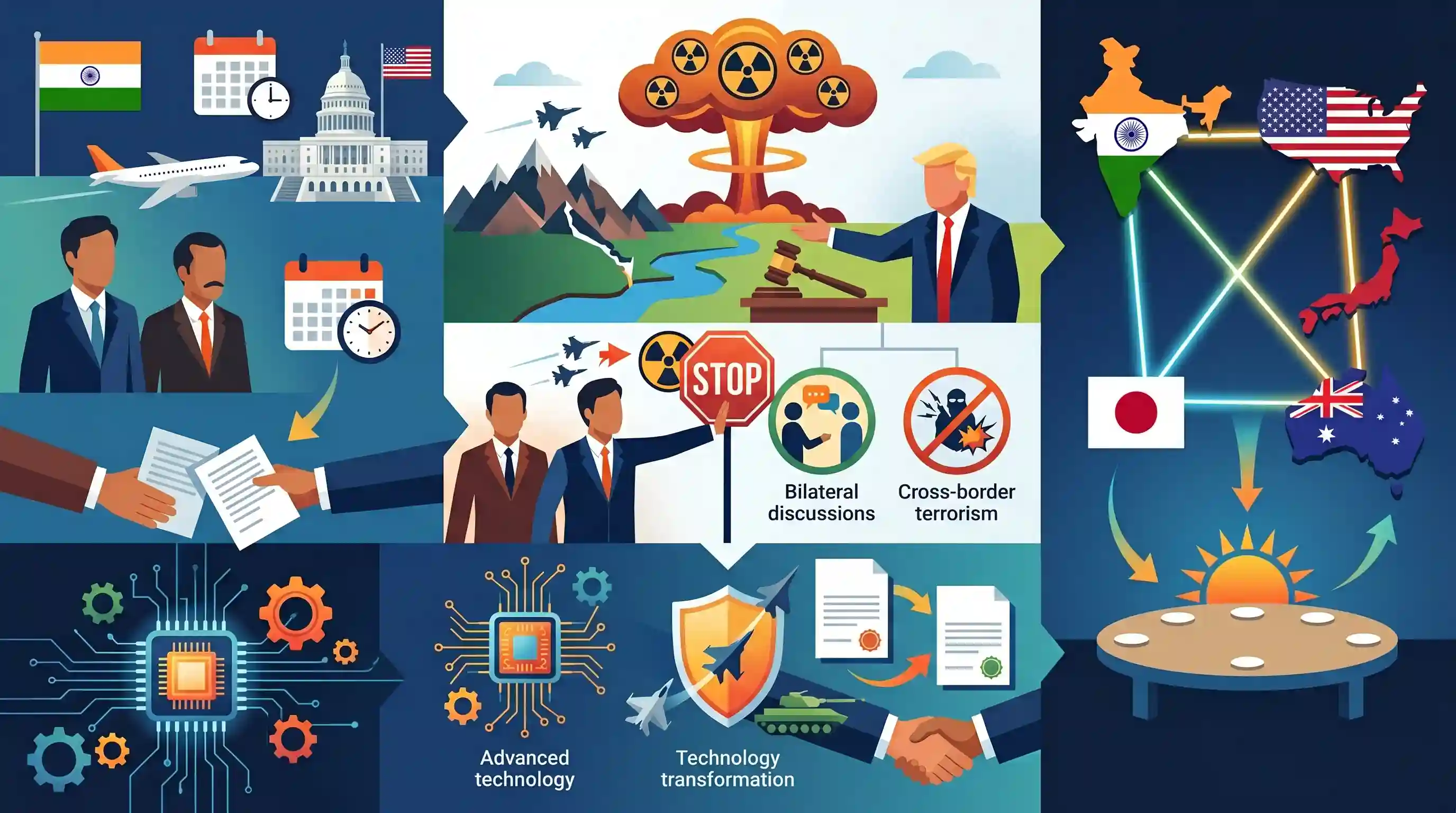
Indian Foreign Secretary Vikram Misri and Deputy NSA Pavan Kapoor are scheduled to visit the United States to establish early contact with the incoming Trump administration and address recent diplomatic tensions. The visit follows President Trump's unsolicited offer to mediate a ceasefire between India and Pakistan in the aftermath of the Indian Air Force's "Operation Sindoor," which sparked narratives of a potential nuclear conflict. The Indian delegation intends to firmly counter this narrative, reiterating its stance on addressing cross-border terrorism and managing relations with Pakistan bilaterally. Furthermore, the talks will focus on strengthening India-US strategic ties through new defence and technology frameworks like COMPACT and "TRUST" (a rebranding of the iCET initiative), and setting the stage for future Quad engagements.
Key Points
- Foreign Secretary Vikram Misri and Deputy NSA Pavan Kapoor are visiting the U.S. to engage with key officials in the new Trump administration amidst strained ties.
- The visit aims to counter President Trump's narrative of potential nuclear conflict following the Indian Air Force's 'Operation Sindoor' and push back against his offer to mediate between India and Pakistan.
- Indian officials will emphasize concerns regarding cross-border terrorism emanating from Pakistan and its implications at international forums like the FATF.
- The agenda includes advancing bilateral defence and tech frameworks, specifically 'COMPACT' and the newly recast 'TRUST' (formerly iCET), along with preparations for an upcoming Quad summit.
Important Terms
COMPACT (Catalysing Opportunities for Military Partnership, Accelerated Commerce & Technology)

A 2025 India-U.S. framework for deepening military partnership, technology sharing, and trade. It aims to institutionalize foundational defense agreements and achieve $500 billion in bilateral trade by 2030.
UPSC context
GS Paper II (International Relations). Tests understanding of India-U.S. strategic ties and defense technology co-production.
TRUST (Transforming the Relationship Utilising Strategic Technology)
The 2025 rebranding of the iCET initiative, expanding India-U.S. cooperation to semiconductors, AI, biotechnology, and critical minerals. It includes a specific Roadmap on Accelerating AI Infrastructure.
UPSC context
GS Paper II & III (IR and Science & Tech). Important for strategic technology partnerships and global supply chain resilience.
Operation Sindoor
A 2025 Indian Air Force-led counter-terrorism mission targeting nine terror camps in Pakistan and PoK. It involved high-intensity aerial combat and precision strikes following a major terror attack in Pahalgam.
UPSC context
GS Paper III (Internal Security). Examines India’s counter-terrorism doctrine, air power usage, and crisis management in South Asia.
iCET (Initiative on Critical and Emerging Technology)
A 2022 strategic mechanism to foster India-U.S. cooperation in high-end technologies like AI and space. It served as the foundation for the later, more expansive TRUST initiative.
UPSC context
GS Paper II (International Relations). Foundational to current technology-driven diplomacy with major global powers.
Quad
The Quadrilateral Security Dialogue comprising India, the U.S., Japan, and Australia. It is a strategic forum focused on ensuring a free, open, and inclusive Indo-Pacific.
UPSC context
GS Paper II (Global Groupings). Central to India’s Indo-Pacific strategy and maritime security cooperation.
Prelims Trap
"The TRUST initiative is a newly launched multilateral technology framework under the Quad."
TRUST (Transforming the Relationship Utilising Strategic Technology) is strictly a bilateral India-US initiative that rebrands/replaces iCET. It is not a multilateral Quad framework.
Static Concepts Connected
What is the core principle of the 1972 Simla Agreement?
- Strict Bilateralism: Mandates that India and Pakistan resolve their differences through peaceful, exclusive bilateral negotiations, legally precluding third-party mediation (including the UN or US).
- LoC Sanctity: Both sides committed to respect the Line of Control (LoC) resulting from the 1971 war ceasefire without prejudice to their respective positions.
How do the FATF Grey and Black lists function?
- Grey List: Officially 'Jurisdictions under Increased Monitoring', these countries have strategic deficiencies in their AML/CFT regimes but have committed to an action plan.
- Black List: Officially 'High-Risk Jurisdictions subject to a Call for Action', requiring member states to apply enhanced due diligence and counter-measures (sanctions).
- Economic Impact: Inclusion severely restricts a country's access to international financial institutions (IMF, World Bank, ADB) and deters foreign direct investment.
Cross-Topic Patterns
Tech diplomacy replacing traditional defence deals
Frameworks like TRUST and COMPACT show a shift in India-US relations from purely military hardware transactions to deep-tech integration, AI co-development, and joint strategic mineral processing.
FATF as a coercive diplomatic tool
India increasingly leverages FATF’s mandate to spotlight Pakistan's modern terror financing (crypto, digital wallets), shifting the strategic approach from military escalation to multilateral economic pressure.

Expect a 2026 prelims pair-matching question on new India-US bilateral frameworks (TRUST, COMPACT) vs multilateral Quad pacts.
Linked PYQs · 3
Linked PYQs · 3
- 2015MainsGS2
Terrorist activities and mutual distrust have clouded India-Pakistan relations. To what extent the use of soft power like sports and cultural exchanges could help generate goodwill between the two countries? Discuss with suitable examples.
- 2020MainsGS2
What is the significance of Indo-US defence deals over Indo-Russian defence deals? Discuss with reference to stability in the Indo-Pacific region.
- 2021MainsGS2
The newly tri-nation partnership AUKUS is aimed at countering China's ambitions in the Indo-Pacific region. Is it going to supersede the existing partnerships in the region? Discuss the strength and impact of AUKUS in the present scenario.
