Delhi High Court Ruling on Visa Expiry and Foreigner Residence
Source:Indian Express ↗
Why It Matters
Clarifies the constitutional limitations on the rights of foreign nationals in India, directly tying into UPSC syllabus topics concerning the fundamental rights framework (citizens vs. non-citizens) and the legal mechanisms governing deportation.
Summary
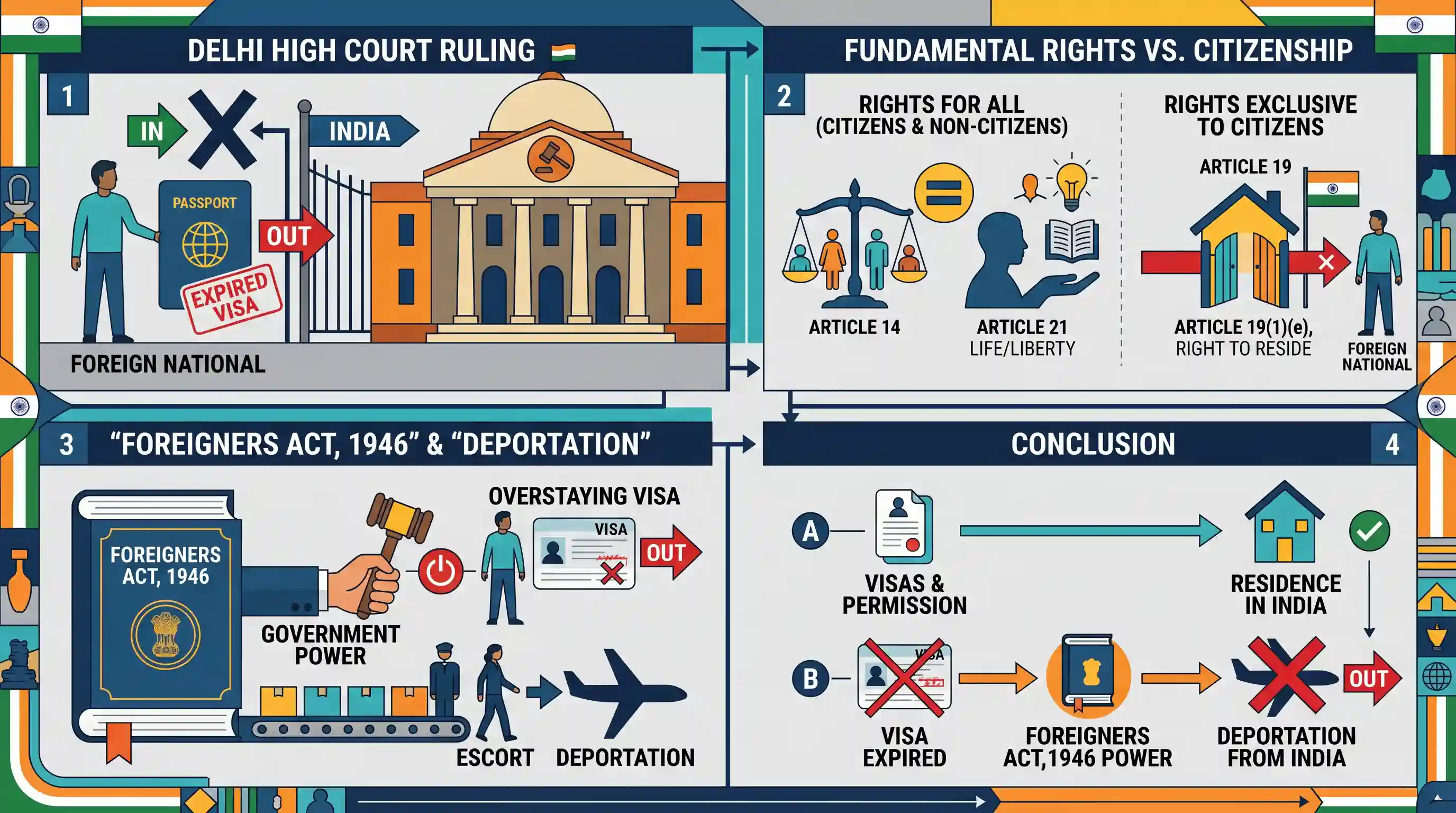
The Delhi High Court ruled that foreign nationals cannot claim a fundamental right to reside in India under Article 19(1)(e) of the Constitution after their visa expires. Dismissing a plea by a Nigerian student facing deportation, the court clarified that while foreigners enjoy rights to equality (Article 14) and life/liberty (Article 21), Article 19 is exclusively for Indian citizens. The judgment reaffirms the government's absolute power to deport individuals overstaying their visas under the Foreigners Act, 1946.
Key Points
- The Delhi High Court ruled that foreign nationals have no fundamental right to reside in India once their visa expires.
- While foreigners enjoy fundamental rights to equality (Article 14) and life and liberty (Article 21), Article 19 rights (including the right to reside and settle) are strictly limited to Indian citizens.
- The government exercises absolute power to deport foreign nationals overstaying their visas, as governed by the Foreigners Act, 1946.
- The court dismissed a Nigerian student's plea to halt his deportation by the FRRO, noting his lack of a valid visa.
Important Terms
Article 19(1)(e)

A constitutional provision granting Indian citizens the right to reside and settle in any part of India; it is not available to foreign nationals.
UPSC context
GS II (Polity); tests the critical distinction between fundamental rights exclusive to citizens versus those extended to all persons.
Foreigners Act, 1946
A law empowering the Central Government to regulate, restrict, or prohibit the entry, presence, and departure of foreigners, including absolute authority to deport overstayers.
UPSC context
GS II (Governance/Polity); tests understanding of the statutory framework for immigration, deportation, and the extent of executive discretion.
Article 21
A fundamental right ensuring protection of life and personal liberty for all persons (citizens and non-citizens) on Indian soil, subject to legal procedure.
UPSC context
GS II (Polity); foundational for understanding the universal scope of human rights within the Indian constitutional framework.
Article 14
Constitutional guarantee of equality before the law and equal protection of laws within India, applicable to both citizens and foreign nationals.
UPSC context
GS II (Polity); key concept for testing the non-discriminatory application of law to any person within Indian territory.
Foreigners Regional Registration Office (FRRO)
The agency under the Bureau of Immigration (Ministry of Home Affairs) responsible for registering, monitoring, and managing the stay of foreign nationals in India.
UPSC context
GS II (Governance); tests knowledge of administrative mechanisms for visa enforcement and internal security oversight of non-citizens.
Prelims Trap
Foreigners facing deportation can claim the right to stay in India under Article 21 if their life is at risk in their home country.
The right to reside is strictly covered by Article 19(1)(e) (citizens only). Courts have repeatedly held that foreigners cannot use Article 21 to back-door a right to reside in India.
Static Concepts Connected
Which Fundamental Rights are exclusive to Indian citizens?
- Citizens only: Articles 15 (discrimination), 16 (public employment), 19 (six freedoms), 29 (cultural rights), and 30 (educational rights of minorities).
- Available to all: Articles 14 (equality), 20 (conviction protection), 21 (life/liberty), 21A (education), 22 (preventive detention), 23-24 (exploitation), and 25-28 (religion).
What is the legal framework governing the deportation of foreigners in India?
- Foreigners Act, 1946: Empowers the Central Government with absolute and unfettered power to expel or deport foreign nationals from India (upheld in the 1955 Hans Muller case).
- Implementing Agency: The Foreigners Regional Registration Offices (FRRO), functioning under the Bureau of Immigration (Ministry of Home Affairs), manage visa tracking and enforce deportation.
Cross-Topic Patterns
Deportation vs. Non-refoulement principle
India is not a signatory to the 1951 Refugee Convention. Consequently, absolute deportation powers under the Foreigners Act frequently clash with customary international law's principle of non-refoulement, a recurring GS2 theme.
CAA 2019 and Foreigners Act exemptions
The CAA creates a citizenship pathway by explicitly exempting specified undocumented migrants from the penal and deportation provisions of the Foreigners Act, 1946, fundamentally linking the two statutes.

Expect a Prelims question contrasting Article 21 protections with absolute deportation powers under the Foreigners Act, 1946.
Linked PYQs · 3
Linked PYQs · 3
- 2022MainsGS2
“Right of movement and residence throughout the territory of India are freely available to the Indian citizens, but these rights are not absolute.” Comment.
- 2021PrelimsGS1
What is the position of the Right to Property in India?
- 2021PrelimsGS1
With reference to India, consider the following statements : 1. There is only one citizenship and one domicile. 2. A citizen by birth only can become the Head of State. 3. A foreigner once granted the citizenship cannot be deprived of it under any circumstances. Which of the statements given above is/are correct?
