Taiwan Strait Maritime Patrol and Parliamentary Diplomacy
Source:The Hindu ↗
Why It Matters
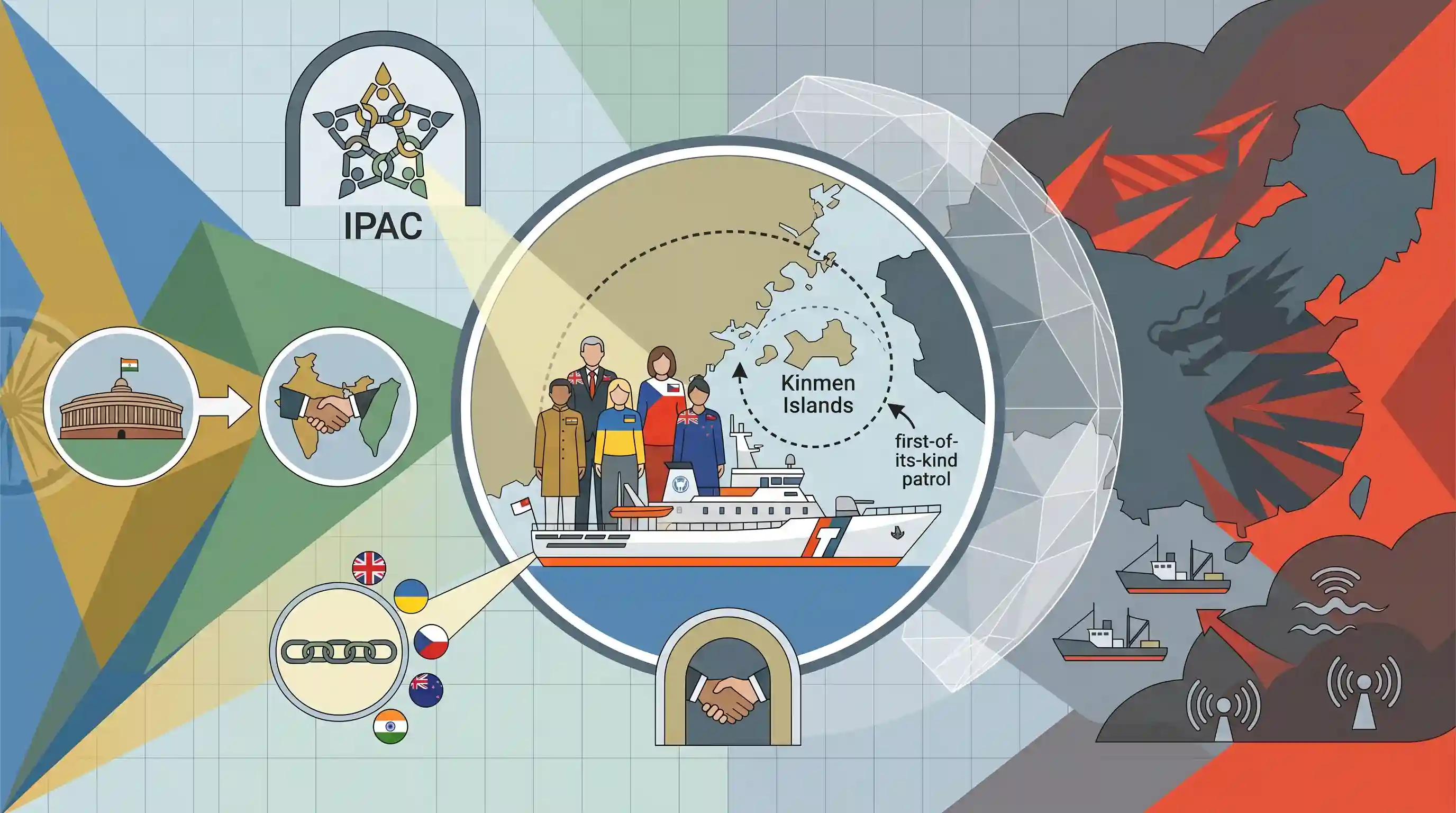
The participation of an Indian lawmaker highlights India's evolving parliamentary diplomacy and increasing strategic alignment with democracies on Indo-Pacific maritime security, despite officially adhering to the 'One China' policy. It also sheds light on the geopolitical significance of the Taiwan Strait and Kinmen, and how international coalitions like IPAC are countering Chinese maritime pressure.
Summary
An Indian lawmaker, along with legislators from Britain, Ukraine, Czech Republic, and New Zealand, participated in a historic, first-of-its-kind patrol with the Taiwan Coast Guard around the sensitive, Taipei-controlled Kinmen islands in the Taiwan Strait. Organized by the Inter-Parliamentary Alliance on China (IPAC), this patrol signals rising international parliamentary solidarity and opposition to Beijing's assertive gray-zone maritime tactics near Taiwan.
Key Points
- First-of-its-kind routine coast guard patrol in the Taiwan Strait featuring foreign legislators.
- The patrol took place around the Kinmen islands, a Taipei-controlled group located just a few kilometers off the coast of mainland China, making it a critical frontline flashpoint.
- Organized by the Inter-Parliamentary Alliance on China (IPAC), a transnational coalition of democratic lawmakers.
- The international delegation comprised seven foreign lawmakers representing Britain, India, Ukraine, the Czech Republic, and New Zealand, along with two Taiwanese legislators.
- The coalition emphasized that global partners have 'skin in the game' when it comes to maintaining cross-strait stability, warning that China's gray-zone maritime actions threaten collective interests.
Important Terms
One China Policy

A diplomatic position acknowledging only one sovereign state under the "China" name (represented by the PRC), restricting official recognition of Taiwan while allowing unofficial cultural and economic relations.
UPSC context
GS Paper II (International Relations); tests comprehension of India-China-Taiwan trilateral dynamics and strategic diplomatic frameworks.
Inter-Parliamentary Alliance on China (IPAC)
An international, cross-party network of democratic legislators aimed at coordinating global responses to challenges posed by China regarding security, human rights, and the rules-based order.
UPSC context
GS Paper II (Bilateral, Regional, and Global Groupings); tests awareness of multi-nation parliamentary alliances addressing regional and global security threats.
Gray-Zone Warfare
A conflict strategy utilizing coercive, unconventional actions—like cyberattacks, economic pressure, and maritime harassment—that remain below the threshold of conventional military war while achieving strategic goals.
UPSC context
GS Paper III (Security Challenges & their Management); tests analytical knowledge of non-traditional, ambiguous threats impacting sovereign maritime borders.
Kinmen Islands
A small, heavily fortified archipelago administered by Taiwan but located just off the coast of mainland China, serving as a critical geopolitical flashpoint in the Taiwan Strait.
UPSC context
GS Paper I (World Geography/Maps) & GS Paper II (IR); tests familiarity with vital Indo-Pacific hotspots and cross-strait maritime boundaries.
Prelims Trap
IPAC is an inter-governmental body, meaning Indian MP participation signals an official shift in New Delhi's executive foreign policy towards Taiwan.
IPAC is an informal, cross-party alliance of individual legislators, not an inter-governmental organization. Its activities do not legally bind or represent the official state policy of the Indian government.
Static Concepts Connected
What is Gray-Zone Warfare and how is it characterized?
- Threshold of conflict: Coercive actions that operate in the ambiguous space between peace and war, remaining below the threshold of conventional military conflict.
- Key instruments: Uses non-military elements like maritime militias, cyber attacks, economic coercion, and information warfare to alter status quo.
- Strategic objective: Achieves gradual, incremental strategic gains ('salami-slicing') without triggering a conventional military response from adversaries.
How do India and Taiwan maintain bilateral relations without formal diplomatic recognition?
- De facto embassies: Facilitated by the India-Taipei Association (ITA) in Taipei and the Taipei Economic and Cultural Centre (TECC) in New Delhi.
- Functional focus: Established in 1995, these offices focus on promoting trade, investment, technology transfer, education, and cultural exchanges.
- One-China policy: India maintains unofficial ties; however, since 2010, New Delhi has stopped explicitly mentioning the 'One-China' policy in official bilateral documents.
Cross-Topic Patterns
Legislative diplomacy and foreign policy
Shows how individual legislative channels allow democratic states to signal security alignments and oppose coercion without violating executive-level diplomatic red lines.
LAC and Taiwan Strait tactical parallels
Connects China's 'salami-slicing' boundary changes in Ladakh to its maritime gray-zone actions around Taiwan, illustrating a unified strategy across land and sea.

Kinmen Island geography + gray-zone warfare doctrine likely to feature as a multi-statement conceptual map question in Prelims 2026.
Linked PYQs · 2
Linked PYQs · 2
- 2014MainsGS2
With respect to the South China sea, maritime territorial disputes and rising tension affirm the need for safeguarding maritime security to ensure freedom of navigation and over flight throughout the region. In this context, discuss the bilateral issues between India and China.
- 2022PrelimsGS1
Which one of the following statements best reflects the issue with Senkaku Islands, sometimes mentioned in the news?
