Political Alliances and Regional Dynamics in Tamil Nadu Elections
Source:The Hindu ↗
Why It Matters
The article serves as a strong case study of how regional political imperatives interact with national electoral alliances. It highlights persistent friction points in Centre-State relations—such as delimitation, education policies (NEET), and language—which are critical for GS Paper 2 questions on federalism, devolution of powers, and the impact of regional parties on national politics.
Summary
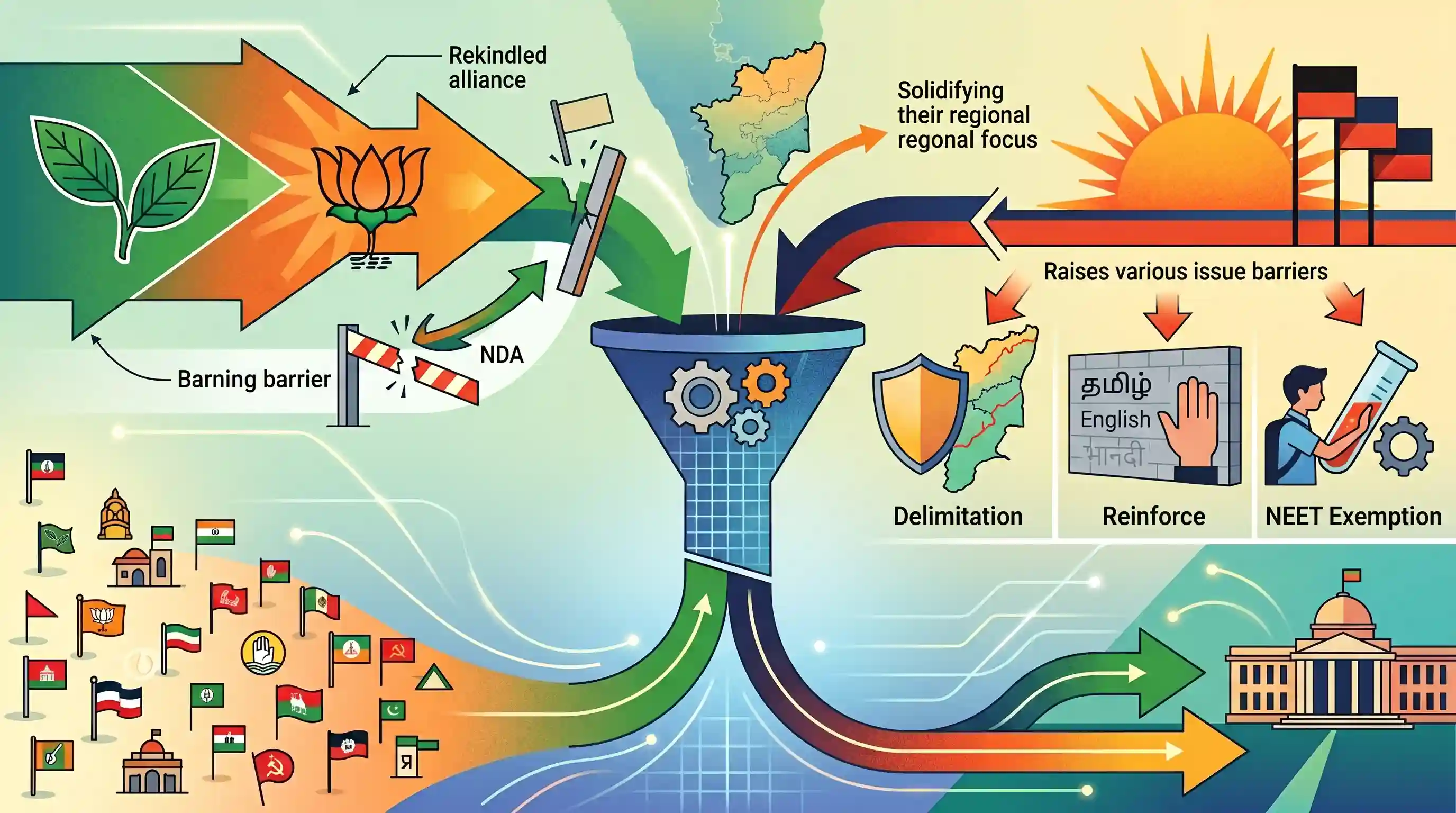
The AIADMK and the BJP have rekindled their alliance ahead of the 2026 Tamil Nadu Assembly elections, aiming to unseat the incumbent DMK. This decision marks a definitive return of the AIADMK to the NDA fold, superseding recent friction points like the Waqf (Amendment) Bill. In response, the DMK has accelerated its regionalist and federal agenda, spotlighting issues like delimitation, the three-language policy, and NEET exemptions to maintain its political narrative. As Tamil Nadu heads toward the polls, the first-past-the-post system is likely to force smaller regional outfits to consolidate under these two major alliances.
Key Points
- The AIADMK and BJP have formally announced a pre-poll alliance to challenge the ruling DMK in the 2026 Tamil Nadu Assembly elections.
- Despite AIADMK MPs voting against the Waqf (Amendment) Bill in the Rajya Sabha recently, the party has decisively aligned with the BJP-led NDA.
- The DMK is championing federalism and state rights issues, raising concerns regarding the three-language policy, NEET exemption, and the delimitation exercise through a Joint Action Committee.
- The upcoming election will feature multiple players, including the Naam Tamilar Katchi and actor Vijay's Tamilaga Vettri Kazhagam, but the first-past-the-post system typically pushes fragmented players to align with dominant fronts.
Important Terms
Waqf (Amendment) Bill

Proposed legislation to reform Waqf property management by increasing government oversight, auditing, and mandating non-Muslim representation on boards; currently under review by a Joint Parliamentary Committee.
UPSC context
GS II: Governance/Minority Rights. Tests understanding of secularism, religious endowment management, and legislative friction between Centre and states.
Joint Action Committee for Fair Delimitation
A platform led by Southern states to ensure the upcoming delimitation exercise (based on post-2026 census) does not penalize states that successfully implemented population control measures.
UPSC context
GS II: Federalism/Constitutional Bodies. Tests knowledge of Article 81/82 and population-based representation challenges in the Indian Union.
First-Past-The-Post (FPTP)
An electoral system where the candidate with the most votes wins a constituency, regardless of a majority. It typically encourages political consolidation and alliance-building.
UPSC context
GS II: Electoral Reforms. Tests understanding of voting mechanics and their impact on the party system and coalitional politics.
Regionalism
A political ideology emphasizing the interests of a specific region, often focused on linguistic or cultural identity; it significantly influences federal relations in India.
UPSC context
GS I: Social Issues/GS II: Federalism. Tests the impact of sub-nationalism on national integration and cooperative federalism.
National Democratic Alliance (NDA)
A BJP-led center-right political coalition formed in 1998, representing the era of coalition politics and the strategic alignment between national and regional parties.
UPSC context
GS II: Parliament and State Legislatures. Tests understanding of coalitional governance and the balance of power between national and regional interests.
DMK and AIADMK
Regional political parties in Tamil Nadu rooted in the Dravidian movement, championing social justice and state autonomy against centralizing national narratives.
UPSC context
GS II: Role of Regional Parties. Tests the role of state parties in shaping federalism and national-level policy decisions.
Prelims Trap
The freeze on the allocation of Lok Sabha seats across states automatically expires in the year 2026.
The freeze under the 84th Amendment lasts until the publication of the relevant figures of the first census taken AFTER the year 2026.
Static Concepts Connected
What constitutional provisions govern the delimitation of constituencies?
- Article 82: Empowers Parliament to enact a Delimitation Act to readjust territorial constituencies after each census.
- The 2026 Freeze: The 84th Amendment (2001) froze inter-state Lok Sabha seat allocation until the first census published after 2026.
- Judicial immunity: Orders of the Delimitation Commission have the full force of law and cannot be challenged in any court.
How does the First-Past-The-Post (FPTP) system structurally influence political alliances?
- Vote consolidation: FPTP heavily penalizes divided opposition, incentivizing parties to form pre-poll alliances to prevent vote-splitting and ensure pluralities.
- Disproportionate outcomes: Since seat shares often deviate wildly from vote shares, fragmented smaller parties are forced to merge into dominant bipolar fronts to secure representation.
Cross-Topic Patterns
Delimitation & Fiscal Federalism
The demographic penalty Southern states fear in delimitation mirrors concerns over the 15th and 16th Finance Commissions using the 2011 census for horizontal tax devolution.
NEP 2020 vs Linguistic Autonomy
State resistance to the three-language formula links directly to historical autonomy agitations and ongoing debates surrounding Eighth Schedule protections and cultural federalism.

Mains GS2 is highly likely to feature a question on how demographic divergence between North and South India strains federalism.
Linked PYQs · 4
Linked PYQs · 4
- 2022MainsGS2
“While the national political parties in India favour centralisation, the regional parties are in favour of State autonomy.” Comment.
- 2019MainsGS2
From the resolution of contentious issues regarding distribution of legislative powers by the courts, 'Principle of Federal Supremacy' and 'Harmonious Construction' have emerged. Explain.
- 2020MainsGS2
There is a need for simplification of procedure for disqualification of persons found guilty of corrupt practices under the Representation of Peoples Act". Comment.
- 2015MainsGS2
The concept of cooperative federalism has been increasingly emphasized in recent years. Highlight the drawbacks in the existing structure and the extent to which cooperative federalism would answer the shortcomings.
