Delhi Women Scheme Income Cap and Family Definition
Source:Indian Express ↗
Why It Matters
The article illustrates the practical governance challenges of translating universal political promises into targeted welfare implementation, highlighting the crucial tasks of identifying legitimate beneficiaries, preventing inclusion errors, and managing state fiscal burdens.
Summary
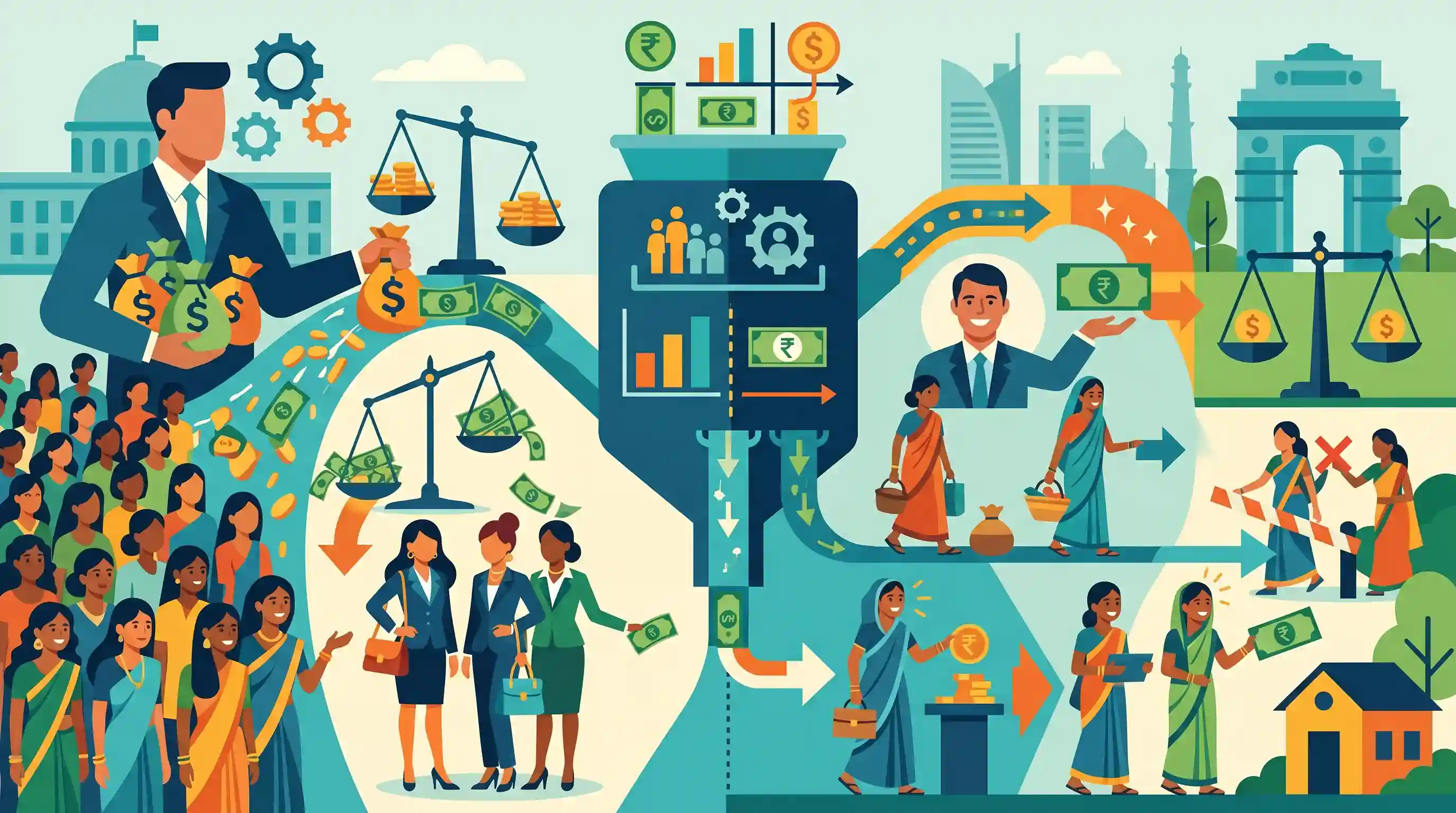
The Delhi government is refining the eligibility criteria for its proposed Mukhyamantri Mahila Samman Yojana, which aims to provide ₹1,000 per month to women over the age of 18. To target the scheme effectively and manage the state's fiscal burden, the government plans to clearly define a "family" unit and impose an annual household income cap of ₹2.5 lakh. This shift toward a targeted approach is designed to reduce inclusion errors by excluding financially well-off individuals, ensuring that direct income support reaches the most economically vulnerable women.
Key Points
- The Delhi government is finalizing the eligibility criteria for the Mukhyamantri Mahila Samman Yojana, which promises ₹1,000 per month to women aged 18 and above.
- To effectively target the scheme and manage fiscal outlays, the government is considering an annual family income cap of ₹2.5 lakh.
- Defining the "family" unit is a key step to assess combined household income and exclude financially well-off beneficiaries.
- The policy shift emphasizes a transition from universal welfare promises to targeted beneficiary identification, reducing inclusion errors.
Important Terms
Mukhyamantri Mahila Samman Yojana

A Delhi government scheme providing ₹1,000 monthly financial assistance to women aged 18+, aiming to improve quality of life for economically vulnerable residents.
UPSC context
GS Paper II: Welfare schemes for vulnerable sections; tests understanding of state-level social security interventions.
Targeted Welfare Scheme
Social security programs that restrict benefits to specific individuals or households meeting certain criteria (like an income cap) rather than providing them to all citizens.
UPSC context
GS Paper II: Governance; tests the debate between universal vs. targeted social protection in India.
Inclusion and Exclusion Errors
Inclusion errors occur when ineligible individuals receive welfare benefits; exclusion errors occur when deserving, eligible beneficiaries are left out of a scheme.
UPSC context
GS Paper II: Issues related to poverty and hunger; tests understanding of efficiency in social safety nets.
Fiscal Prudence
The responsible management of public finances to ensure sustainable spending, controlled deficits, and efficient resource allocation without excessive borrowing.
UPSC context
GS Paper III: Indian Economy and Budgeting; tests concepts of fiscal consolidation and state financial health.
Direct Benefit Transfer (DBT)
A mechanism to transfer subsidies or welfare payments directly into the bank accounts of beneficiaries, minimizing leakages and intermediaries using the JAM trinity.
UPSC context
GS Paper II: Government policies and interventions; tests knowledge of technology-led governance reforms.
Prelims Trap
The scheme operates as a Universal Basic Income (UBI), providing unconditional ₹1,000 monthly cash transfers to all adult women in Delhi.
It is a targeted Direct Benefit Transfer, not a UBI. The ₹2.5 lakh income cap and specific family definition are deliberately designed to exclude financially stable households to manage state fiscal burden.
Static Concepts Connected
What is the difference between Universal Basic Income (UBI) and Targeted Welfare?
- Universality: UBI offers unconditional transfers to all citizens, while targeted welfare restricts benefits to specific vulnerable demographic or economic groups.
- Inclusion/Exclusion Errors: Targeting reduces fiscal outlay but risks 'exclusion errors' (leaving out the poor). UBI eliminates exclusion errors but faces massive fiscal constraints.
How do state-level cash transfers impact State Finances and FRBM limits?
- Revenue vs. Capital Expenditure: Direct cash transfers increase committed revenue expenditure, often crowding out capital expenditure needed for asset creation.
- FRBM Adherence: States must fund these schemes while adhering to their fiscal deficit limits (typically 3% of GSDP) mandated by the FRBM Act.
Cross-Topic Patterns
Electoral dynamics and women's DBT schemes
The explosion of state-level female cash transfers correlates with rising female voter turnout, establishing women as a primary, independent political constituency shaping state-level welfare economics.
Targeting criteria vs. Exclusion Errors
While defining families prevents inclusion errors, strict income or document criteria often trigger exclusion errors, disproportionately impacting undocumented domestic workers and intra-state migrants.

State-level women’s DBT schemes, inclusion errors, and state fiscal capacity (FRBM limits) will likely merge in a 2026 Mains question.
Linked PYQs · 4
Linked PYQs · 4
- 2023MainsGS2
“Development and welfare schemes for the vulnerable, by its nature, are discriminatory in approach.” Do you agree? Give reasons for your answer.
- 2019MainsGS2
Performance of welfare schemes that are implemented for vulnerable sections is not so effective due to absence of their awareness and active involvement at all stages of policy process. Discuss.
- 2025MainsGS3
Explain how the Fiscal Health Index (FHI) can be used as a tool for assessing the fiscal performance of states in India. In what way would it encourage the states to adopt prudent and sustainable fiscal policies?
- 2021MainsGS2
Can the vicious cycle of gender inequality, poverty and malnutrition be broken through microfinancing of women SHGs? Explain with examples.
