Substantive Political Representation and Women Empowerment
Source:Indian Express ↗
Why It Matters
Women's political representation is a perennial and highly important topic for UPSC, bridging GS1 (Indian Society), GS2 (Polity and Social Justice), and Essay. With the passage of the Nari Shakti Vandan Adhiniyam, the debate transitioning from 'descriptive' (quotas) to 'substantive' (actual decision-making power) representation is crucial for Mains answers.
Summary
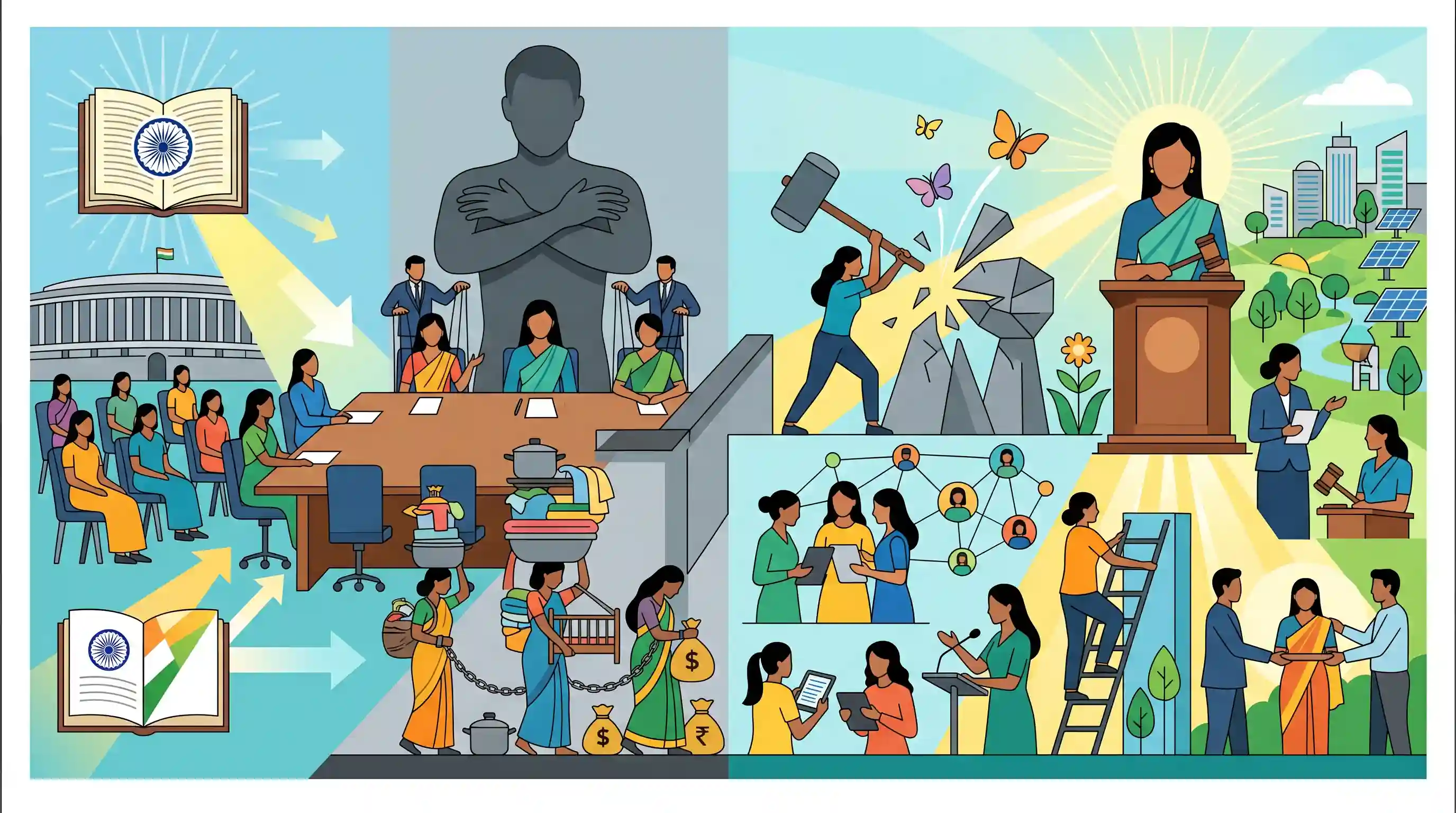
The article asserts that while legislative quotas such as the Women's Reservation Act and the 73rd/74th Constitutional Amendments provide women with a vital "seat at the table," they do not automatically translate to substantive leadership. Deep-seated patriarchal norms and systemic structural barriers—such as the unequal distribution of unpaid care work and lack of financial autonomy—frequently undermine these descriptive representation efforts. The persistence of proxy representation, where male relatives wield actual power, demonstrates that mere numerical quotas are inadequate. For women to become effective leaders and decision-makers, society must go beyond quotas to build an enabling ecosystem. This requires dismantling patriarchal mindsets, enhancing women's social capital, and implementing comprehensive capacity-building measures to ensure true gender equity in governance.
Key Points
- Descriptive representation (numerical quotas) through legislative measures like the Women's Reservation Act provides a necessary 'seat at the table' but is insufficient for genuine women's empowerment.
- Substantive representation requires women to have an active, influential voice in decision-making, which is often hindered by deep-rooted patriarchal norms and stereotypes.
- Structural barriers such as the disproportionate burden of unpaid care work, lack of financial independence, and limited social capital restrict women's ability to exercise true leadership.
- The phenomenon of proxy representation (e.g., the 'Sarpanch Pati' syndrome in local bodies) highlights how patriarchal power structures can subvert the intended impact of reservation policies.
- Creating an enabling ecosystem through capacity building, gender sensitization, and dismantling systemic inequalities is crucial to transforming women from mere participants into effective leaders.
Important Terms
Nari Shakti Vandan Adhiniyam

The Constitution (106th Amendment) Act, 2023, reserving 33% of seats for women in Lok Sabha, State Legislative Assemblies, and the Delhi Assembly.
UPSC context
GS Paper 2 (Polity); tests understanding of legislative reforms for gender parity and constitutional amendments.
73rd and 74th Constitutional Amendment Acts
1992 Acts mandating 33% reservation for women in rural (Panchayats) and urban (Municipalities) local bodies, respectively, institutionalizing democratic decentralization.
UPSC context
GS Paper 2 (Polity); foundational for questions on local self-government and women's empowerment.
Panchayati Raj Institutions (PRIs)
A three-tier system of local self-government in rural India (Village, Intermediate, and District) established to ensure grassroots political participation and development.
UPSC context
GS Paper 2 (Polity); tests knowledge of grassroots governance and its socio-economic impact.
Substantive Representation
A concept where elected officials actively advocate for and promote the specific policy interests and priorities of the group they represent.
UPSC context
GS Paper 1/2 (Social Issues/Governance); tests the distinction between numerical presence and actual decision-making impact.
Proxy Representation
A phenomenon where male relatives exercise actual administrative power behind an elected woman representative, often referred to as 'Sarpanch-Pati' in rural India.
UPSC context
GS Paper 2 (Governance); critical for analyzing barriers to genuine women’s leadership and grassroots power dynamics.
Descriptive Representation
The extent to which a legislature demographically mirrors the diversity of the population (e.g., gender, race) it represents.
UPSC context
GS Paper 2 (Social Justice); tests the conceptual basis and limitations of reservation policies.
Prelims Trap
"The 106th CAA reserves 33% seats for women in all houses of Parliament and State Legislatures."
The 106th CAA specifically excludes the Rajya Sabha and State Legislative Councils. It also does not apply immediately, pending a delimitation exercise post-census.
Static Concepts Connected
What are the key constitutional provisions of the 106th Amendment Act?
- New Articles: Inserts Article 330A and 332A to reserve one-third of seats for women in the Lok Sabha and State Legislative Assemblies.
- Delhi Assembly: Amends Article 239AA to extend the one-third reservation to the Legislative Assembly of the National Capital Territory of Delhi.
- Delimitation Dependency: The reservation will take effect only after delimitation is undertaken based on the first census published post-enactment.
- Sunset Clause: The reservation is initially valid for 15 years, though Parliament can extend it via law.
How does the 73rd Amendment mandate women's representation in PRIs?
- Minimum Quota: Article 243D mandates that at least one-third of total seats to be filled by direct election in every Panchayat shall be reserved for women.
- Chairperson Roles: Not less than one-third of the total number of offices of Chairpersons in Panchayats at each level must be reserved for women.
- State Enhancements: Over 20 states (including Bihar, MP, and Kerala) have enacted legislation to increase this reservation to 50%.
Cross-Topic Patterns
Care Economy + Demographic Dividend
Unpaid care work inherently limits women's FLFP and political agency, bridging GS1 Society (patriarchy), GS2 Governance (representation), and GS3 Economy (labor force).
Local Governance + Electoral Reforms
The 'Sarpanch Pati' syndrome in PRIs provides a direct empirical baseline for evaluating the likely implementation challenges of the 106th CAA at the national and state levels.

Expect a GS2 Mains question analyzing the 'Sarpanch Pati' syndrome as a preview of challenges for the Women's Reservation Act implementation.
Linked PYQs · 4
Linked PYQs · 4
- 2019MainsGS2
“The reservation of seats for women in the institutions of local self-government has had a limited impact on the patriarchal character of the Indian Political Process.” Comment.
- 2024MainsGS1
Distinguish between gender equality, gender equity and women's empowerment. Why is it important to take gender concerns into account in programme design and implementation?
- 2023MainsGS2
Discuss the contribution of civil society groups for women's effective and meaningful participation and representation in state legislatures in India.
- 2025MainsGS2
Women's social capital complements in advancing empowerment and gender equity. Explain.
