Taliban Envoy Arrival and India Diplomatic Shift
Source:The Hindu ↗
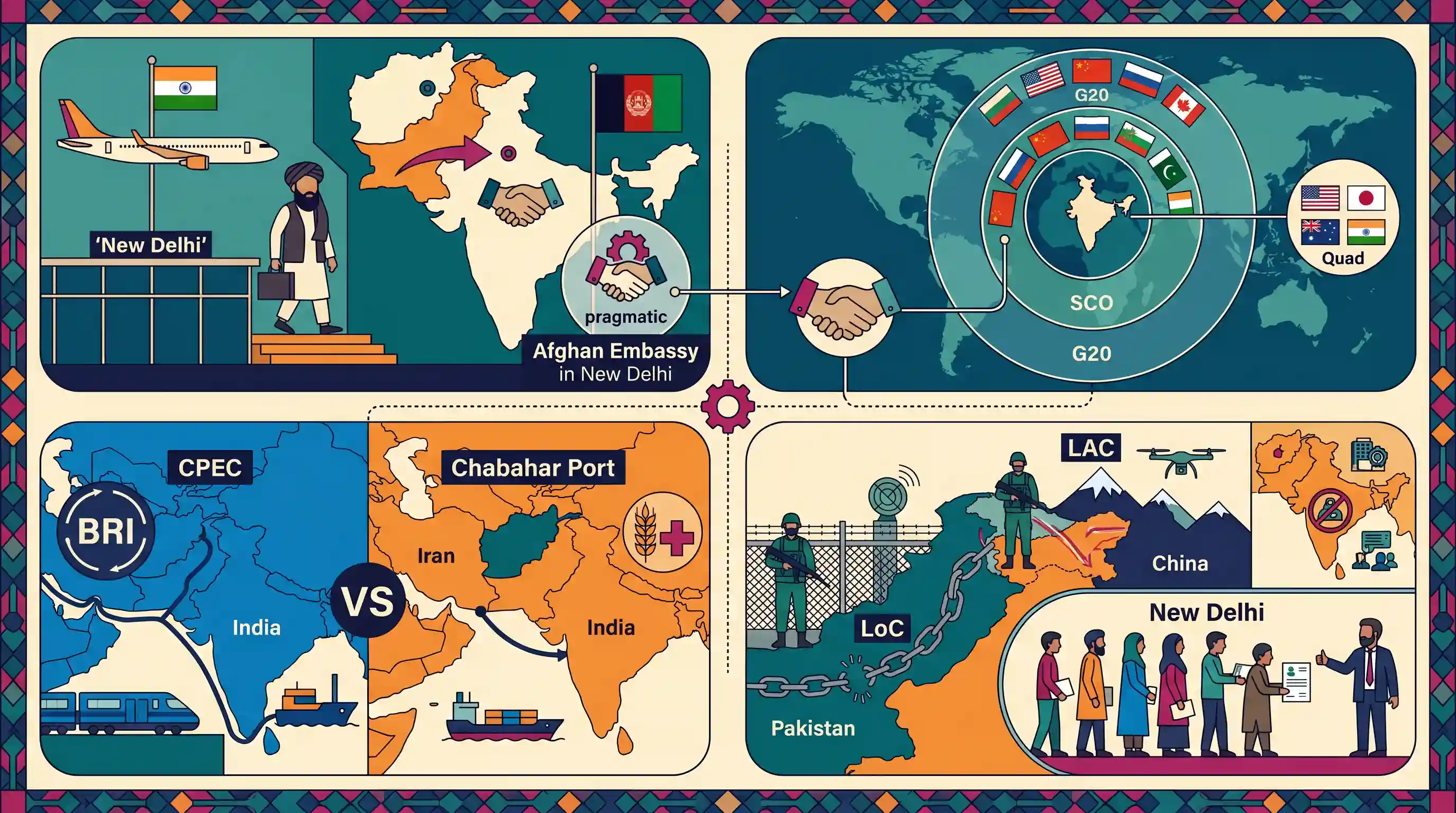
Why It Matters
This highlights a significant evolution in India's 'Neighbourhood First' policy, demonstrating how realpolitik dictates engagement with non-state or unrecognized actors (like the Taliban) to secure geopolitical, economic, and regional security interests. Understanding these dynamic diplomatic maneuvers is crucial for analyzing India's strategy in South Asia and Central Asia.
Summary
In a major diplomatic development, the first Taliban-appointed diplomat has arrived in New Delhi to take charge of the Afghan Embassy as the Charge d'Affaires. This marks a pragmatic shift in India's foreign policy, actively engaging with the Taliban administration for strategic and regional interests without granting formal diplomatic recognition to the regime. The appointment follows the departure of diplomats representing the ousted Ashraf Ghani government and reflects a mutual necessity for functional bilateral channels, especially after India upgraded its diplomatic presence in Kabul to 'Embassy status' in October 2025.
Key Points
- For the first time, a Taliban-appointed diplomat, Mufti Noor Ahmad Noor, has arrived in New Delhi to act as the Charge d'Affaires at the Afghan Embassy.
- This development signifies a shift in India's diplomatic posture towards pragmatism, balancing strategic engagement with the Taliban without formally recognizing its regime.
- The embassy was previously managed by diplomats from the Ashraf Ghani era, but internal strife led to its eventual takeover by Taliban-aligned officials.
- This move follows India's decision in October 2025 to officially upgrade its mission in Kabul back to 'Embassy status', highlighting a mutual desire for functional diplomatic channels.
Important Terms
Charge d'Affaires

A diplomatic official who heads an embassy in the absence of an ambassador. Under the Vienna Convention, it is the lowest rank, often used when countries lack full or formal ties.
UPSC context
GS Paper II (International Relations). Tests knowledge of diplomatic protocols and India's nuanced engagement with non-recognized regimes like the Taliban.
Islamic Emirate of Afghanistan (IEA)
The official name used by the Taliban for their government. Most nations, including India, avoid this term officially to deny the regime formal legal legitimacy (de jure recognition).
UPSC context
GS Paper II (Bilateral Relations). Important for understanding the distinction between statehood and government legitimacy in regional security contexts.
Formal Diplomatic Recognition
The formal act of acknowledging a government's legal legitimacy. While India engages with the Taliban for humanitarian and strategic reasons, it officially withholds this to avoid endorsing the 2021 takeover.
UPSC context
GS Paper II (IR Concepts). Relevant for analyzing India's 'pragmatic' foreign policy and the 'Neighborhood First' strategy.
Technical Mission
A limited-status diplomatic office focused on coordinating humanitarian aid and specific projects. India operated one in Kabul from 2022 until its upgrade to full 'Embassy' status in 2025.
UPSC context
GS Paper II (India and Neighborhood). Tests understanding of transitional diplomatic tools used to maintain strategic presence in conflict zones.
Taliban
A fundamentalist Deobandi Islamic movement that returned to power in Afghanistan in August 2021. India maintains a 'pragmatic' relationship with them to secure its interests against regional terror groups.
UPSC context
GS Paper II & III (Internal Security). Crucial for topics like regional stability, cross-border terrorism, and India's strategic interests.
Ministry of External Affairs (MEA)
The Indian government department responsible for formulating and executing foreign policy. It manages all international relations, diplomatic missions, and the nation's representation at the United Nations and other forums.
UPSC context
GS Paper II (Governance). Fundamental for understanding the institutional framework of India’s foreign policy execution and decision-making.
Prelims Trap
India has formally granted de jure recognition to the Taliban regime by accepting its diplomat.
Accepting a Charge d'Affaires facilitates functional bilateral channels (de facto engagement). It does not constitute formal legal (de jure) recognition of the Taliban.
Static Concepts Connected
What is the difference between De facto and De jure recognition in international law?
- De facto: Provisional recognition of factual control over a territory, allowing functional ties without formal diplomatic exchange.
- De jure: Formal, legal, and permanent recognition of a government, typically leading to full, official diplomatic relations.
What is a Charge d'Affaires under the Vienna Convention on Diplomatic Relations?
- Definition: A diplomatic officer designated to temporarily or permanently head a diplomatic mission in the absence of an ambassador.
- Accreditation: Accredited to the host country's Minister of Foreign Affairs, unlike an Ambassador who is accredited to the Head of State.
Cross-Topic Patterns
Afghanistan as Central Asian gateway
Pragmatic ties secure India's strategic access to Central Asian Republics (CARs) via the Chabahar port, bypassing Pakistan's geographical blockade.
Diplomatic presence & counter-terrorism
Maintaining a diplomatic outpost in Kabul is vital for monitoring the Af-Pak region's security dynamics and transnational terrorist groups like ISKP.

Expect a multi-statement Prelims question contrasting 'de facto' vs 'de jure' recognition linked to India's shifting Afghan policy.
Linked PYQs · 2
Linked PYQs · 2
- 2022PrelimsGS1
Consider the following countries: 1. Azerbaijan 2. Kyrgyzstan 3. Tajikistan 4. Turkmenistan 5. Uzbekistan Which of the above have borders with Afghanistan ?
- 2021MainsGS3
Analyse the multidimensional challenges posed by external state and non-state actors, to the internal security of India. Also discuss measures required to be taken to combat these threats.
