Evolution of Indian Party System and Electoral Decline of Left
Source:Indian Express ↗
Why It Matters
The article offers critical insights into the evolution and current transition of the Indian party system, which is a key component of the GS2 syllabus. It connects political ideology and party organization with contemporary socio-economic issues like the gig economy and informalization of labor (GS3), making it highly relevant for holistic Mains answers on Indian democracy and labor rights.
Summary
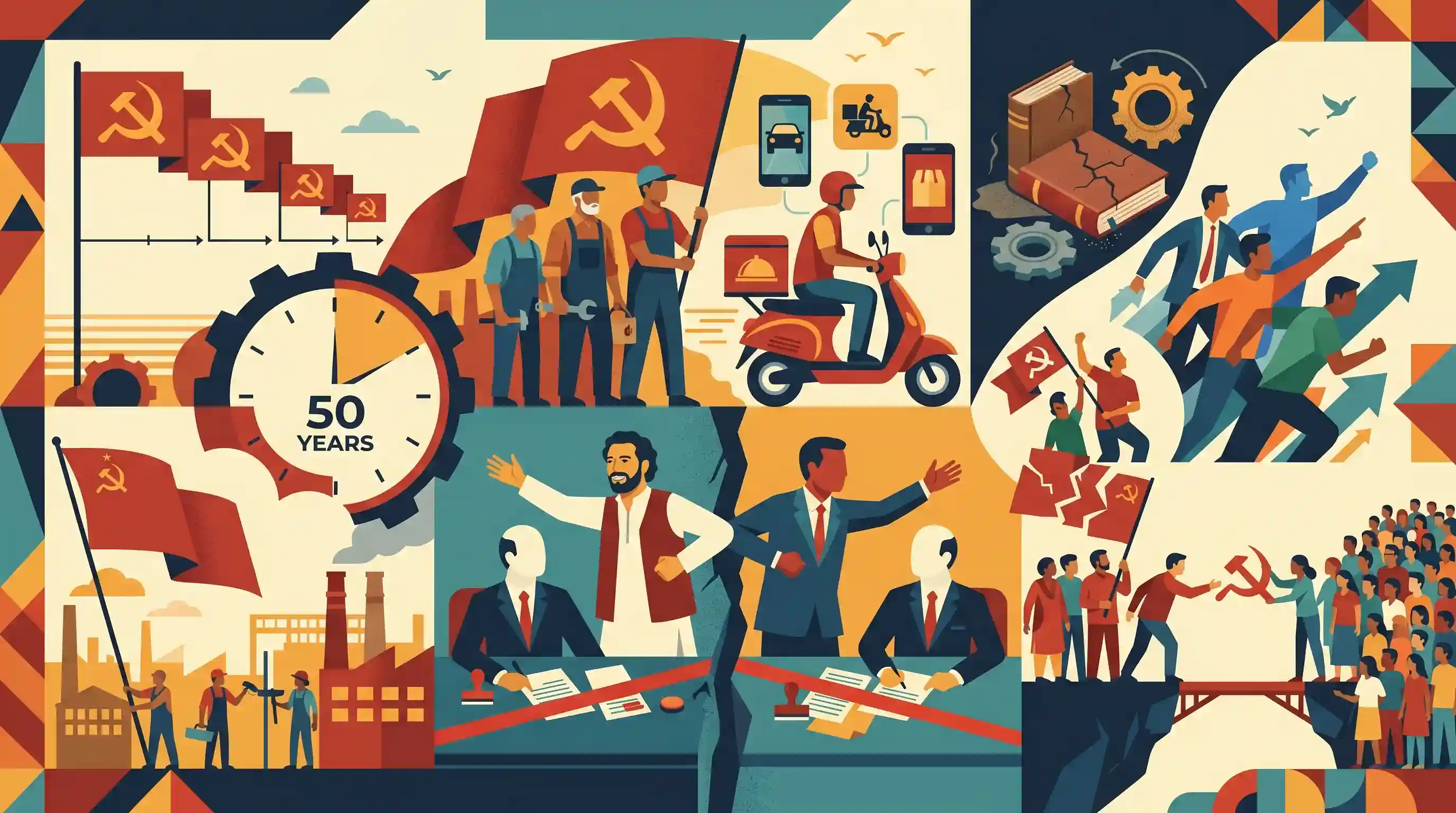
An editorial analysis of the historic electoral nadir of India's communist parties, marking the first time in 50 years without a communist government in the country. The piece attributes this decline not just to electoral anti-incumbency, but to structural failures: an inability to adapt to modern labor realities like the gig economy, persistent factionalism between popular leaders and party bureaucracy, and a broader ideological stagnation. Consequently, the Left is being outflanked by other cadre-based political forces, requiring an urgent recalibration of ideas and mass connection to survive.
Key Points
- Following the recent defeat of the LDF in Kerala, India is without a communist government for the first time in nearly 50 years.
- The Left's electoral decline is symptomatic of a broader depletion of ideas, organizational rigidity, and an inability to correctly estimate 'concrete conditions'.
- Communist parties have failed to adapt to the changing nature of work, leaving them unable to effectively champion workers' rights in the modern 'gig economy'.
- Historically, deep factional faultlines have emerged from the persistent tension between popular mass leaders and the rigid party organization.
- The political vacuum left by the communists is increasingly being filled by other cadre-based, ideologically driven political forces in India.
Important Terms
Communist Party of India (Marxist) [CPI(M)]

A major national party formed in 1964 after splitting from the CPI. It advocates Marxism-Leninism and has historically led governments in West Bengal, Kerala, and Tripura.
UPSC context
GS-II: Political Parties. Vital for understanding the evolution of the Indian party system and the history of regional governance.
Communist Party of India (CPI)
Founded in 1925, it is India\'s oldest communist party. It played a significant role in the freedom struggle and the country\'s first democratically elected communist government (Kerala, 1957).
UPSC context
GS-I: Modern History; GS-II: Polity. Tests knowledge of ideological movements and post-independence political history.
Left Democratic Front (LDF)
A CPI(M)-led coalition of left-wing parties in Kerala. It traditionally alternated power with the Congress-led UDF until its historic consecutive win in 2021.
UPSC context
GS-II: Federalism & Regional Parties. Relevant for studying coalition dynamics and state-level political shifts.
Gig Economy
A labor market characterized by short-term contracts or freelance work mediated through digital platforms, lacking traditional employer-employee relationships and social security benefits.
UPSC context
GS-III: Economy & Labour Issues. Crucial for discussing employment trends, social security gaps, and regulatory challenges.
Cadre-based Party
A political organization structured around a core of highly disciplined, trained, and ideologically committed members (cadres) who perform the party\'s organizational and mobilization work.
UPSC context
GS-II: Political Parties. Important for analyzing party structures, internal discipline, and grassroots mobilization strategies.
Left Front (West Bengal)
The CPI(M)-led alliance that governed West Bengal for 34 consecutive years (1977–2011), known for implementing major agrarian reforms like Operation Barga.
UPSC context
GS-I: Post-Independence History. Essential for studying land reforms and the history of long-term state governance.
Prelims Trap
"The CPI(M) formed India’s first democratically elected communist government in Kerala in 1957."
The 1957 Kerala government was formed by the undivided Communist Party of India (CPI). The party split into CPI and CPI(M) only in 1964.
Static Concepts Connected
How does the Code on Social Security, 2020 address gig and platform workers?
- Distinct classification: It legally recognizes "gig" and "platform" workers for the first time, distinguishing them from traditional employees in employer-employee relationships.
- Social Security Fund: Mandates a national/state fund financed by contributions from aggregators (1-2% of their annual turnover) for life, disability, and health benefits.
- Missing union rights: While granted social security, gig workers are excluded from collective bargaining and trade union rights under the separate Industrial Relations Code.
What are the Election Commission's criteria for recognized 'National Party' status?
- Vote share criteria: Secure at least 6% of valid votes in four or more states (Lok Sabha or Assembly elections) AND win 4 Lok Sabha seats.
- Seat share criteria: Win at least 2% of total Lok Sabha seats (minimum 11 seats currently) elected from at least three different states.
- State party criteria: Be officially recognized as a State Party in at least four different states.
Cross-Topic Patterns
Platform capitalism vs. Trade Unionism
The algorithmic control and independent-contractor classification of gig workers bypass the Industrial Disputes Act, neutralizing the traditional, organized mobilization that historically fueled Left politics in India.
Ideological shift in Federalism debates
Left state governments historically spearheaded structural movements for fiscal autonomy and decentralization. Their decline alters Center-State bargaining, shifting the federalism mantle entirely to regional, identity-based parties.

Mains GS2/GS3 may link the decline of traditional trade unionism to the rise of the gig economy and gaps in the new Labour Codes.
Linked PYQs · 3
Linked PYQs · 3
- 2016MainsGS2
The Indian party system is passing through a phase of transition which looks to be full of contradictions and paradoxes." Discuss.
- 2016MainsGS3
How globalization has led to the reduction of employment in the formal sector of the Indian economy? Is increased informalization detrimental to the development of the country?
- 2025MainsGS1
Trace India's consolidation process during early phase of independence in terms of polity, economy, education and international relations.
