School Level AI Literacy Needed for Future Digital Readiness
Source:Indian Express ↗
Why It Matters
Integrating AI into the school curriculum touches upon critical governance and policy issues (GS2), future skill development and technology adoption (GS3), and technological ethics (GS4). It highlights the practical application of NEP 2020 and the ongoing challenge of combating the digital divide to ensure inclusive socio-economic growth.
Summary
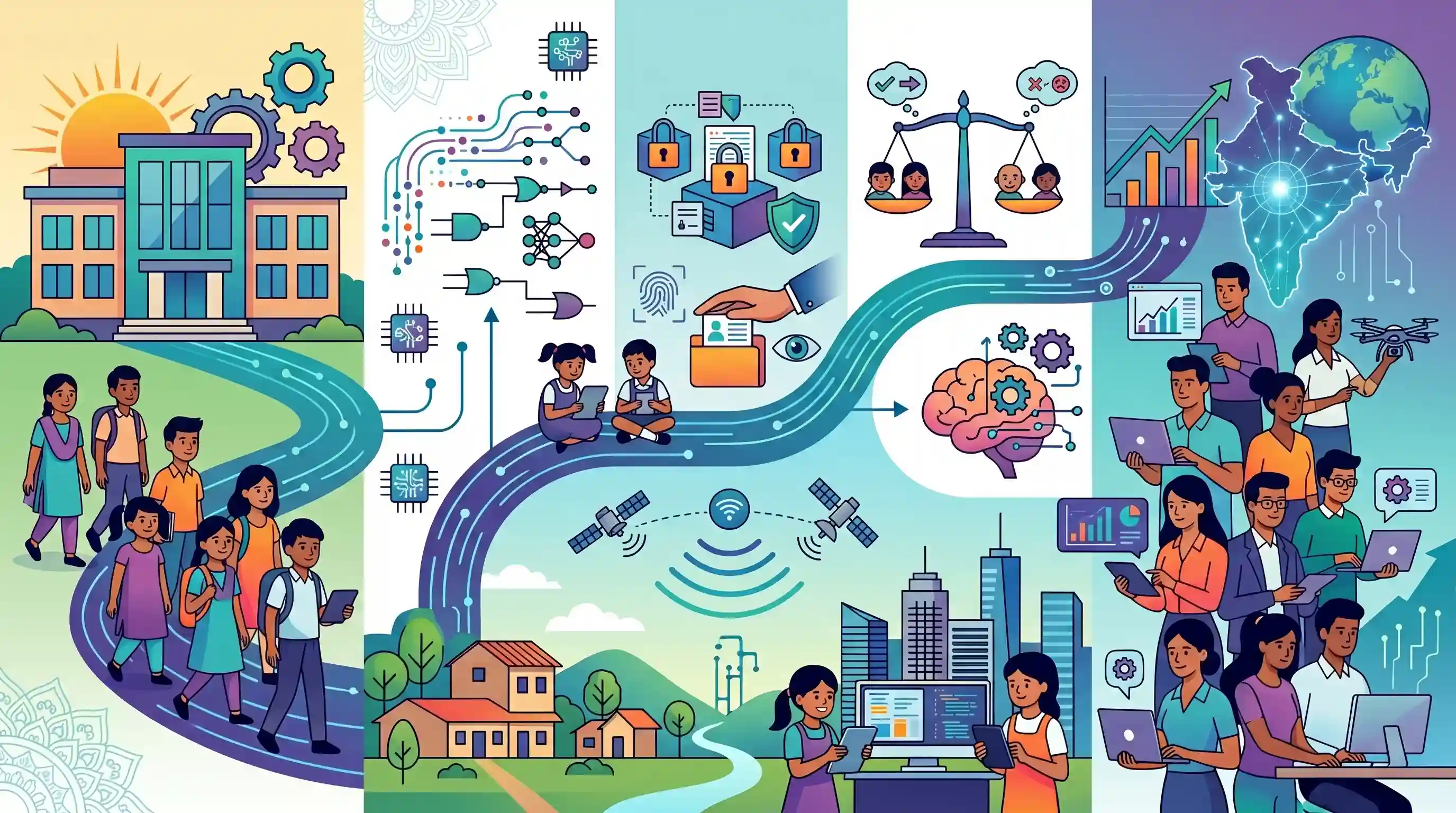
The article advocates for the systemic integration of Artificial Intelligence (AI) literacy into the Indian school curriculum to prepare the youth for a technology-dominated future. It argues that AI education should not be restricted to mere programming but must encompass a comprehensive understanding of algorithms, data privacy, and the ethical implications of emerging technologies. Introducing these concepts early aligns with the vision of the National Education Policy (NEP) 2020 and is crucial for bridging the digital divide between rural and urban areas. Ultimately, fostering critical thinking and technological fluency at the school level is positioned as a necessary step for India to harness its demographic dividend and build a globally competitive, AI-ready workforce.
Key Points
- Early Integration in Curriculum: Recommends introducing foundational AI concepts at the school level to prepare students for a rapidly evolving, technology-driven future.
- Holistic AI Literacy: Suggests that AI education must extend beyond basic coding to include critical thinking, data privacy awareness, and understanding algorithmic biases.
- Bridging the Digital Divide: Emphasizes the need to democratize AI education across both urban and rural schools to prevent exacerbating socio-economic inequalities.
- Policy Synergy: The push for AI literacy aligns with the National Education Policy (NEP) 2020, aiming to transition students from passive consumers of technology to informed users and creators.
- Future-Proofing the Workforce: Building an AI-literate youth base is essential for India to leverage its demographic dividend and remain globally competitive in the future economy.
Important Terms
National Education Policy (NEP) 2020

India's 21st-century educational roadmap replacing the 1986 policy. It emphasizes holistic, flexible, and multidisciplinary learning through reforms like the 5+3+3+4 structure to create a 'global knowledge superpower.'
UPSC context
GS Paper 2 (Education/Governance). Tests understanding of structural reforms and alignment with SDG 4 (Quality Education).
AI Literacy
Competencies enabling individuals to critically understand, evaluate, and use AI systems. It encompasses human-AI collaboration, problem-solving, and awareness of algorithmic bias beyond simple programming or coding skills.
UPSC context
GS Paper 3 (S&T). Tests awareness of IT/Computers and the readiness of human resources for a tech-driven economy.
Demographic Dividend
Economic growth potential arising when a country's working-age population (15–64) outnumbers its dependents. It represents a 'window of opportunity' for rapid development through investment in human capital.
UPSC context
GS Paper 1 (Population) and GS Paper 3 (Growth). Tests the impact of age-structure shifts on national productivity.
Digital Divide
The gap between demographics and regions with effective access to modern digital technology and those without it, often driven by rural-urban, gender, or income disparities.
UPSC context
GS Paper 2 (Social Justice/Equity). Tests issues related to inclusive growth and the reach of government digital initiatives.
Ethical AI
The framework of moral principles—like fairness, transparency, and accountability—ensuring that AI development benefits society while minimizing harms such as bias, privacy invasion, and lack of human oversight.
UPSC context
GS Paper 4 (Ethics). Tests the ability to apply ethical reasoning to contemporary technological and governance challenges.
Prelims Trap
The 'Responsible AI for Youth' program is a flagship initiative of the Ministry of Education.
The 'Responsible AI for Youth' initiative is actually spearheaded by the Ministry of Electronics and IT (MeitY), not the Ministry of Education.
Static Concepts Connected
What is the Demographic Dividend and how does India harness it?
- Definition: Economic growth potential resulting from shifts in a population’s age structure, where the working-age population exceeds the non-working-age dependents.
- Time Window: India's demographic window of opportunity is expected to remain open until approximately 2055-56.
- Harnessing prerequisites: Translating sheer numbers into productive human capital requires heavy investments in health, skill development, and futuristic education (like AI literacy).
What are the primary ethical concerns associated with Artificial Intelligence?
- Algorithmic Bias: AI models often inherit and amplify historical socio-economic prejudices present in their training data, leading to discriminatory outcomes.
- Data Privacy: The mass collection of personal information required to train AI models threatens user consent and raises risks of unauthorized surveillance.
- Black-box effect: Many deep learning models lack transparency, making it impossible to audit how they arrive at critical decisions (e.g., loan or job rejections).
Cross-Topic Patterns
BharatNet infrastructure vs. AI literacy
Mandating AI education without reliable rural internet access via BharatNet risks mutating the existing digital divide into a permanent socio-economic 'AI divide'.
NEP 2020 and the Demographic Dividend
Integrating deep tech in early education links directly to harnessing India's demographic dividend by creating a globally competitive workforce before the population ages post-2055.
AI ethics as a governance tool
Teaching algorithmic bias in schools creates a foundation for future administrators, linking GS-3 tech advancements with GS-4 ethical governance and data privacy frameworks.

Expect a GS-2/GS-3 hybrid question in 2026 linking NEP 2020’s tech provisions with MeitY initiatives and the widening rural digital divide.
Linked PYQs · 4
Linked PYQs · 4
- 2021MainsGS2
Has digital illiteracy, particularly in rural areas, coupled with lack of Information and Communication Technology (ICT) accessibility hindered socio-economic development? Examine with justification.
- 2023MainsGS3
Introduce the concept of Artificial Intelligence (AI). How does Al help clinical diagnosis? Do you perceive any threat to privacy of the individual in the use of Al in healthcare?
- 2024MainsGS4
The application of Artificial Intelligence as a dependable source of input for administrative rational decision-making is a debatable issue. Critically examine the statement from the ethical point of view.
- 2025MainsGS2
The National Commission for Protection of Child Rights has to address the challenges faced by children in the digital era. Examine the existing policies and suggest measures the Commission can initiate to tackle the issue.
