Barda Sanctuary Maldhari Relocation For Asiatic Lion Habitat
Source:theprint ↗
Why It Matters
Important for understanding conservation strategies for endangered species like the Asiatic lion and policy measures addressing human-wildlife coexistence in protected areas of Gujarat.
Summary
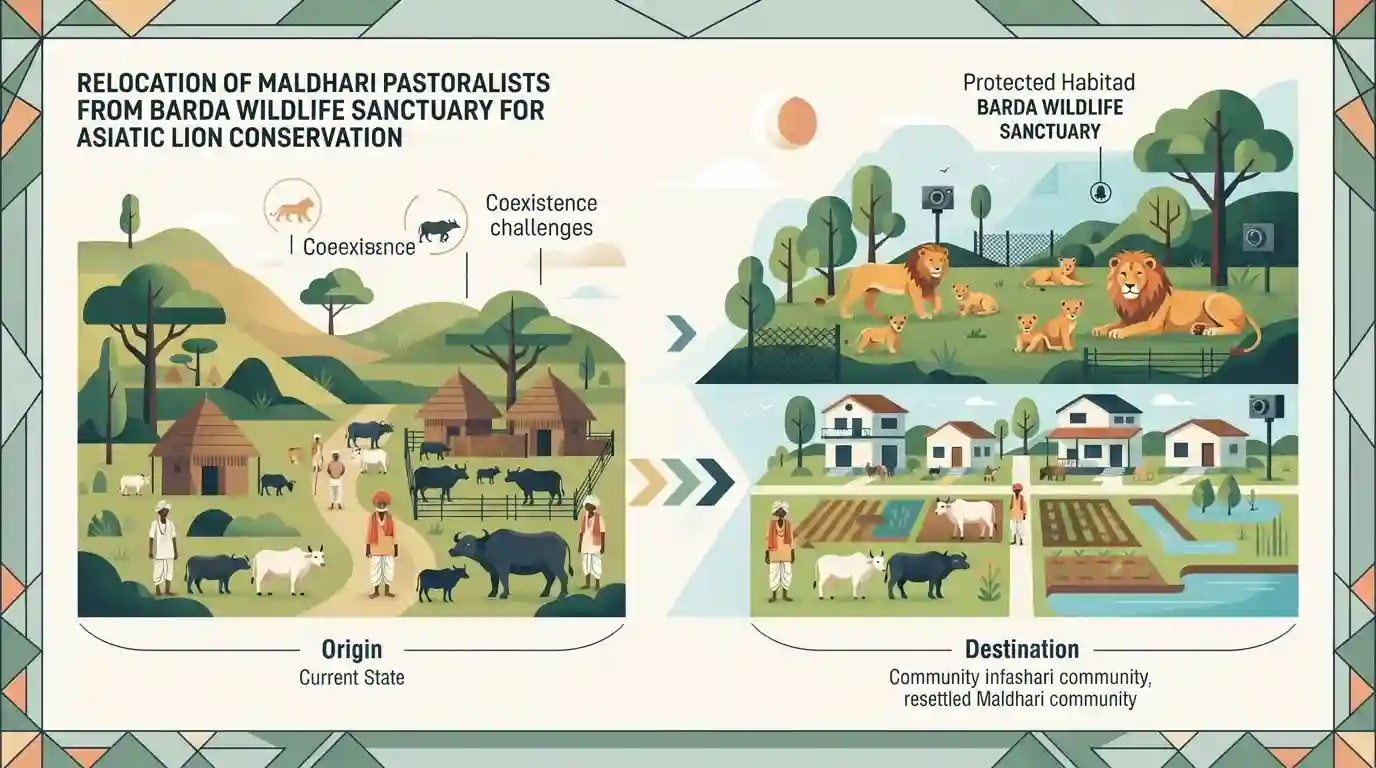
The Gujarat government has announced a special rehabilitation scheme to relocate Maldhari pastoralists from the Barda Wildlife Sanctuary to facilitate its development as a safe, secondary habitat for Asiatic lions.
Key Points
- Gujarat Chief Minister announced a comprehensive relocation and rehabilitation scheme for Maldharis living inside the Barda Wildlife Sanctuary.
- Barda Sanctuary is being developed as a vital second home for the Asiatic lions, supplementing the Gir National Park population.
- The rehabilitation package aims to ensure conflict-free wildlife conservation while providing alternative livelihood and settlement support to the pastoralist Maldhari community.
Important Terms
Maldhari Rehabilitation Scheme

A voluntary government rehabilitation initiative providing financial compensation and land plots to Maldhari pastoralists residing inside the Barda Wildlife Sanctuary to facilitate Asiatic lion conservation.
UPSC context
Important for GPSC Paper 3 (Environment, Biodiversity, and Wildlife Conservation), testing schemes related to protected area management and community relocation.
Barda Wildlife Sanctuary
A protected area spanning Porbandar and Devbhumi Dwarka districts in Gujarat, designated as a secondary habitat for Asiatic lions.
UPSC context
Important for GPSC Paper 3 under Gujarat geography and biodiversity conservation, testing knowledge of protected areas and endangered species habitat.
Maldharis
Traditional semi-nomadic pastoralist communities residing in forest settlements (*nes*) within protected areas of Gujarat, known for livestock rearing.
UPSC context
Important for GPSC Paper 3 (Social Justice and Environment), testing issues concerning indigenous pastoral communities, forest rights, and wildlife conservation.
Static Concepts Connected
What are the key protected area categories and management protocols for Asiatic lions in Gujarat?
- Primary Habitat: Gir National Park (Sasan Gir) is the exclusive wild home of the Asiatic lion (*Panthera leo leo*).
- Secondary Habitat: Barda Wildlife Sanctuary (Porbandar/Devbhumi Dwarka) is developed as the secondary home, supported by Project Lion.
- Local Community: Maldharis are traditional pastoralist communities residing inside Gir and Barda, partially relocated via NTCA packages.
Cross-Topic Patterns
Project Lion & Protected Area Network expansion
Project Lion aligns with Project Tiger and Elephant under the MoEFCC, integrating conservation genetics and habitat connectivity in Saurashtra.
Maldhari Pastoralism vs Wildlife Conservation Rights
Voluntary relocation of pastoralists like Maldharis under NTCA guidelines balances indigenous livelihood rights with wildlife corridor security.

Expect match-the-following or statement questions on Barda Sanctuary location, Project Lion, and Maldhari rehabilitation package details.
Linked PYQs · 1
Linked PYQs · 1
- 2026GPSC_PRELIMSGS1
The 'Great Indian Bustard (GIB)' (Ghorad) is frequently seen in the news in the context of wildlife conservation efforts in western India. Consider the following statements regarding this species: 1. Currently, the highest surviving wild population of the Great Indian Bustard in India is located in the semi-arid grasslands of Gujarat. 2. It is a long-distance migratory bird that travels from Central Asia to the Indian subcontinent to escape harsh winters. Which of the above statement(s) is/are correct?
