Strategic Imperative of Diplomatic Dialogue in India Pakistan Ties
Source:Indian Express ↗
Why It Matters
India-Pakistan relations are a perennial theme in UPSC GS-2 (International Relations) and GS-3 (Internal Security). Understanding the nuances of diplomatic engagement versus national security imperatives helps candidates craft balanced answers on foreign policy, conflict resolution, and border management.
Summary
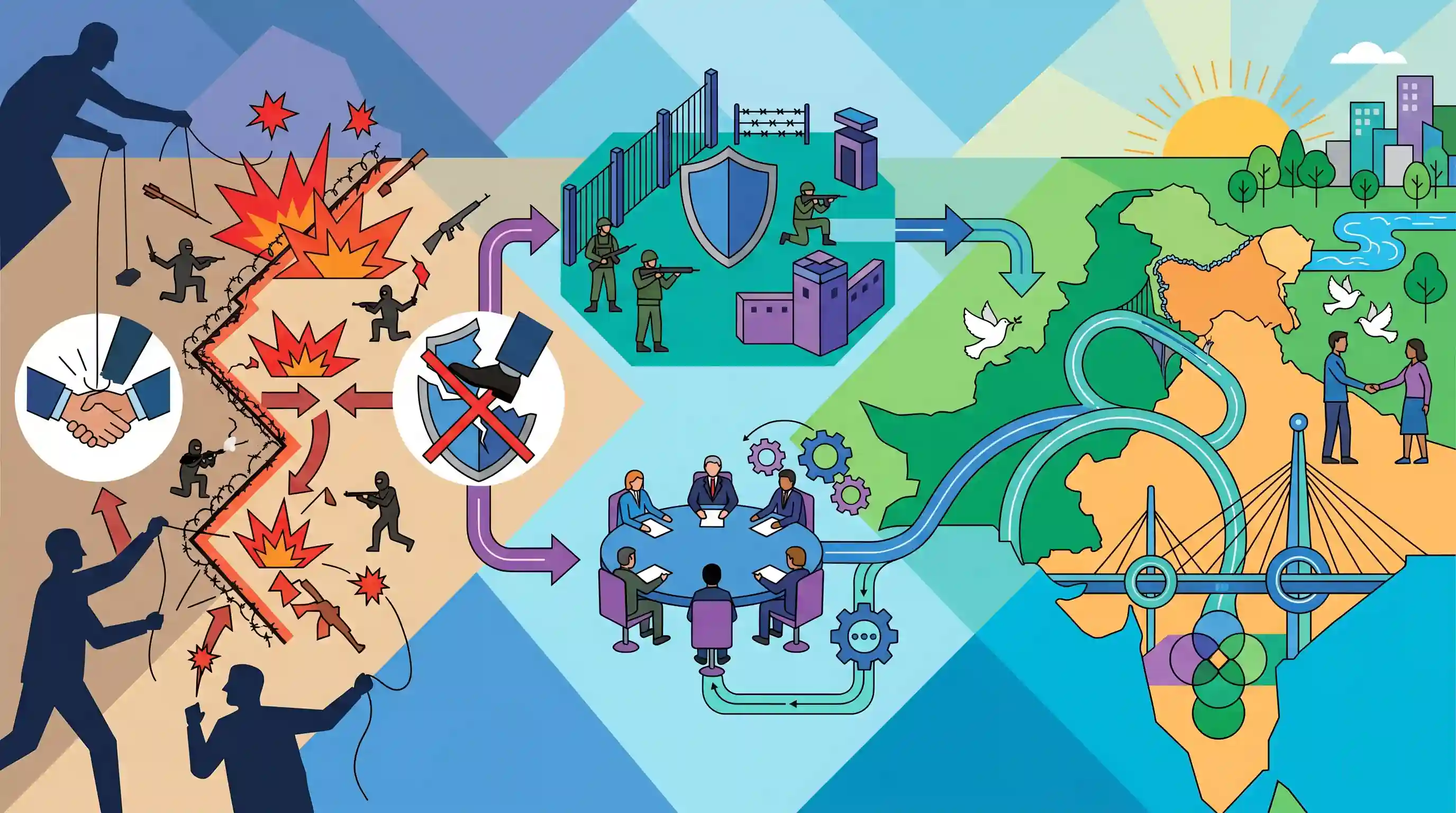
The article makes a strong case for renewing diplomatic dialogue between India and Pakistan, challenging the narrative that engaging in talks equates to a strategic defeat or a sign of weakness. It highlights the necessity of maintaining communication channels to manage conflicts, prevent escalation, and ensure regional stability in South Asia. The author suggests that a firm stance against cross-border terrorism and the pursuit of diplomatic engagement are not mutually exclusive, and that sustained peace requires active, politically-backed dialogue.
Key Points
- The article advocates for the resumption of dialogue between India and Pakistan, arguing that seeking peace and engaging in talks should not be construed as a sign of weakness or a concession.
- It emphasizes that diplomacy and strategic communication are essential tools to manage deep-rooted mutual distrust and prevent the escalation of conflicts.
- While India maintains its firm stance against cross-border terrorism, the absence of dialogue can lead to a strategic vacuum, increasing risks of miscalculation.
- Constructive engagement, potentially through backchannels or track II diplomacy, remains vital for long-term regional stability in South Asia.
Prelims Trap
India suspended the Indus Waters Treaty and revoked Pakistan's MFN status following the cessation of official Track I diplomatic dialogue.
India revoked Pakistan's MFN status in 2019, but the Indus Waters Treaty (1960) has never been suspended, even during full-scale wars or complete diplomatic freezes.
Static Concepts Connected
What are the different tracks of diplomacy in international relations?
- Track I: Official, direct government-to-government diplomatic engagement using formal institutional channels.
- Track II: Unofficial, informal dialogues involving non-state actors like academics, NGOs, and retired officials to build trust and explore solutions without diplomatic commitments.
- Track 1.5: Engagements where official and non-official actors cooperate concurrently in conflict resolution, often using backchannels.
What is the core of the 2003 India-Pakistan Ceasefire Agreement?
- Coverage Area: An unwritten military agreement effective November 2003 covering the International Border, Line of Control (LoC), and Actual Ground Position Line (AGPL) in Siachen.
- 2021 Reaffirmation: In February 2021, the Director Generals of Military Operations (DGMOs) of both countries issued a rare joint statement to strictly recommit to this ceasefire.
Cross-Topic Patterns
Border Security + IR Doctrines
India's internal security matrix in J&K is directly dictated by the 'terror and talks cannot go together' doctrine, inextricably linking domestic border management with foreign policy.
Hydro-politics + Bilateral Stalemates
Extended diplomatic freezes often elevate domestic calls to renegotiate or abrogate the Indus Waters Treaty, linking bilateral political stalemates to regional hydro-politics.

Expect a GS-2 Mains question evaluating the efficacy of Track-II diplomacy when official Track-I engagement remains frozen.
Linked PYQs · 3
Linked PYQs · 3
- 2015MainsGS2
Terrorist activities and mutual distrust have clouded India-Pakistan relations. To what extent the use of soft power like sports and cultural exchanges could help generate goodwill between the two countries? Discuss with suitable examples.
- 2024MainsGS3
India has a long and troubled border with China and Pakistan fraught with contentious issues. Examine the conflicting issues and security challenges along the border. Also give out the development being undertaken in these areas under the Border Area Development Programme (BADP) and Border Infrastructure and Management (BIM) Scheme.
- 2020MainsGS3
Analyze internal security threats and transborder crimes along Myanmar, Bangladesh and Pakistan borders including Line of Control (LoC). Also discuss the role played by various security forces in this regard.
