Nuclear Energy Advancements and India Long Term Climate Goals
Source:Indian Express ↗
Why It Matters
Nuclear energy sits at the vital intersection of India's energy security, strategic autonomy, and climate action. Understanding the balance between indigenous technology development (like the 3-stage program) and international cooperation (IAEA safeguards, imported uranium) is frequently tested in both Prelims and Mains.
Summary
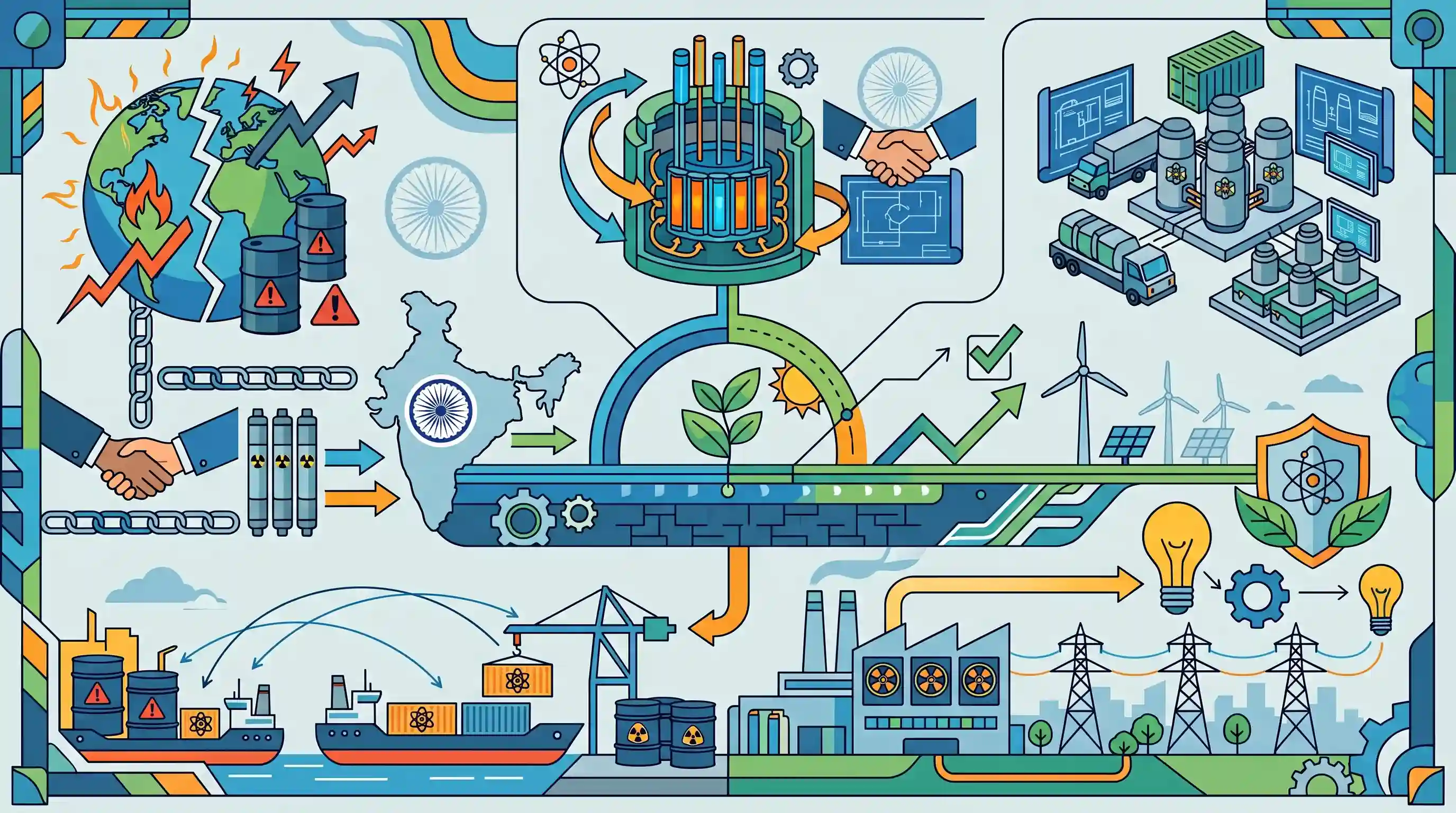
The article examines recent advancements in India's nuclear energy sector against the backdrop of global energy security challenges and climate commitments. It emphasizes the strategic necessity of nuclear power—spanning indigenous Fast Breeder Reactors to emerging concepts like Small Modular Reactors (SMRs)—in providing reliable, low-carbon baseload electricity. The piece argues that navigating international frameworks, securing stable fuel supplies, and commercializing new nuclear technologies are critical for India to reconcile its growing energy demands with its Net Zero by 2070 goals.
Key Points
- Nuclear energy provides vital, clean baseload power necessary to offset coal dependency and achieve India's Net Zero by 2070 target.
- Recent progress underscores the viability of India's indigenous Three-Stage Nuclear Power Programme, particularly advancements in Fast Breeder Reactor (FBR) technology.
- Emerging technologies like Small Modular Reactors (SMRs) are increasingly viewed as a solution to the traditional challenges of nuclear power, such as high capital costs and long gestation periods.
- Securing domestic and international fuel supplies, while balancing IAEA safeguards, remains crucial for India's strategic energy autonomy.
Important Terms
Three-Stage Nuclear Power Programme

A strategic plan formulated by Homi Bhabha to utilize India's vast thorium reserves via three stages: Pressurized Heavy Water Reactors, Fast Breeder Reactors, and Thorium-based reactors for energy independence.
UPSC context
GS3 (S&T/Energy); tests understanding of indigenization and the strategic role of thorium in India's long-term energy security.
Net Zero by 2070
India's commitment at COP26 (2021) to achieve carbon neutrality by 2070, balancing greenhouse gas emissions with removals through renewables and carbon sinks as part of the 'Panchamrita' strategy.
UPSC context
GS3 (Environment); tests knowledge of India's climate commitments and its role in global climate change mitigation efforts.
International Atomic Energy Agency (IAEA)
A UN-affiliated 'Atoms for Peace' organization in Vienna that promotes peaceful nuclear energy and implements safeguards. India maintains specific safeguards agreements with it for civilian nuclear facilities.
UPSC context
GS2 (International Relations); tests understanding of global nuclear governance and India’s unique status regarding international safeguards.
Department of Atomic Energy (DAE)
An executive department directly under the Prime Minister’s Office responsible for nuclear policy, research, and managing India's nuclear power infrastructure and strategic programs.
UPSC context
GS3 (Infrastructure/Energy); tests knowledge of the administrative structure and institutional framework governing India's atomic energy sector.
NPCIL (Nuclear Power Corporation of India Limited)
A Public Sector Undertaking under the DAE tasked with the design, construction, and operation of India's commercial nuclear power plants, including indigenous PHWRs and imported LWRs.
UPSC context
GS3 (Energy); tests awareness of the lead agency responsible for commercial nuclear power generation and indigenous technology deployment.
Prelims Trap
"Fast Breeder Reactors (Stage-II) directly consume India's vast Thorium reserves to generate electricity."
Stage-II FBRs use a Plutonium-Uranium core. Thorium is merely used as a 'blanket' around the core to breed Uranium-233 for Stage-III.
Static Concepts Connected
What is the sequence of India's Three-Stage Nuclear Programme?
- Stage I: Pressurized Heavy Water Reactors (PHWRs) use natural Uranium to produce electricity and Plutonium-239 as a byproduct.
- Stage II: Fast Breeder Reactors (FBRs) use Plutonium and breed more fissile material, converting a Thorium blanket into Uranium-233.
- Stage III: Advanced reactors will utilize U-233 and India's vast Thorium-232 reserves to sustain long-term power generation.
Why are Small Modular Reactors (SMRs) gaining strategic importance?
- Capacity: Generates up to 300 MW(e) per unit, making them suitable for remote regions or smaller, decentralized grid networks.
- Economics: Factory-fabricated modular designs drastically reduce the prohibitive upfront capital costs and long gestation periods of traditional reactors.
- Grid Integration: Provides flexible, low-carbon baseload electricity to complement intermittent renewables, enhancing overall grid stability.
Cross-Topic Patterns
SMRs + Private Sector Integration
Recent policy shifts and budget announcements emphasize private sector participation in Small Modular Reactor (SMR) deployment, linking core atomic science to economic liberalization and the Atomic Energy Act.
Clean Baseload + Net Zero 2070
Nuclear is increasingly positioned as the only viable clean baseload power alternative to coal, crucial for balancing grid instability caused by intermittent solar/wind to reach India's 2070 target.

Expect a 2026 multi-statement question merging SMR capacity limits, the FBR Plutonium-Thorium fuel cycle, and IAEA civilian safeguards.
Linked PYQs · 3
Linked PYQs · 3
- 2017MainsGS3
Give an account of the growth and development of nuclear science and technology in India. What is the advantage of fast breeder reactor programme in India?
- 2025MainsGS3
The fusion energy programme in India has steadily evolved over the past few decades. Mention India's contributions to the international fusion energy project International Thermonuclear Experimental Reactor (ITER). What will be the implications of the success of this project for the future of global energy?
- 2020PrelimsGS1
In India, why are some nuclear reactors kept under "IAEA Safeguards" while others are not?
