New State Governments Fiscal Deficit and Mounting Public Debt
Source:Indian Express ↗
Why It Matters
Subnational debt levels and fiscal discipline are critical for India's overall macroeconomic stability. Understanding the tension between political mandates (populist schemes) and statutory fiscal limits (FRBM/Article 293) is crucial for both GS2 (Federalism) and GS3 (Economy).
Summary
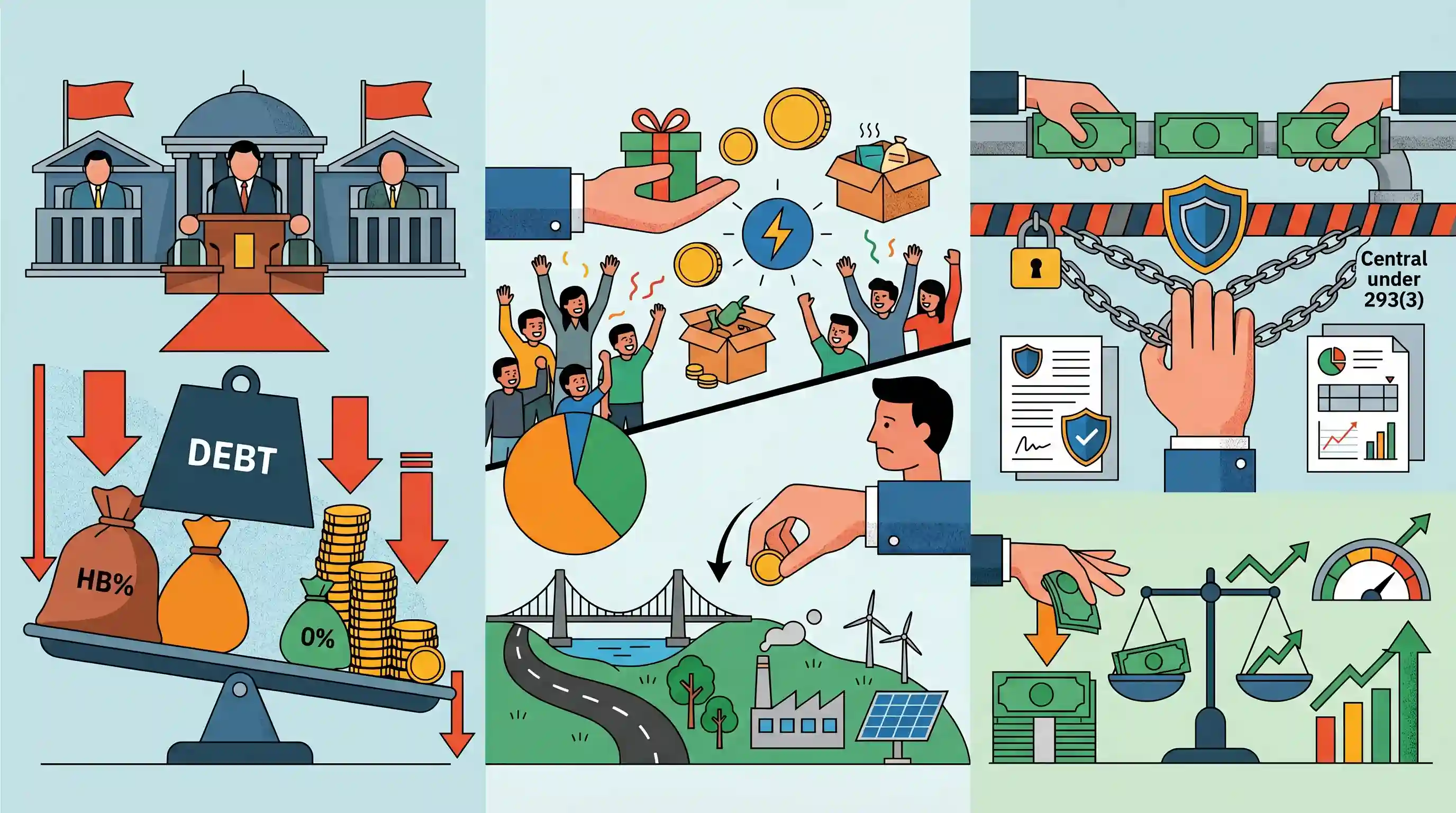
The article examines the chronic macroeconomic challenge of mounting debt burdens awaiting newly formed state governments in India. Driven by high debt-to-GSDP ratios and structural revenue deficits, states face a difficult balancing act between fulfilling pre-election populist pledges (welfare schemes or 'freebies') and maintaining fiscal prudence. Such unchecked revenue expenditure risks squeezing out productive capital investments. Additionally, state borrowing is strictly capped by their respective FRBM Acts and the Central Government's oversight under Article 293(3) of the Constitution. Ensuring sustainable subnational finances will necessitate expenditure rationalization, adherence to fiscal health metrics, and responsible macroeconomic management.
Key Points
- Newly elected state governments inherit strained public finances, characterized by high debt-to-GSDP ratios and persistent fiscal deficits.
- Pre-election populist promises (often termed 'freebies') increase revenue expenditure, thereby crowding out critical capital expenditure needed for long-term growth.
- States are legally and constitutionally constrained in their borrowing capacity by state-level FRBM limits and the Centre's oversight via Article 293(3).
- Navigating these challenges requires structural fiscal reforms, enhanced revenue generation, and a strategic balancing of welfare obligations with fiscal prudence.
Important Terms
Fiscal Responsibility and Budget Management (FRBM) Act

A 2003 law mandating fiscal discipline by setting specific targets to reduce fiscal deficits and public debt to sustainable levels for both Union and State governments.
UPSC context
GS Paper 3: Indian Economy; tests knowledge of fiscal policy, deficit targets, and N.K. Singh Committee recommendations.
Article 293(3) of the Constitution
Constitutional provision requiring a State to obtain the Central Government's consent for any new loan if it has outstanding liabilities to the Centre.
UPSC context
GS Paper 2: Federalism/Centre-State Relations; crucial for understanding the Centre's oversight on subnational borrowing and fiscal autonomy.
Finance Commission
A constitutional body (Article 280) that recommends the distribution of tax revenues between the Centre and States and suggests measures for fiscal consolidation.
UPSC context
GS Paper 2 & 3: Fiscal Federalism; tests vertical/horizontal devolution mechanisms and grants-in-aid principles.
Reserve Bank of India (RBI)
India's central bank that serves as the 'banker and debt manager' for both Central and State governments, managing their public borrowing and market securities.
UPSC context
GS Paper 3: Banking and Monetary Policy; relevant for understanding public debt management and government banking transactions.
Revenue Deficit
The excess of revenue expenditure (day-to-day costs like salaries/subsidies) over revenue receipts, indicating the government is borrowing for consumption rather than capital formation.
UPSC context
GS Paper 3: Government Budgeting; tests ability to analyze the 'quality' of government expenditure and its impact on growth.
Debt-to-GSDP Ratio
A key metric of fiscal health measuring a state's total debt relative to its economic output; the N.K. Singh Committee recommended a 20% limit for States.
UPSC context
GS Paper 3: Indian Economy; essential for assessing subnational debt sustainability and macroeconomic stability.
Prelims Trap
States can independently borrow from domestic markets as long as they do not breach their State FRBM fiscal deficit limits.
Under Article 293(3), states must obtain the Centre's prior consent for any new borrowing if they have any outstanding debt owed to the Centre, which applies to virtually all Indian states.
Static Concepts Connected
How does the Constitution regulate the borrowing powers of State governments?
- Domestic only: States can borrow solely within the territory of India upon the security of the Consolidated Fund of the State (Article 293(1)).
- Centre's consent: Prior consent from the Union government is mandatory if a state has outstanding loans or guarantees previously extended by the Centre (Article 293(3)).
- Imposing conditions: The Centre holds the authority to impose specific conditions on the state while granting consent for such borrowings (Article 293(4)).
What are the key debt recommendations of the N.K. Singh FRBM Review Committee?
- Debt-to-GDP ratio: Recommended a prudent general government (combined Centre and States) debt-to-GDP ceiling of 60%.
- Centre vs States: Specifically allocated a 40% debt limit for the Central government and a combined 20% limit for the State governments.
- Escape clause: Provided specific triggers (like national security crises or severe agricultural collapse) allowing temporary deviation from strict fiscal targets.
Cross-Topic Patterns
Fiscal Federalism & Power Sector Reforms
The Centre frequently links additional borrowing space for states (above the standard FRBM threshold) to the implementation of specific structural reforms, such as reducing power DISCOM losses.
Freebies vs Capital Crowding Out
The 'freebies' debate perfectly illustrates the shift from capital to revenue expenditure. Mounting state debt for welfare crowds out both public infrastructure development and private investment.

Expect a 2026 prelims Q linking Article 293(3) borrowing consent, off-budget borrowing definitions, and N.K. Singh Committee debt targets.
Linked PYQs · 5
Linked PYQs · 5
- 2025MainsGS3
Explain how the Fiscal Health Index (FHI) can be used as a tool for assessing the fiscal performance of states in India. In what way would it encourage the states to adopt prudent and sustainable fiscal policies?
- 2018PrelimsGS1
Consider the following statements: 1. The Fiscal Responsibility and Budget Management (FRBM) Review Committee Report has recommended a debt to GDP ratio of 60% for the general (combined) government by 2023, comprising 40% for the Central Government and 20% for the State Governments. 2. The Central Government has domestic liabilities of 21% of GDP as compared to that of 49% of GDP of the State Governments. 3. As per the Constitution of India, it is mandatory for a State to take the Central Government's consent for raising any loan if the former owes any outstanding liabilities to the latter. Which of the statements given above is/are correct?
- 2013MainsGS3
What were the reasons for the introduction of Fiscal Responsibility and Budget Management (FRBM) Act, 2003 ? Discuss critically its salient features and their effectiveness.
- 2025MainsGS2
Examine the evolving pattern of Centre-State financial relations in the context of planned development in India. How far have the recent reforms impacted the fiscal federalism in India?
- 2021MainsGS2
How have the recommendations of the 14th Finance Commission of India enabled the States to improve their fiscal position?
