Centre-State Fiscal Relations and Federal Finance Challenges
Source:Indian Express ↗
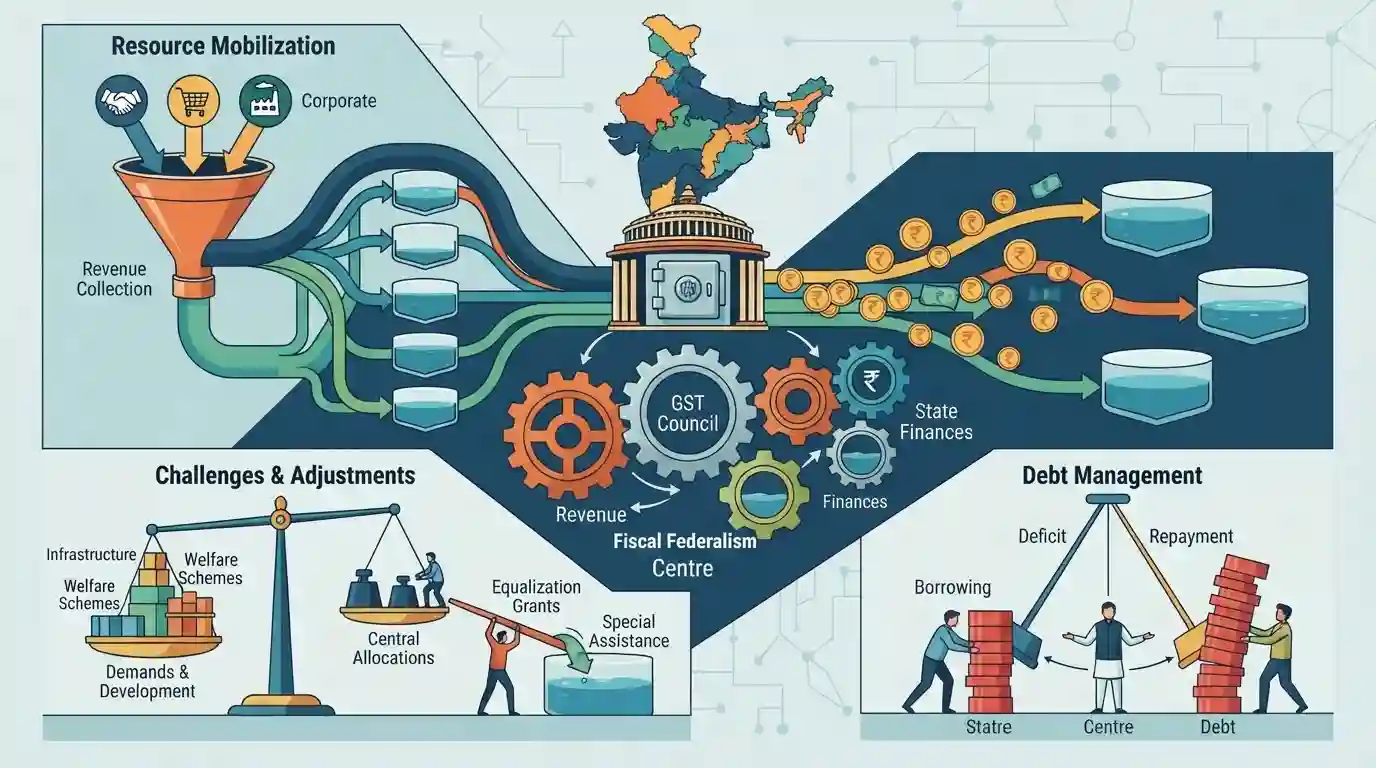
Why It Matters
Understanding the structural friction points in Centre-State financial relations is vital for evaluating macroeconomic stability, fiscal federalism, and cooperative federalism in India.
Summary
The editorial discusses the growing challenges and necessary structural adjustments in Centre-State financial relations, highlighting fiscal federalism, resource allocation, and debt management issues in India.
Key Points
- Centre-state fiscal relations are facing mounting pressure due to changing revenue dynamics, tax devolution formulas, and expenditure obligations.
- Fiscal federalism in India requires a delicate balance between central resource mobilization and state-level autonomy in public spending.
- Growing debt burdens and off-budget borrowings by states call for strict adherence to fiscal responsibility frameworks.
- The recommendations of upcoming Finance Commissions play a critical role in redefining vertical and horizontal tax devolution.
Important Terms
Finance Commission

A constitutional body established under Article 280 to recommend the distribution of tax revenues between the Union and states and among the states themselves.
UPSC context
GS Paper II (Polity - Federalism and Constitutional Bodies) and GS Paper III (Indian Economy - Fiscal Federalism).
Reserve Bank of India
India's central banking institution that regulates the monetary policy, currency issuance, and banking system, while also acting as a banker to the government.
UPSC context
GS Paper III (Indian Economy - Monetary Policy and Financial Sector).
Union Government
The central government of India operating at the national level, holding supreme legislative and executive authority over subjects specified in the Union List.
UPSC context
GS Paper II (Indian Polity - Centre-State Relations).
State Governments
Constituent sub-national administrative units in India's federal structure, responsible for governance, law and order, and public service delivery within their respective territorial boundaries.
UPSC context
GS Paper II (Indian Polity - Federalism and Devolution of Powers).
Prelims Trap
All taxes and duties collected by the Union government compulsorily form part of the divisible pool shared with the states.
Cesses and surcharges collected by the Union are NOT part of the divisible pool of taxes shared with states under Article 270, despite often forming a large share of gross tax revenue.
Static Concepts Connected
What are the constitutional provisions governing tax devolution and the divisible pool in India?
- Article 270 Provision: Article 270 mandates the collection of taxes by the Union and distribution of proceeds between the Union and states based on Finance Commission recommendations.
- Cesses Exclusion: Cesses and surcharges levied for specific purposes under Article 270/271 are excluded from the divisible pool shared with states.
- Article 280 Mandate: Article 280 establishes the Finance Commission every five years to recommend the vertical and horizontal sharing formulas.
Cross-Topic Patterns
Cesses, Surcharges, and Macroeconomic Stability
The friction over cesses and surcharges reduces the divisible pool, directly constricting state-level welfare spending and forcing states into off-budget borrowings that trigger RBI macroeconomic warnings.
Fiscal Federalism meets Decentralized Governance
Finance Commission devolution formulas directly impact grassroots developmental outlays, connecting macro-fiscal federalism with local body fund devolution under the 73rd and 74th Amendments.

Expect a statement-based prelims question on Article 280 (Finance Commission) and the constitutional exclusion of cesses from the divisible pool.
Linked PYQs · 4
Linked PYQs · 4
- 2025MainsGS2
Examine the evolving pattern of Centre-State financial relations in the context of planned development in India. How far have the recent reforms impacted the fiscal federalism in India?
- 2025MainsGS3
Explain how the Fiscal Health Index (FHI) can be used as a tool for assessing the fiscal performance of states in India. In what way would it encourage the states to adopt prudent and sustainable fiscal policies?
- 2024MainsGS2
What changes has the Union Government recently introduced in the domain of Centre-State relations ? Suggest measures to be adopted to build the trust between the Centre and the States and for strengthening federalism.
- 2021MainsGS2
How have the recommendations of the 14th Finance Commission of India enabled the States to improve their fiscal position?
