Centre state fiscal federalism faces structural financial reckoning
Source:Indian Express ↗
কেন এটি গুরুত্বপূর্ণ
It provides critical insights into India's fiscal federalism, touching upon the financial autonomy of states, Centre-State resource sharing, and sustainable macroeconomic management which are recurring themes in GS Paper II and III.
সারসংক্ষেপ
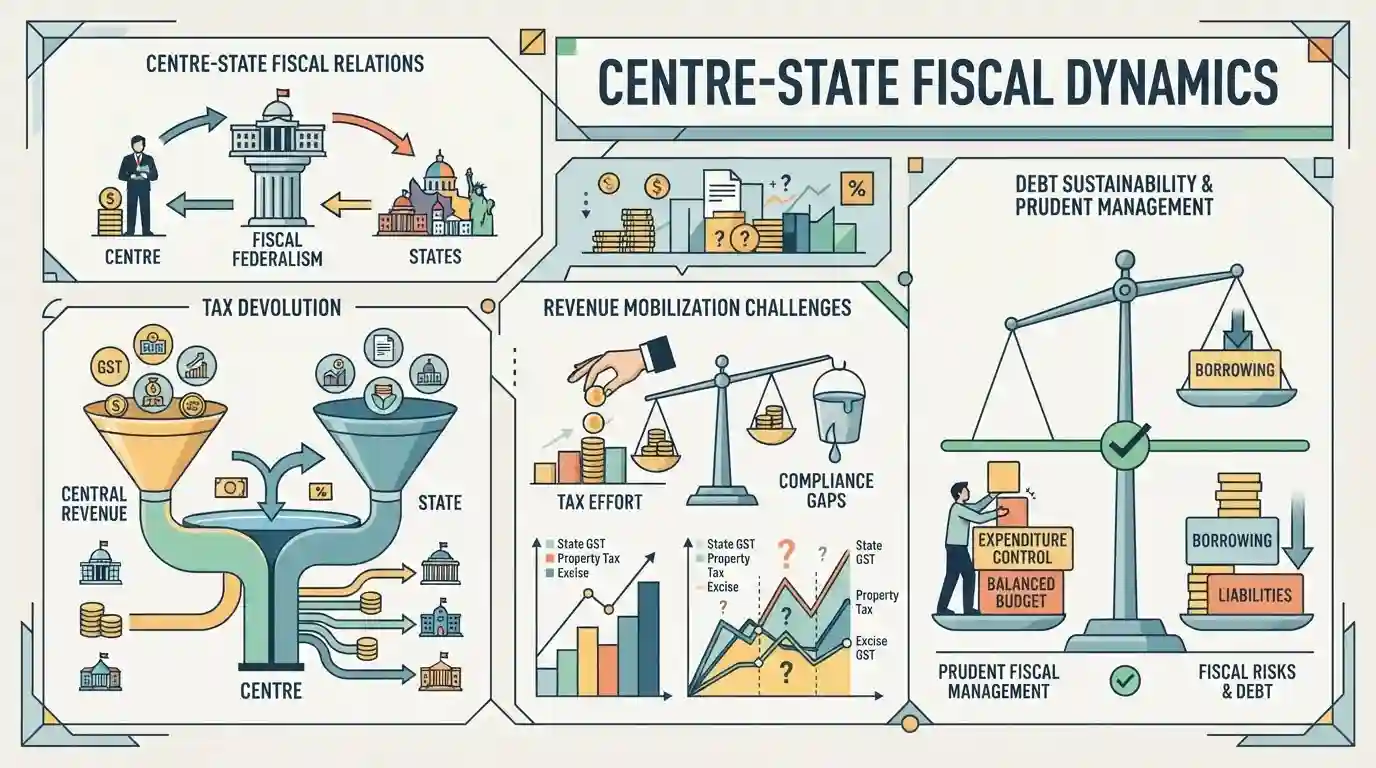
The article discusses the evolving landscape of Centre-State finances, highlighting structural challenges in fiscal federalism, tax devolution, revenue mobilization, and debt sustainability, emphasizing the need for prudent fiscal management and balanced resource distribution.
মূল বিষয়
- Centre-state fiscal relations are undergoing a critical reckoning amidst debates over tax devolution, horizontal and vertical imbalances, and revenue sharing.
- States face mounting fiscal pressures and structural liabilities, requiring careful calibration of borrowing limits and debt sustainability.
- Strengthening cooperative federalism necessitates transparent dialogue on fiscal health indices and resource allocation mechanisms.
গুরুত্বপূর্ণ শব্দ
Finance Commission

A constitutional body established under Article 280 of the Indian Constitution to recommend the vertical devolution of tax proceeds and horizontal distribution of funds among states, ensuring fiscal equity.
UPSC context
UPSC GS Paper II (Polity & Constitution - Statutory/Constitutional Bodies) and GS Paper III (Indian Economy - Fiscal Federalism).
Goods and Services Tax (GST)
An indirect tax system that subsumed multiple central and state levies, transforming India's indirect taxation and redefining Centre-State fiscal autonomy through the GST Council.
UPSC context
UPSC GS Paper III (Indian Economy - Government Budgeting, Taxation, and Fiscal Federalism).
Reserve Bank of India
India's central banking institution that manages state borrowings, provides temporary Ways and Means Advances (WMA) for cash flow mismatches, and regulates monetary policy.
UPSC context
UPSC GS Paper III (Indian Economy - Banking, Monetary Policy, and State Debt Sustainability).
সংযুক্ত স্থির ধারণা
What are the constitutional mechanisms governing Centre-State financial relations in India?
- Article 280: Article 280 establishes the Finance Commission every five years to recommend tax devolution and grants-in-aid between Centre and States.
- Article 275: Article 275 provides for statutory grants-in-aid from the Consolidated Fund of India to States in need of assistance.
- Article 282: Article 282 permits discretionary grants by the Union or States for any public purpose, bypassing statutory commission formulas.
আন্তঃবিষয় প্যাটার্ন
GST Compensation Cess + Fiscal Federalism
States' heavy reliance on GST compensation cess and shared taxes mirrors debates over vertical fiscal imbalance in the Finance Commission awards.
State Debt Sustainability + RBI Fiscal Watch
Escalating debt-to-GSDP ratios and unfunded liabilities in states intersect with RBI guidelines on state development loans and FRBM targets.

Expect statement-based Qs linking Finance Commission devolution criteria with Article 280 mandates and horizontal equity indices.
সংযুক্ত PYQ · 3
সংযুক্ত PYQ · 3
- 2025MainsGS3
Explain how the Fiscal Health Index (FHI) can be used as a tool for assessing the fiscal performance of states in India. In what way would it encourage the states to adopt prudent and sustainable fiscal policies?
- 2025MainsGS2
Examine the evolving pattern of Centre-State financial relations in the context of planned development in India. How far have the recent reforms impacted the fiscal federalism in India?
- 2024MainsGS2
What changes has the Union Government recently introduced in the domain of Centre-State relations ? Suggest measures to be adopted to build the trust between the Centre and the States and for strengthening federalism.
