Indian Rupee Depreciation Pressures and Trade Agreement Strategy
Source:Indian Express ↗
Why It Matters
Exchange rate volatility and global trade dynamics are recurring themes in both Prelims and Mains (GS3). Understanding the intersection of geopolitics (US tariffs on Russian oil purchases) and macroeconomics (rupee depreciation, inflation) is critical for answering questions on protectionism, currency manipulation, and India's trade policy strategy.
Summary
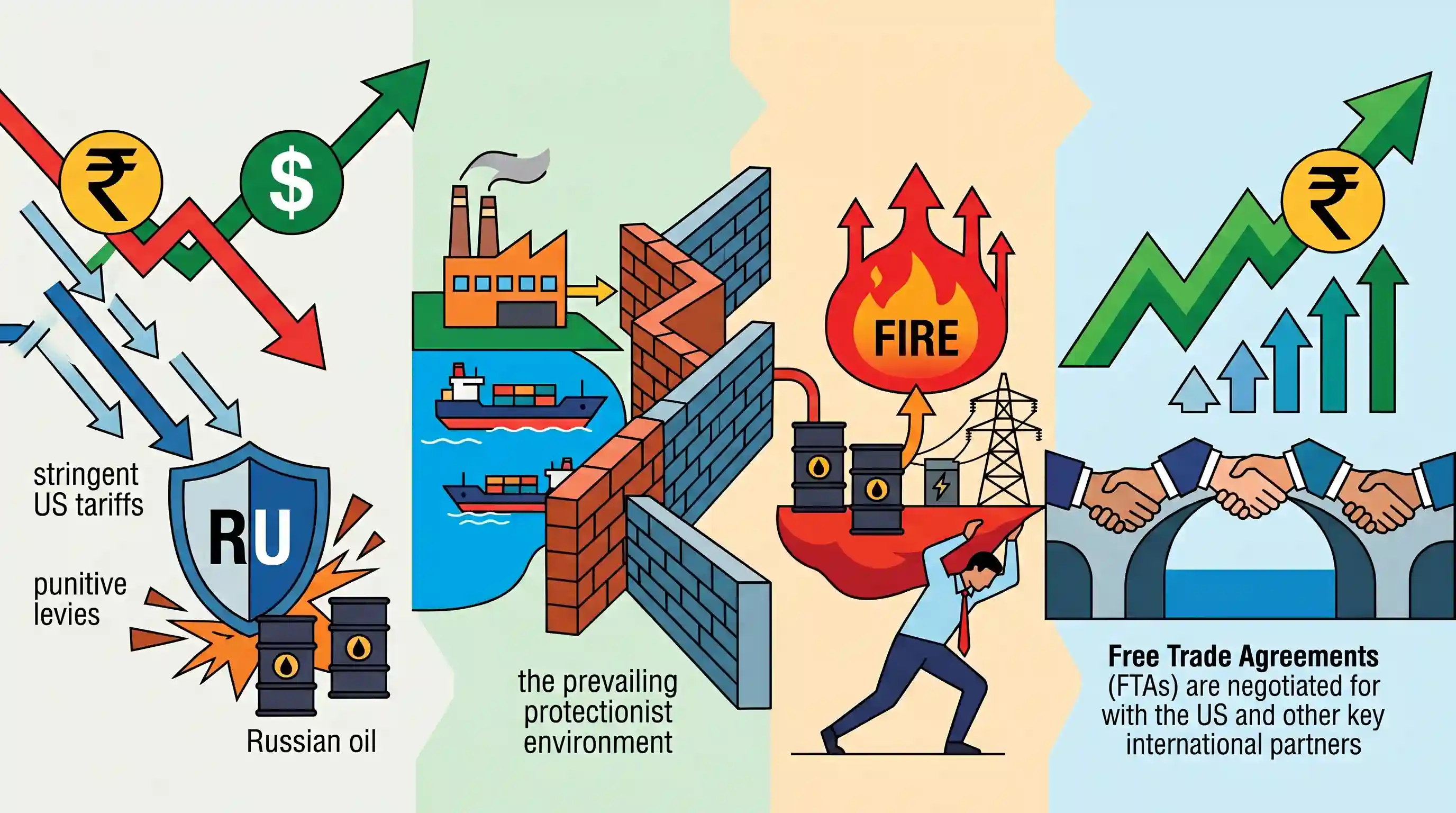
The Indian Rupee has depreciated to record lows against the US Dollar, largely driven by external shocks such as stringent US tariffs, including punitive levies on India for purchasing Russian oil. While a weaker currency typically offers a competitive edge to exporters, the prevailing protectionist environment negates this advantage and instead exacerbates India's imported inflation and fiscal strain, given its heavy reliance on energy imports. The editorial argues that rather than relying solely on central bank interventions, India must actively negotiate and close Free Trade Agreements (FTAs) with the US and other key partners to secure market access, counter protectionist headwinds, and fundamentally strengthen the rupee.
Key Points
- The Indian Rupee recently fell to an all-time low of 88.44 against the US dollar, depreciating while other major and emerging market currencies have strengthened.
- The sharp depreciation is heavily attributed to protectionist US trade policies, including a 50% tariff imposition, half of which is a penalty for purchasing Russian oil.
- As a net energy importer, a weaker rupee exacerbates India's macroeconomic challenges by fueling imported inflation and straining government finances.
- While a devalued currency can theoretically improve export competitiveness, this benefit is stifled by rising global tariffs and lack of market access.
- To stabilize the external sector and structurally strengthen the rupee, India needs to expedite and finalize comprehensive trade deals with the US and other strategic partners.
Important Terms
Free Trade Agreements (FTAs)

Treaties between two or more countries to reduce or eliminate trade barriers like tariffs and quotas, facilitating easier cross-border flow of goods and services.
UPSC context
GS II (IR) and GS III (Economy); tests understanding of trade policy, market access, and global economic integration.
Reserve Bank of India (RBI)
India’s central bank that regulates the banking sector, controls monetary policy, and manages the rupee’s exchange rate through market interventions to ensure financial stability.
UPSC context
GS III (Economy); essential for understanding monetary tools, inflation targeting, and foreign exchange management.
Protectionism
Policy of restricting international trade through tariffs, quotas, or subsidies to protect domestic industries from foreign competition, often leading to higher consumer costs.
UPSC context
GS III (Economy); assesses impact of trade barriers on exports, growth, and global supply chain resilience.
Imported Inflation
A rise in domestic prices caused by the increased cost of imported goods, typically resulting from currency depreciation or surges in global commodity prices.
UPSC context
GS III (Economy); tests knowledge of inflation mechanisms and external shocks to the domestic economy.
Balance of Payments (BoP)
A comprehensive ledger recording all financial transactions between a country’s residents and the rest of the world, comprising current, capital, and financial accounts.
UPSC context
GS III (Economy); crucial for analyzing external sector health, trade deficits, and foreign reserve movements.
Exchange Rate Dynamics
Fluctuations in a currency's value relative to others, driven by market demand and supply, interest rates, inflation, and central bank interventions.
UPSC context
GS III (Economy); critical for evaluating trade competitiveness, export performance, and currency stability.
Prelims Trap
Continuous depreciation of the Indian Rupee will necessarily reduce the trade deficit by boosting exports.
Depreciation theoretically makes exports cheaper, but rising global tariffs (protectionism) and highly inelastic import demand (like crude oil) often negate this, worsening the trade deficit.
Static Concepts Connected
How does depreciation differ from devaluation in India's exchange rate system?
- Depreciation: A market-driven fall in a currency's value in a floating exchange rate system due to demand and supply forces.
- Devaluation: A deliberate downward adjustment of a currency's value by the government or central bank in a fixed exchange rate system.
- Managed Float: India uses a managed floating system where the RBI intervenes to curb extreme volatility, not to peg a specific rate.
What is 'Imported Inflation' and how does a weakening Rupee drive it?
- Definition: A rise in the general price level caused by higher costs of imported raw materials (like crude oil or fertilizers) and finished goods.
- Exchange Rate Link: A depreciating Rupee means more local currency is required to buy dollars, instantly inflating the domestic retail price of essential dollar-denominated imports.
- Macroeconomic Impact: It forces the RBI to maintain tighter monetary policies to control prices, which can inadvertently slow down domestic economic growth.
Cross-Topic Patterns
Energy security vs. Trade sanctions
Buying discounted Russian oil stabilized India's macro-economy initially. However, punitive US tariffs targeting this practice link India's energy sourcing directly to balance of payments stress.
FTAs as geoeconomic shields
Modern FTAs are no longer just about tariff reduction; they act as critical geoeconomic buffers against unilateral protectionist policies, securing market access when WTO dispute mechanisms stall.

Expect a 2026 Prelims question testing the limitations of currency depreciation on export growth during a period of rising global protectionism.
Linked PYQs · 4
Linked PYQs · 4
- 2022PrelimsGS1
With reference to the Indian economy, consider the following statements: 1. If the inflation is too high, Reserve Bank of India (RBI) is likely to buy government securities. 2. If the rupee is rapidly depreciating, RBI is likely to sell dollars in the market. 3. If interest rates in the USA or European Union were to fall, that is likely to induce RBI to buy dollars. Which of the statements given above are correct?
- 2021PrelimsGS1
Consider the following statements : The effect of devaluation of a currency is that it necessarily 1. improves the competitiveness of the domestic exports in the foreign markets 2. increases the foreign value of domestic currency 3. improves the trade balance Which of the above statements is/are correct?
- 2018MainsGS3
How would the recent phenomena of protectionism and currency manipulations in world trade affect macroeconomic stability of India?
- 2019MainsGS2
‘What introduces friction into the ties between India and the United States is that Washington is still unable to find for India a position in its global strategy, which would satisfy India's national self-esteem and ambitions.’ Explain with suitable examples.
