Madhya Pradesh Government Warehouse Foodgrain Spoilage
Source:timesofindia ↗
Why It Matters
This article directly addresses critical issues of food storage, waste, and logistics under India's Public Distribution System. It highlights how operational inefficiency and coordination failure between state-level procurement and warehousing agencies (MP State Civil Supplies Corporation and State Warehousing Corporation) lead to heavy public losses and undermine food security initiatives like the National Food Security Act (NFSA), 2013.
Summary
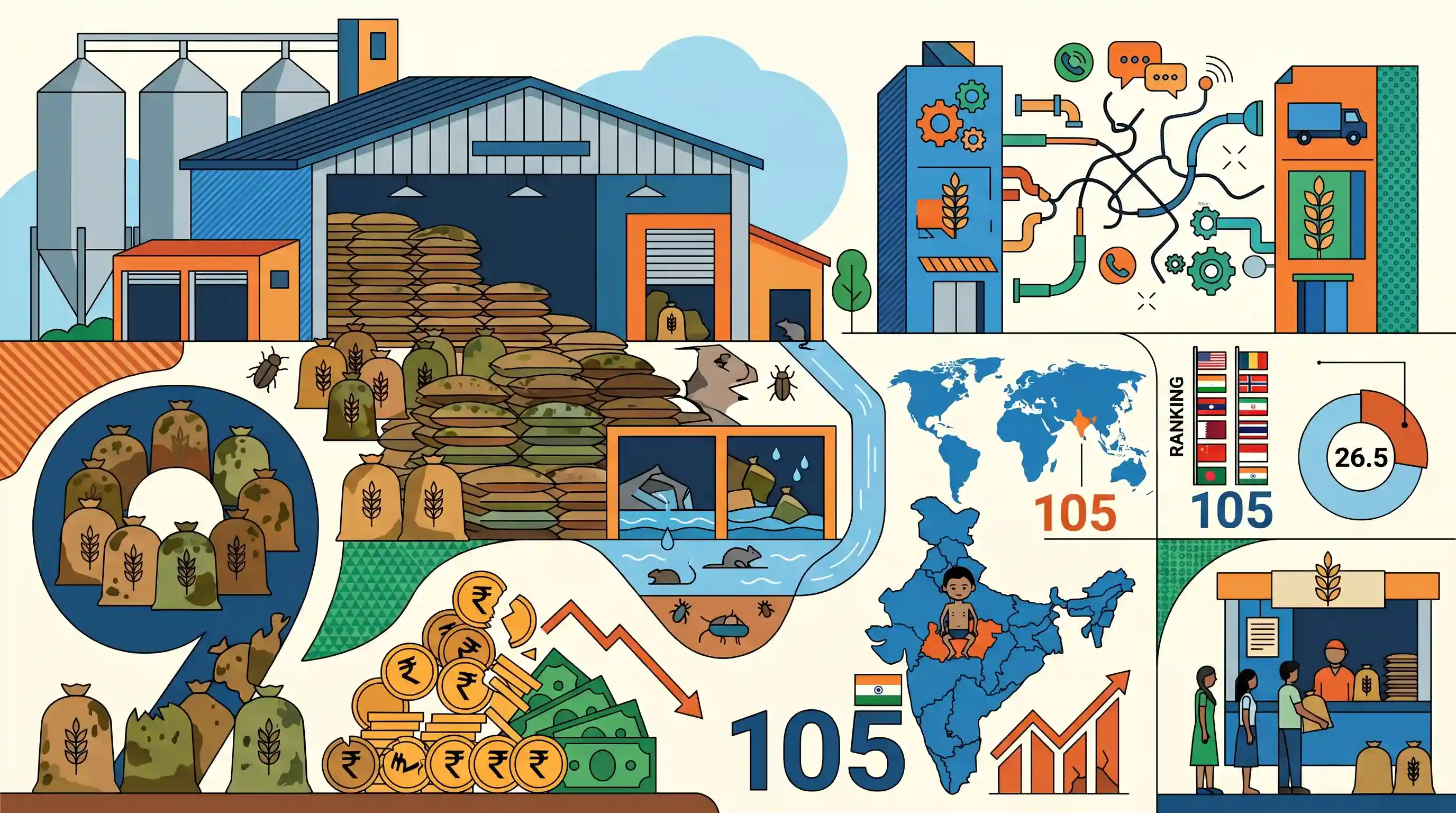
An estimated 9 lakh quintals of foodgrains, mostly wheat, have rotted in government warehouses in Madhya Pradesh, resulting in a ₹200 crore loss. This massive waste highlights critical gaps in storage and logistics coordinate between the MP State Civil Supplies Corporation and the MP State Warehousing and Logistics Corporation. The incident underscores India's struggle with food security and child malnutrition, as Madhya Pradesh has the country's highest percentage of underweight children under five (26.5%), and India ranks 105th on the Global Hunger Index.
Key Points
- Approximately 9 lakh quintals of foodgrains, of which over 90% was wheat, rotted in government-run warehouses in Madhya Pradesh, leading to an estimated financial loss of around ₹200 crore.
- The wasted foodgrain quantity is nearly equivalent to the entire state of Madhya Pradesh's monthly wheat allotment under the Public Distribution System (which was around 11 lakh quintals in January 2025).
- This severe food storage mismanagement occurs against the backdrop of high malnutrition; 26.5% of children under the age of 5 in MP are underweight (the highest in India as of October 2023) and India ranks 105th on the Global Hunger Index.
- The procurement mechanism involves purchasing foodgrains from farmers via cooperative societies, storing them in facilities run by the MP State Warehousing and Logistics Corporation, and distribution by the MP State Civil Supplies Corporation. Delay in picking up the stock on time by the Civil Supplies Corporation caused the spoilage.
- To recover some costs, the Civil Supplies Corporation issued tenders to auction the rotten grain across five categories: Feed I and II (fit for cattle), Feed III (poultry feed), Industrial/Manure use, and pure Manure (unfit for feed or industrial use).
Important Terms
National Food Security Act (NFSA), 2013

An Indian law providing food and nutritional security by legally entitling up to 75% of rural and 50% of urban populations to receive free or highly subsidized food grains through the Targeted Public Distribution System.
UPSC context
GS Paper 2: Welfare schemes for vulnerable sections; GS Paper 3: Issues of buffer stocks, food security, and PDS.
Public Distribution System (PDS)
An Indian food security mechanism that procures food grains from farmers at Minimum Support Prices and distributes them to vulnerable populations at subsidized rates through a nationwide network of Fair Price Shops.
UPSC context
GS Paper 3: PDS objectives, functioning, limitations, revamping, and food security buffer stock management.
Mukhyamantri Ladli Behna Yojana
A welfare scheme in Madhya Pradesh providing monthly financial aid directly to eligible women to foster economic self-reliance, improve health, and encourage family-level decision-making.
UPSC context
GS Paper 2: Welfare schemes for vulnerable sections, women empowerment, and child health/nutrition indicators.
Madhya Pradesh State Warehousing and Logistics Corporation
A state government body in Madhya Pradesh responsible for the scientific storage, preservation, and logistics of agricultural produce, seeds, and fertilizers to minimize post-harvest food grain losses.
UPSC context
GS Paper 3: Storage, transport, and warehousing infrastructure in agriculture, post-harvest losses, and supply chain management.
Madhya Pradesh State Civil Supplies Corporation
A state-level public undertaking in Madhya Pradesh responsible for procuring foodgrains at Minimum Support Prices and ensuring their distribution through the Public Distribution System.
UPSC context
GS Paper 3: Public Distribution System functioning, procurement at Minimum Support Prices, and agricultural marketing.
Prelims Trap
State Food Commissions are non-statutory advisory bodies established via executive orders of respective state governments.
Under Section 16 of the National Food Security Act (NFSA) 2013, every State Government must constitute a statutory State Food Commission, which possesses specific civil court-like powers rather than just advisory status.
Static Concepts Connected
What is the Decentralized Procurement Scheme (DPS) of foodgrains in India?
- State Autonomy: State agencies directly procure, store, and distribute foodgrains under the targeted public distribution system instead of relying on the central Food Corporation of India (FCI).
- FCI Role: FCI only intercedes to take over surplus grains from state agencies for the central pool or to supply deficit states.
- Financial Subsidy: The Central Government reimburses the state governments for the economic cost of procurement based on mutually approved costing sheets.
What are the four core indicators used to calculate the Global Hunger Index (GHI)?
- Undernourishment: The share of the population with insufficient caloric intake (measures chronic hunger).
- Child Stunting: The share of children under five who have low height for their age, reflecting chronic undernutrition.
- Child Wasting: The share of children under five who have low weight for their height, reflecting acute undernutrition.
- Child Mortality: The mortality rate of children under the age of five, reflecting the fatal mix of inadequate nutrition and unhealthy environments.
Cross-Topic Patterns
PDS storage vs. climate-resilient agriculture
Inadequate scientific storage makes bumper open-cap harvests highly vulnerable to unseasonal extreme weather events, directly jeopardizing fiscal outlays and food security.
Malnutrition paradox vs. decentralized governance
The coexistence of decaying state grains and rising NFHS child-underweight statistics exposes major institutional gaps in localized governance and targeted nutritional delivery.

UPSC 2026 may contrast record buffer stocks with persistent NFHS child wasting to test reforms in cold-chain logistics and PDS supply chains.
Linked PYQs · 3
Linked PYQs · 3
- 2023MPPSC_PRELIMSGS1
The Food Preservation Commission is a statutory body established under which of the following Acts?
- 2008MPPSC_PRELIMSGS1
Public Distribution System is aimed at :
- 2023MPPSC_PRELIMSGS1
Which of the following is not a National Nutrition Programme of the Government of India?
