Ethanol blending targets and food versus fuel policy trade-offs
Source:The Hindu ↗
Why It Matters
The article illustrates the critical trade-offs in public policy between achieving renewable energy targets (reducing fossil fuel dependence) and ensuring food security (managing food inflation and agricultural shortfalls). It directly maps to GS3 topics on energy, cropping patterns, and agricultural pricing.
Summary
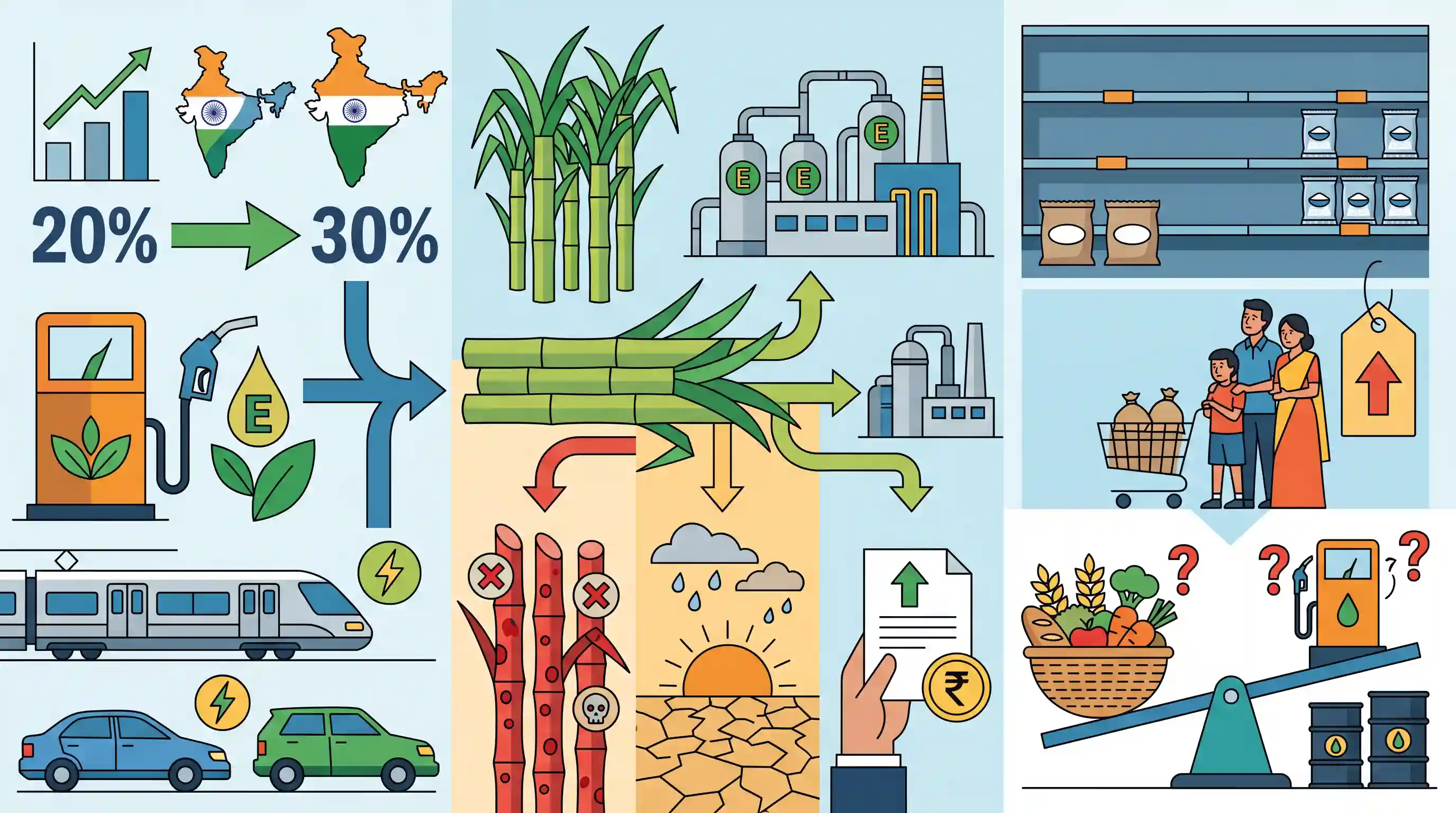
India's Ethanol Blending Programme (EBP) has successfully reached its 20% target ahead of schedule, sparking discussions for an ambitious 30% goal. However, this surge in ethanol production relies heavily on sugarcane diversion, which, coupled with declining crop yields due to red-rot disease and rainfall deficits, has constrained sugar supplies. The resulting supply pressure and recent hikes in the Fair Remunerative Price (FRP) have driven up retail sugar prices, bringing the classic 'food vs. fuel' debate to the forefront of India's agricultural and energy policymaking.
Key Points
- India achieved its 20% ethanol blending target in petrol in 2025, ahead of the original 2030 deadline, and is now considering a 30% target.
- Sugarcane production has declined since FY23 due to factors like red-rot disease, deficient rainfall, and flowering issues.
- The diversion of sugarcane for ethanol (reaching nearly 670 crore litres in FY24) has intensified the 'food vs. fuel' debate by impacting domestic sugar availability.
- A recent hike in the Fair Remunerative Price (FRP) for sugarcane to protect farmers, combined with supply constraints, has driven retail sugar prices up to ₹45 per kg.
- To mitigate sugarcane shortfalls and manage the blending program, the government is exploring the use of grains for ethanol production.
Important Terms
Ethanol Blending Programme (EBP)

A government initiative to mix ethanol with petrol to reduce crude oil imports, lower greenhouse gas emissions, and boost farmer incomes.
UPSC context
GS Paper III: Energy Security; tests knowledge of renewable energy targets and agricultural diversification strategies.
Fair Remunerative Price (FRP)
The government-mandated minimum price that sugar mills are legally bound to pay sugarcane farmers, recommended by CACP and approved by CCEA.
UPSC context
GS Paper III: Agriculture; tests understanding of statutory pricing mechanisms and farmer income support in India.
National Policy on Biofuels (NPB) 2018
A strategic framework that categorizes biofuels (1G, 2G, 3G) and sets blending targets to reduce fossil fuel dependence.
UPSC context
GS Paper III: Environment/Energy; tests policy shifts in biofuels and India's global climate commitments (Panchamrit).
Red-rot disease
A devastating fungal disease of sugarcane (Colletotrichum falcatum) known as 'sugarcane cancer' that causes significant loss in yield and sugar content.
UPSC context
GS Paper III: Agriculture/Science; tests awareness of biological threats to cash crops and their impact on agro-industries.
Ministry of Petroleum and Natural Gas (MoPNG)
The nodal Union Ministry responsible for exploration, production, and distribution of oil, natural gas, and the implementation of ethanol blending.
UPSC context
GS Paper II: Governance; tests institutional roles in managing India's energy transition and strategic fuel reserves.
Food vs Fuel Debate
The policy dilemma of whether to use agricultural crops (like sugarcane and maize) for biofuel production or for food consumption.
UPSC context
GS Paper III: Food Security; tests critical analysis of energy security versus nutritional security and food inflation.
Centre for Monitoring Indian Economy (CMIE)
A private economic think tank providing high-frequency data and business intelligence on India's macroeconomic indicators, including unemployment and inflation.
UPSC context
GS Paper III: Indian Economy; tests the use of non-governmental datasets in analyzing socio-economic trends.
Prelims Trap
Ethanol for the blending programme can only be extracted from surplus sugarcane.
The National Policy on Biofuels explicitly permits ethanol production from damaged food grains (wheat, broken rice) and surplus maize, not just sugarcane.
Static Concepts Connected
What is the statutory pricing mechanism (FRP) for Sugarcane in India?
- Statutory backing: Governed by the Sugarcane (Control) Order, 1966 under the Essential Commodities Act.
- Approval authority: Recommended by the Commission for Agricultural Costs and Prices (CACP) but approved by the CCEA.
- State Advised Price: Several states announce a higher State Advised Price (SAP), which overrides the FRP for local sugar mills.
How are biofuels classified based on their feedstock generations?
- First Generation (1G): Produced directly from edible food crops like sugarcane, wheat, and maize grown on arable land.
- Second Generation (2G): Derived from non-edible agricultural waste, cellulosic biomass, or woody crops (e.g., crop stubble).
- Third & Fourth: 3G relies on algae; 4G uses genetically engineered crops or microbes specifically to capture and store carbon.
Cross-Topic Patterns
Biofuels + Monetary Policy (Inflation)
The diversion of sugarcane and maize to fuel increases food inflation, complicating the RBI's inflation-targeting mandate and highlighting the macroeconomic 'Food vs Fuel' trade-off.
Climate Change + Plant Pathology
Rising occurrences of Red-Rot fungal disease are linked to changing rainfall patterns, directly threatening both food and energy-security targets by drastically reducing sugarcane yields.

A multi-statement Prelims question comparing 1G vs 2G biofuel feedstocks alongside the statutory mechanism of sugarcane FRP is highly likely.
Linked PYQs · 4
Linked PYQs · 4
- 2009PrelimsGS1
In the context of alternative sources of energy, ethanol as a viable bio-fuel can be obtained from
- 2015PrelimsGS1
The Fair and Remunerative Price (FRP) of sugarcane is approved by the
- 2023MainsGS3
Discuss several ways in which microorganisms can help in meeting the current fuel shortage.
- 2025PrelimsGS1
Consider the following statements : Statement I: Of the two major ethanol producers in the world, i.e., Brazil and the United States of America, the former produces more ethanol than the latter. Statement II: Unlike in the United States of America where corn is the principal feedstock for ethanol production, sugarcane is the principal feedstock for ethanol production in Brazil. Which one of the following is correct in respect of the above statements?
