National Food Security Act Amendments and Impact on Vulnerable Groups
Source:Indian Express ↗
हे का महत्त्वाचे आहे
Crucial for understanding contemporary debates on social safety nets, welfare delivery mechanisms, and legislative changes impacting the National Food Security Act, which forms a core component of GS2 (Governance/Welfare) and GS3 (Agriculture/Food Security).
सारांश
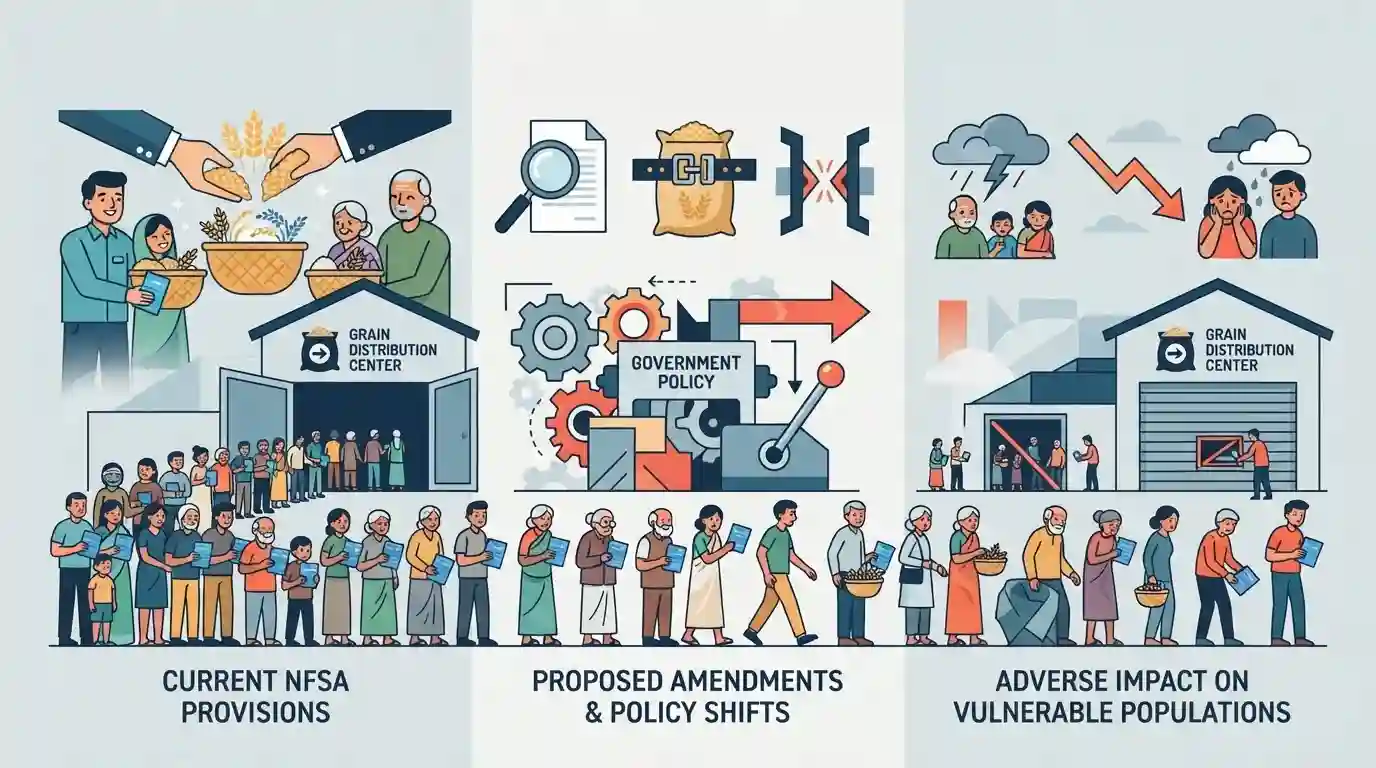
This opinion piece examines the proposed amendments to the National Food Security Act (NFSA), arguing that changes tightening eligibility or altering provisions could adversely affect the poorest and most vulnerable populations dependent on subsidised food grains through the Targeted Public Distribution System.
मुख्य मुद्दे
- Proposed amendments to the National Food Security Act (NFSA) threaten to undermine food security provisions for the poorest segments of society.
- Shifting from universal or broad-based entitlements to exclusionary criteria or altered eligibility can lead to the exclusion of genuine beneficiaries (exclusion errors).
- Food security is a cornerstone of India's welfare architecture, intersecting with poverty alleviation, nutritional outcomes, and agricultural price stabilization.
- Debates around public distribution system (PDS) reforms often balance fiscal prudence with the constitutional mandate of a welfare state.
महत्त्वाच्या संज्ञा
National Food Security Act (NFSA) 2013

A landmark 2013 Indian legislation that legally entitles about two-thirds of the population to subsidized food grains, shifting food security from a welfare approach to a rights-based approach.
UPSC context
GS Paper II & III: Essential for welfare schemes, food security, and poverty alleviation policies.
Targeted Public Distribution System (TPDS)
An operational system in India that channels subsidized food grains specifically to targeted vulnerable populations categorized into Priority Households and Antyodaya Anna Yojana.
UPSC context
GS Paper III (Agriculture): Tests understanding of food distribution mechanisms, supply chains, and buffer stock management.
पूर्वपरीक्षा सापळा
legally entitles approximately 67% of India's total population (75% rural and 50% urban)
Aspirants often confuse the statutory coverage percentages of the NFSA. It is 67% overall, comprising 75% of the rural population and 50% of the urban population, not a uniform 67% across both.
संबंधित स्थिर संकल्पना
What are the primary categories and grain entitlements under the National Food Security Act (NFSA), 2013?
- Coverage Scale: Covers roughly 67% of India’s population—75% in rural areas and 50% in urban areas.
- Priority Households: Entitled to receive 5 kg of food grains per person per month at highly subsidized prices (₹3/2/1 per kg for rice/wheat/coarse grains).
- AAY Households: Poorest of the poor families receive 35 kg of food grains per household per month at the same highly subsidized rates.
आंतर-विषय नमुने
NFSA Entitlements vs. Fiscal Deficit Consolidation
The debate between fiscal deficit targets and legal welfare entitlements under the NFSA mirrors fiscal federalism and Centre-State subsidy-sharing disputes.
Census Delays and Welfare Exclusion Errors
Exclusion errors caused by relying on outdated 2011 census data link welfare delivery failures directly to the long-delayed decennial census.

NFSA coverage criteria + AAY vs PHH entitlements + Census 2011 data reliance will likely feature in a welfare/governance match or statement MCQ.
संबंधित PYQ · 2
संबंधित PYQ · 2
- 2023MainsGS2
“Development and welfare schemes for the vulnerable, by its nature, are discriminatory in approach.” Do you agree? Give reasons for your answer.
- 2024MainsGS3
Elucidate the importance of buffer stocks for stabilizing agricultural prices in India. What are the challenges associated with the storage of buffer stock? Discuss.
