Retail Inflation Trends and Food Price Volatility
Source:Indian Express ↗
Why It Matters
Inflation is a fundamental macroeconomic indicator frequently tested in UPSC Prelims and Mains. Understanding the composition of the CPI basket (especially the high weightage of food), the causes of food inflation, and how it influences the RBI's monetary policy (inflation targeting) is essential for GS Paper 3 (Indian Economy).
Summary
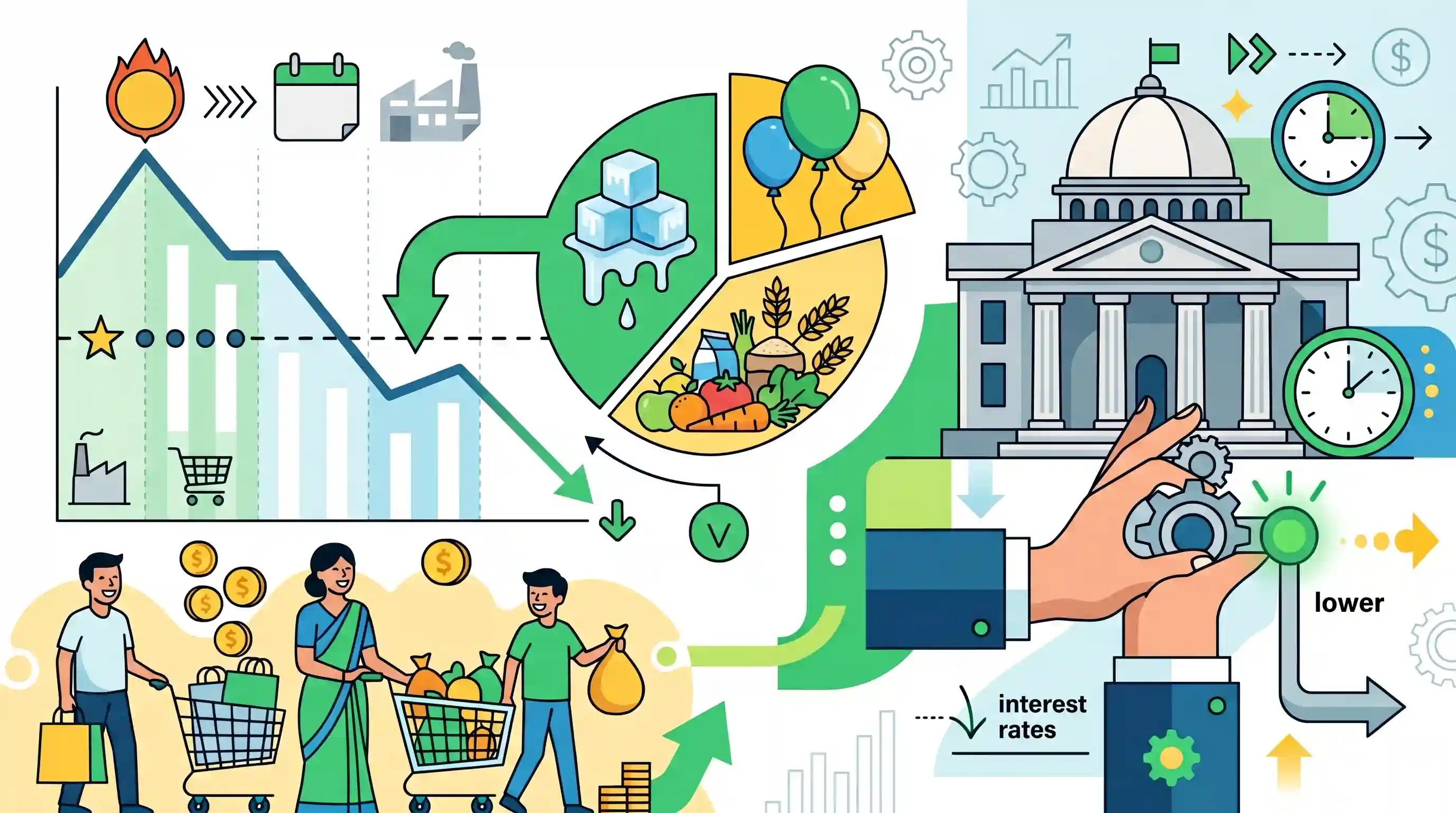
India's retail inflation, measured by the Consumer Price Index (CPI), fell to 2.82% in May, marking its lowest level since February 2019. This significant decline was primarily driven by a drop in food prices. Because food and beverages constitute a large portion of the CPI basket, fluctuations in food prices heavily dictate the overall retail inflation trajectory. This moderation in price pressures provides relief to consumers and brings inflation well below the Reserve Bank of India's (RBI) target of 4%, which could shape the central bank's future monetary policy stance regarding benchmark interest rates.
Key Points
- Retail inflation, measured by the Consumer Price Index (CPI), declined to 2.82% in May, the lowest since February 2019.
- The fall in overall inflation was primarily driven by a decrease in food prices.
- Food and beverages hold a significantly higher weightage in the CPI basket compared to the Wholesale Price Index (WPI), making retail inflation highly sensitive to food price fluctuations.
- The moderation in CPI inflation brings it well below the Reserve Bank of India's (RBI) medium-term target of 4%, potentially influencing future monetary policy and interest rate decisions.
Important Terms
Reserve Bank of India (RBI)

India's central bank and regulatory body responsible for maintaining monetary stability, managing currency, and controlling inflation through the Monetary Policy Committee.
UPSC context
GS Paper III (Indian Economy); tests knowledge of central banking, inflation control, and liquidity management tools.
Consumer Price Index (CPI)
A primary index measuring retail-level price changes for a fixed basket of goods and services; used as the headline inflation metric for monetary policy.
UPSC context
GS Paper III (Economy); essential for understanding purchasing power, cost of living, and real interest rate calculations.
Monetary Policy Committee (MPC)
A statutory body formed under the RBI Act, 1934, that determines the benchmark repo rate to achieve the target inflation of 4% (+/- 2%).
UPSC context
GS Paper III (Economy); focuses on the institutional framework and decision-making process for price stability.
National Statistical Office (NSO)
An agency under the Ministry of Statistics and Programme Implementation (MoSPI) responsible for compiling and releasing key economic data including CPI and GDP.
UPSC context
GS Paper III (Economy); critical for identifying official data sources and statistical methodologies for macroeconomic indicators.
Consumer Food Price Index (CFPI)
A measure of change in retail prices of food products, which holds significant weight in the Indian CPI basket due to high household spending.
UPSC context
GS Paper III (Economy/Agriculture); tests understanding of supply-side inflation drivers and their impact on the overall economy.
Prelims Trap
"The RBI's official mandate under the FIT framework is to maintain Core Inflation at 4%."
The FIT framework legally mandates the RBI to target Headline CPI, not Core CPI. While Core is tracked for underlying trends, the official 4% target applies strictly to all-commodity Headline retail inflation.
Static Concepts Connected
How do CPI and WPI differ in measuring inflation?
- Services inclusion: CPI captures price changes at the retail level for both goods and services, whereas WPI exclusively measures wholesale goods.
- Food weightage: Food accounts for nearly 46% of the CPI basket, compared to just 24% in WPI, making retail inflation highly sensitive to agricultural prices.
- Publishing agency: The NSO (MoSPI) releases the CPI, while the Office of Economic Adviser (Ministry of Commerce and Industry) compiles the WPI.
What are the legal parameters of Flexible Inflation Targeting (FIT)?
- Statutory basis: Instituted through a 2016 amendment to the Reserve Bank of India Act, 1934, legally binding the central bank to the framework.
- Target band: The official target is 4% Headline CPI, with an upper tolerance limit of 6% and a lower limit of 2%.
- Accountability: If inflation stays outside the 2-6% tolerance band for three consecutive quarters, the RBI must submit a report to the Government explaining the failure.
Cross-Topic Patterns
Climate Shocks & Monetary Policy
Frequent climate anomalies like El Niño disrupt agricultural yields, driving food inflation. This supply-side shock directly restricts the RBI's ability to lower interest rates to spur economic growth.
Supply-Side vs Demand-Pull Interventions
While RBI's repo rate manages demand-pull inflation, structural food inflation requires fiscal and administrative interventions like export bans, import duty cuts, and buffer stock releases (OMSS).

Expect a 2026 multi-statement Prelims question testing the limitations of RBI's repo rate in curbing supply-driven food inflation.
Linked PYQs · 4
Linked PYQs · 4
- 2020PrelimsGS1
Consider the following statements: 1. The weightage of food in Consumer Price Index (CPI) is higher than that in Wholesale Price Index (WPI). 2. The WPI does not capture changes in the prices of services, which CPI does. 3. Reserve Bank of India has now adopted WPI as its key measure of inflation and to decide on changing the key policy rates. Which of the statements given above is/are correct?
- 2010PrelimsGS1
With reference to India, consider the following statements : 1. The Wholesale Price Index (WPI) in India is available on a monthly basis only. 2. As compared to Consumer Price Index for Industrial Workers (CPI(IW)), the WPI gives less weight to food articles. Which of the statements given above is/are correct ?
- 2024MainsGS3
What are the causes of persistent high food inflation in India? Comment on the effectiveness of the monetary policy of the RBI to control this type of inflation.
- 2014MainsGS3
There is also a point of view that Agricultural Produce Market Committees (APMCs) set up under the State Acts have not only impeded the development of agriculture but also have been the cause of food inflation in India. Critically examine.
