Retail Inflation Trends: Food Price Dynamics and RBI Mandate
Source:Indian Express ↗
Why It Matters
The interplay between food prices and overall retail inflation is a core macroeconomic concept for UPSC, directly tying into the RBI's inflation targeting mandate and monetary policy decisions.
Summary
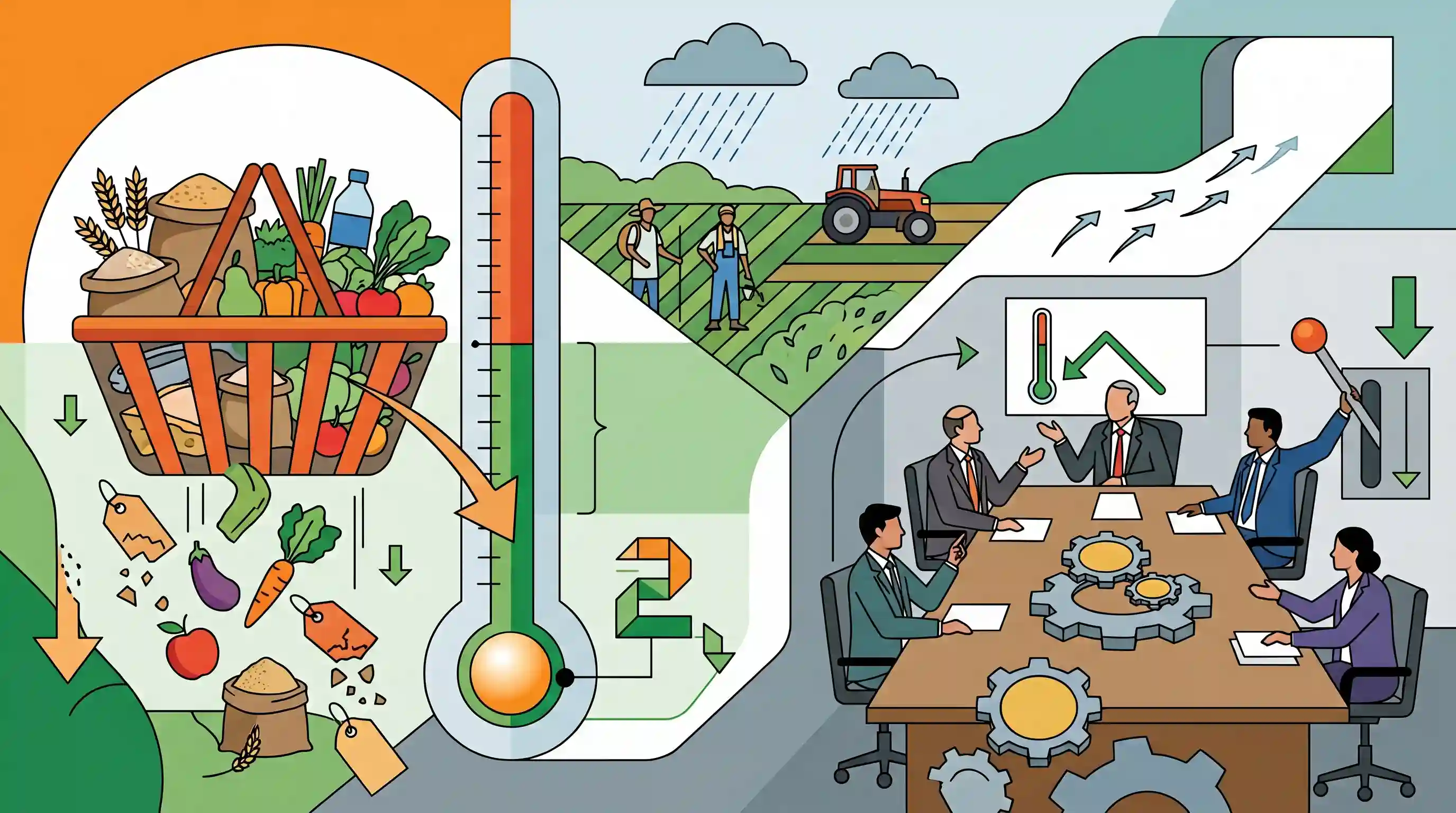
Early indicators suggest that India's consumer price index (CPI) inflation for June may drop to an unusually low 2-2.1%. This steep decline is largely attributed to softening food prices, which carry significant weight in the retail inflation basket. Falling to the bottom edge of the Reserve Bank of India's 2-6% tolerance band, this development highlights the heavy reliance of headline inflation on agricultural supply dynamics. A sustained easing of inflationary pressures could provide the RBI's Monetary Policy Committee with the headroom needed to consider reducing interest rates.
Key Points
- Headline retail inflation (CPI) for June is projected to fall sharply to 2-2.1%, primarily due to a significant moderation in food prices.
- Food items carry a dominant weightage in India's CPI basket, meaning agricultural price fluctuations heavily dictate overall inflation trends.
- The projected 2% inflation rate touches the lower end of the RBI's mandated inflation targeting band of 4% (+/- 2%).
- A sustained drop in inflation could prompt the RBI's Monetary Policy Committee to ease its stance and consider interest rate cuts to support growth.
Important Terms
Reserve Bank of India (RBI)

India's central bank and regulatory authority for the banking system. It formulates monetary policy, manages currency, and oversees foreign exchange to ensure financial stability and sustainable economic growth.
UPSC context
GS Paper III (Indian Economy); tests understanding of central bank roles, liquidity control, and the institutional framework for economic stability.
Monetary Policy Committee (MPC)
A six-member statutory body, chaired by the RBI Governor, responsible for fixing the benchmark interest rate (repo rate) to keep retail inflation within the government-mandated target range.
UPSC context
GS Paper III (Indian Economy); tests knowledge of the institutional mechanism for inflation targeting and the repo rate's impact on liquidity.
Consumer Price Index (CPI)
A retail-level price index measuring the average change in prices for a basket of goods and services consumed by households, representing the cost of living and retail inflation.
UPSC context
GS Paper III (Indian Economy); primary metric for monetary policy formulation and the official anchor for inflation targeting in India.
Headline Inflation
The total inflation figure for an economy, calculated using all items in the price index, including volatile components like food and fuel that are subject to supply shocks.
UPSC context
GS Paper III (Indian Economy); tests the distinction between total price changes and persistent underlying (core) inflation trends.
Flexible Inflation Targeting (FIT)
A monetary framework where the government sets a target inflation rate (currently 4% with a 2–6% band) for the RBI to maintain while also considering economic growth objectives.
UPSC context
GS Paper III (Indian Economy); key topic concerning the legal mandate of the RBI and reforms in India’s monetary policy framework.
Consumer Food Price Index (CFPI)
A sub-index of the CPI that tracks changes in the retail prices of food products, which holds significant weight in India’s retail inflation basket due to high consumption.
UPSC context
GS Paper III (Economy/Agriculture); tests understanding of supply-side inflation factors and the role of agricultural commodities in price stability.
Prelims Trap
"The RBI uses Core Inflation (excluding food and fuel) as the primary anchor for monetary policy."
The RBI's Flexible Inflation Targeting framework explicitly targets Headline CPI (Combined), not Core CPI. Therefore, volatile food and fuel prices directly dictate India's benchmark interest rates.
Static Concepts Connected
What is the mandate and structure of the Monetary Policy Committee (MPC)?
- Statutory Body: Formed under the RBI Act, 1934 (amended in 2016) with 6 members (3 RBI officials, 3 appointed by the Central Government).
- Inflation Target: Mandated to maintain Headline CPI inflation at a central target of 4%, with a tolerance band of 2% to 6%.
- Decision Making: Determines the benchmark policy rate (repo rate) by majority vote. The RBI Governor acts as ex-officio chairperson and holds a casting vote.
How does CPI differ from WPI in measuring Indian inflation?
- Food Weightage: CPI assigns approx 46% weightage to food and beverages, making it highly sensitive to agriculture. WPI gives food a significantly lower weightage.
- Services & Scope: CPI tracks prices at the retail consumer level and includes services (like housing and health). WPI tracks wholesale goods and excludes services entirely.
Cross-Topic Patterns
Monetary policy limits on supply-driven inflation
Rate cuts stimulate demand, but agricultural bottlenecks historically dominate India's inflation, exposing the limits of repo rate interventions on structural supply-side shocks.
Climate patterns dictating RBI's monetary stance
With food driving nearly half of the CPI basket, monsoon variability directly impacts the RBI's ability to lower interest rates, tightly linking physical geography to macroeconomic policy.

Expect a 2026 prelims statement testing the exact statutory mandate of MPC linking CPI (Combined) weightages to agricultural supply shocks.
Linked PYQs · 3
Linked PYQs · 3
- 2024MainsGS3
What are the causes of persistent high food inflation in India? Comment on the effectiveness of the monetary policy of the RBI to control this type of inflation.
- 2020PrelimsGS1
Consider the following statements: 1. The weightage of food in Consumer Price Index (CPI) is higher than that in Wholesale Price Index (WPI). 2. The WPI does not capture changes in the prices of services, which CPI does. 3. Reserve Bank of India has now adopted WPI as its key measure of inflation and to decide on changing the key policy rates. Which of the statements given above is/are correct?
- 2010PrelimsGS1
With reference to India, consider the following statements : 1. The Wholesale Price Index (WPI) in India is available on a monthly basis only. 2. As compared to Consumer Price Index for Industrial Workers (CPI(IW)), the WPI gives less weight to food articles. Which of the statements given above is/are correct ?
