Food Adulteration and FSSAI Regulatory Challenges in India
Source:The Hindu ↗
Why It Matters
Food safety and adulteration directly impact public health, consumer rights, and agricultural supply chain integrity. For UPSC aspirants, understanding regulatory architecture like FSSAI, enforcement gaps, and health implications is critical for questions concerning governance, food security, and social welfare in GS Paper III.
Summary
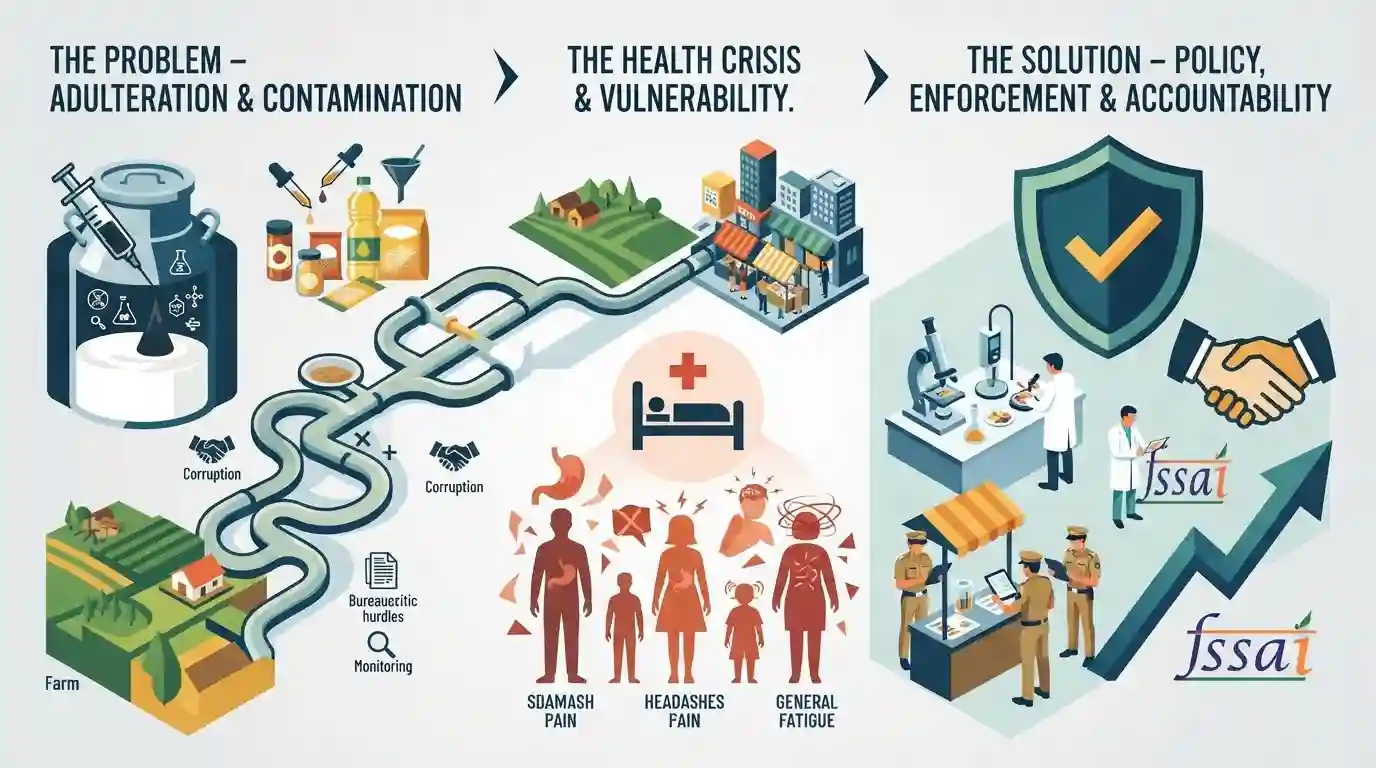
The article investigates the pervasive issue of food adulteration and milk safety in India, shedding light on the regulatory loopholes, infrastructural gaps within agencies like the FSSAI, and the severe health risks posed by contaminated food products. It highlights the challenges of monitoring complex supply chains and emphasizes the urgent need for stricter enforcement, enhanced testing capabilities, and comprehensive accountability mechanisms to protect public health.
Key Points
- Food adulteration remains a pervasive public health and consumer safety issue in India, affecting essential commodities like milk, spices, and everyday food products.
- Regulatory bodies such as the FSSAI face acute capacity constraints, including inadequate testing infrastructure, staff shortages, and enforcement bottlenecks at state and local levels.
- Adulteration not only cheats consumers economically but poses severe, long-term health risks, including chronic toxicity, organ damage, and anti-microbial resistance.
- Tighter supply-chain transparency, stricter penalties, and enhanced grassroots monitoring are vital to curb food fraud and ensure food safety compliance.
Important Terms
Food Safety and Standards Act, 2006

The foundational legislation consolidating multiple pre-existing laws to establish a unified framework for food safety, science-based standards, and regulatory governance under the FSSAI across India.
UPSC context
UPSC GS Paper II & III: Important statutory frameworks, governance, and food security/public health policies.
Food Safety and Standards Authority of India (FSSAI)
An autonomous statutory body established under the FSS Act, 2006, responsible for laying down science-based standards for food articles and regulating their manufacture, storage, distribution, and sale.
UPSC context
UPSC GS Paper II & III: Statutory bodies, regulatory enforcement, and institutional mechanisms for public health.
Prevention of Food Adulteration Act, 1954
A landmark pre-2006 legislation enacted to curb food adulteration by prescribing penalties, inspection mechanisms, and quality standards, later repealed by the FSS Act.
UPSC context
UPSC GS Paper II & III: Evolution of social legislation, consumer protection, and historical food safety regulations.
Prelims Trap
The Food Safety and Standards Authority of India (FSSAI) was created directly by the Prevention of Food Adulteration Act, 1954.
The FSSAI was established under the Food Safety and Standards Act, 2006, not the older Prevention of Food Adulteration Act, 1954 which it repealed.
Static Concepts Connected
What are the key structural and statutory features of the Food Safety and Standards Authority of India (FSSAI)?
- Statutory Basis: Statutory Body established under the Food Safety and Standards Act, 2006, consolidating multiple legacy laws and orders.
- Parent Ministry: Operates under the administrative control of the Ministry of Health and Family Welfare, Government of India.
- Core Mandate: Formulates science-based standards for food articles and regulates their manufacture, storage, distribution, sale, and import.
- Enforcement Tier: Enforcement is primarily delegated to State Food Safety Commissioners and district-level officers, leading to varying implementation capacity.
Cross-Topic Patterns
Food Safety vs Consumer Protection Jurisdictions
The FSSAI functions under the Ministry of Health, while agricultural standards fall under APEDA and Consumer Affairs handles consumer protection, creating jurisdictional overlaps.
Dairy Adulteration and Antimicrobial Resistance Link
Widespread use of antibiotics in dairy farming to boost yield directly accelerates the national burden of Antimicrobial Resistance (AMR) in humans.

FSSAI statutory powers, structural bottlenecks in state-level enforcement, and AMR linkages are prime candidates for Mains GS-3.
Linked PYQs · 1
Linked PYQs · 1
- 2018PrelimsGS1
Consider the following statements: 1. The Food Safety and Standards Act, 2006 replaced the Prevention of Food Adulteration Act, 1954. 2. The Food Safety and Standards Authority of India (FSSAI) is under the charge of Director General of Health Services in the Union Ministry of Health and Family Welfare. Which of the statements given above is/are correct?
