Systemic Challenges in Food Safety Regulation and Milk Adulteration
Source:The Hindu ↗
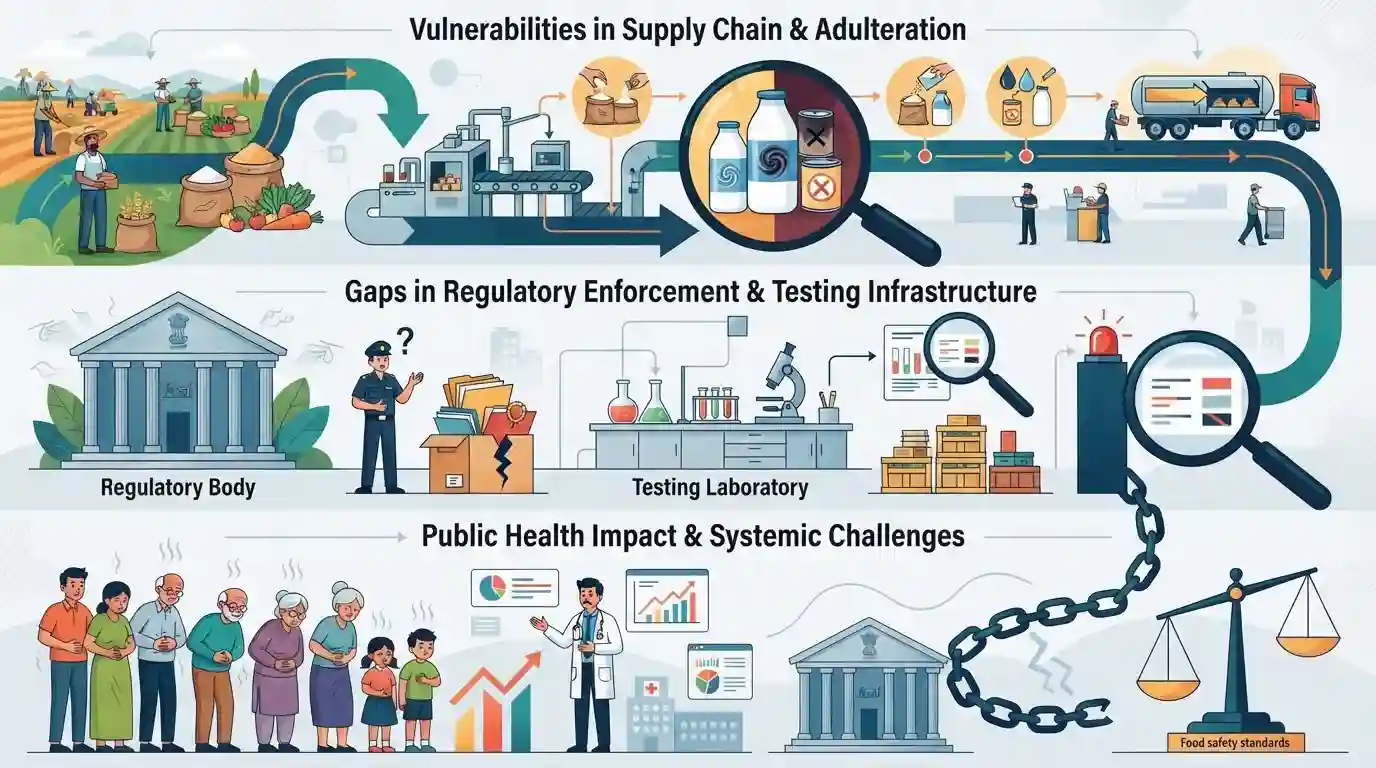
Why It Matters
Food safety and adulteration directly impact public health, consumer rights, and the integrity of agricultural supply chains in India, making it a critical topic for GS Paper III (Food Processing and Security).
Summary
The article examines the persistent challenge of food adulteration in India, highlighting vulnerabilities in food safety systems, particularly concerning staple commodities like milk. It underscores the gaps in regulatory enforcement, testing infrastructure, and the systemic challenges faced by bodies like the FSSAI in protecting public health against contaminated food supplies.
Key Points
- Food adulteration in India, particularly involving essential items like milk and daily staples, remains a widespread public health hazard.
- Institutional challenges such as inadequate testing infrastructure, manpower shortages, and enforcement bottlenecks hinder effective implementation of food safety regulations.
- Regulatory bodies like the FSSAI face significant constraints in monitoring unorganized sectors and local vendors, where the majority of adulteration occurs.
- Ensuring food safety requires strengthening supply chain transparency, upgrading testing labs at state and district levels, and imposing stricter penalties on offenders.
Important Terms
Food Safety and Standards Act 2006

A central legislation enacted to consolidate various legacy food laws into a single framework, establishing science-based standards and creating the FSSAI to regulate food safety across India.
UPSC context
UPSC GS Paper II (Statutory Bodies & Governance) and GS Paper III (Food Processing and Supply Chain Management).
FSSAI
The premier statutory regulatory body established under the FSSAI Act 2006 to regulate food manufacturing, storage, distribution, and sale, ensuring safe food for public health.
UPSC context
UPSC GS Paper II (Regulatory Bodies) and GS Paper III (Public Health and Food Safety).
Prevention of Food Adulteration Act 1954
An early central legislation enacted in 1954 to prevent food adulteration across India, later repealed and replaced by the comprehensive Food Safety and Standards Act 2006.
UPSC context
UPSC GS Paper III (Evolution of Food Safety Laws and Governance in India).
Static Concepts Connected
What are the key structural and statutory features of the Food Safety and Standards Authority of India (FSSAI)?
- Statutory Origin: Statutory body established under the Food Safety and Standards Act, 2006, which repealed multiple central food laws like the PFA Act 1954.
- Parent Ministry: Functioning under the administrative control of the Ministry of Health and Family Welfare, laying down science-based standards for articles of food.
- Core Mandate: Mandated to regulate manufacture, storage, distribution, sale, and import of food to ensure safe and wholesome food for human consumption.
- Decentralized Enforcement: Enforcement is primarily carried out through State Food Safety Commissioners and Food Safety Officers at the ground level.
Cross-Topic Patterns
Food Safety vs. WTO SPS Measures
Food safety and health standards directly intersect with WTO SPS (Sanitary and Phytosanitary) measures, impacting India's agricultural export competitiveness and compliance in global markets.
Informal Economy Governance and Food Safety
The unorganized food sector's dominance links public health enforcement challenges with broader informal economy governance and MSME formalization hurdles.

FSSAI mandate shifts vs. State enforcement capacities and Prevention of Food Adulteration Act transition will feature in GS-3/Prelims.
Linked PYQs · 1
Linked PYQs · 1
- 2018PrelimsGS1
Consider the following statements: 1. The Food Safety and Standards Act, 2006 replaced the Prevention of Food Adulteration Act, 1954. 2. The Food Safety and Standards Authority of India (FSSAI) is under the charge of Director General of Health Services in the Union Ministry of Health and Family Welfare. Which of the statements given above is/are correct?
