Climate Smart Dairy Entrepreneurship and Sustainable Farming
Source:The Hindu ↗
Why It Matters
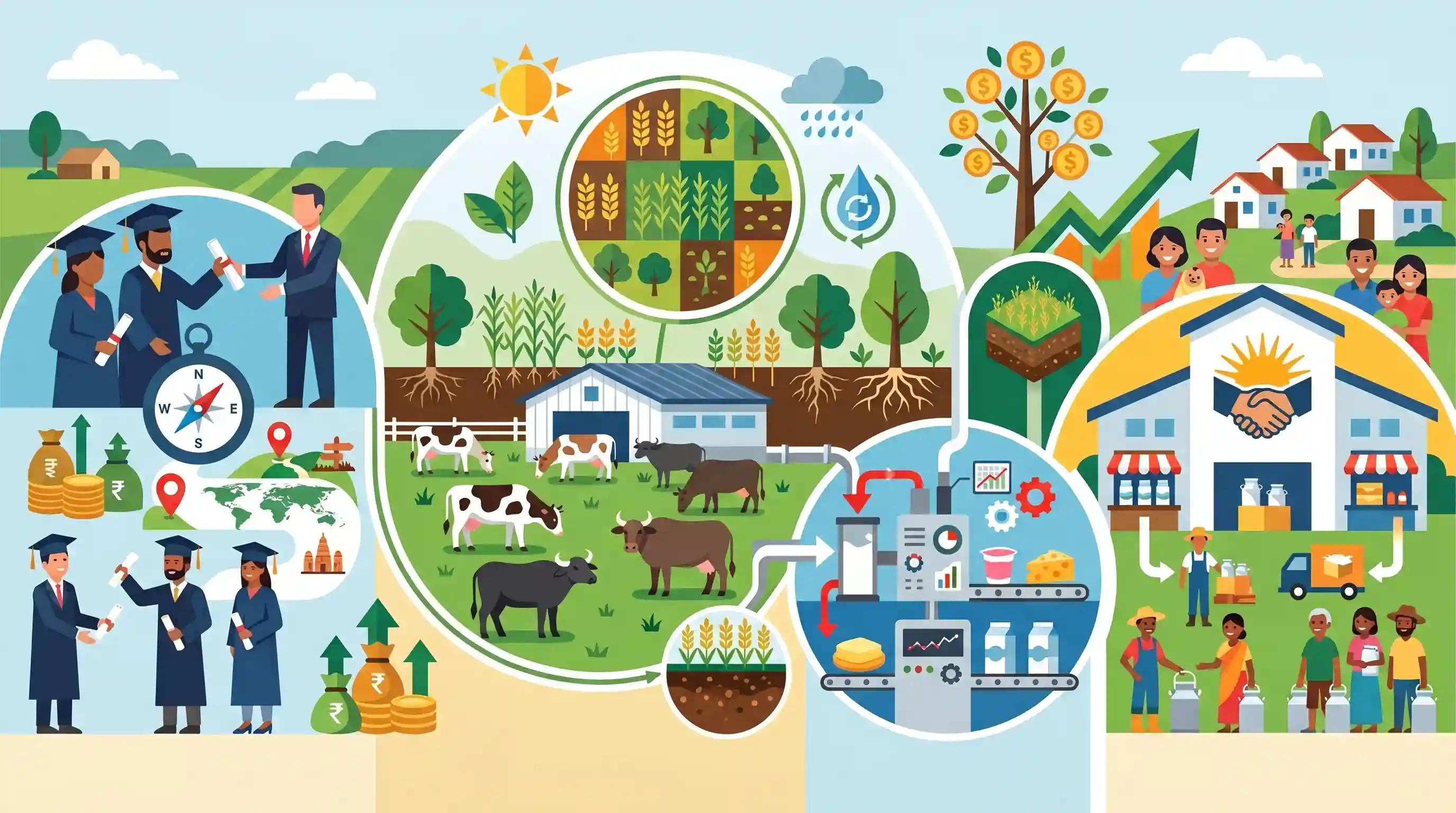
The article highlights 'Climate Smart Dairy Entrepreneurship,' showcasing a practical model for making animal husbandry both ecologically sustainable and economically viable. It is directly relevant to UPSC GS3 topics concerning livestock rearing, farmers' income, climate-resilient agriculture, and the role of agricultural credit and cooperatives.
Summary
At the valedictory event of the 'Climate Smart Dairy Entrepreneurship Programme', Tamil Nadu's Minister for Milk and Dairy Development underscored the importance of transitioning to sustainable farming that balances profitability with environmental conservation. The three-month programme, a collaborative effort involving Tanuvas and the Environmental Defense Fund, trained over a hundred entrepreneurs in advanced animal husbandry, milk value addition, and sustainable breeding. A key component was a multi-state 'Dairy Yatra' learning expedition. The event also highlighted plans to streamline the Animal Husbandry Department, provide state-wide farming loans, and revitalize cooperative societies to bolster the rural dairy economy.
Key Points
- The Tamil Nadu government emphasized the need for sustainable agricultural practices that are both profitable and environmentally friendly, specifically targeting the dairy sector.
- A 'Climate Smart Dairy Entrepreneurship Programme' jointly organized by Tanuvas, Kumaraguru Institutions, and the Environmental Defense Fund trained 112 dairy entrepreneurs over three months.
- The training focused on critical areas such as sustainable breeding, nutrition, housing, animal health management, and milk value addition.
- 40 entrepreneurs participated in a 'Dairy Yatra', a 6,000-km learning expedition across five states to study advanced dairy practices.
- The government assured the provision of loans to farmers across the state and highlighted efforts to ensure that cooperative societies operate profitably.
Important Terms
Climate Smart Dairy Entrepreneurship Programme

A collaborative initiative by Kumaraguru Institutions, TANUVAS, and EDF to train rural entrepreneurs in sustainable, low-emission, and profitable dairy farming practices through scientific breeding and feed management.
UPSC context
GS Paper III: Sustainable agriculture, livestock economics, and climate change mitigation strategies in the primary sector.
Dairy Yatra
A 6,000-km learning expedition across five Indian states (TN, KA, MH, GJ, RJ) exposing dairy entrepreneurs to diverse cooperative models, innovative fodder systems, and advanced animal husbandry practices.
UPSC context
GS Paper III: Agricultural extension services and the role of field-based learning in technology transfer for farmers.
Tamil Nadu Veterinary and Animal Sciences University (TANUVAS)
A premier state university in Chennai providing academic, research, and technical support for veterinary sciences and animal husbandry, vital for livestock productivity and breed improvement.
UPSC context
GS Paper III: Institutional support for agriculture and allied sectors; role of research in food security.
Environmental Defense Fund (EDF)
A global non-profit organization that partners with Indian institutions to reduce methane emissions and improve dairy productivity through the "farmer-first" approach and the Resilient Dairy Alliance.
UPSC context
GS Paper III: International collaboration in climate resilience and sustainable agricultural value chains.
Kumaraguru Institutions
A prominent educational group in Coimbatore that spearheads rural transformation by integrating scientific dairy practices with entrepreneurship to empower smallholder farmers and rural youth.
UPSC context
GS Paper III: Private sector participation in agricultural development and rural entrepreneurship ecosystems.
Animal Husbandry Department
The state administrative body responsible for livestock health, breeding programs, and supporting the rural economy through veterinary services and credit facilities for dairy farmers.
UPSC context
GS Paper II: Government policies and interventions; GS Paper III: Economics of animal rearing.
Prelims Trap
Methane emissions in the dairy sector are primarily caused by poor manure management and agricultural runoff.
Aspirants often confuse the primary source. Enteric fermentation (digestion) in ruminants causes the vast majority of methane emissions, far more than manure management.
Static Concepts Connected
How do ruminant livestock contribute to greenhouse gas emissions?
- Enteric Fermentation: Microbes in the animal's rumen produce methane as a byproduct of breaking down carbohydrates, primarily released when the animal burps.
- Manure Management: The decomposition of livestock waste in anaerobic (oxygen-free) environments releases significant amounts of both methane and nitrous oxide.
- Mitigation Strategies: Using specialized feed additives, improved forage quality, and selective breeding can significantly reduce the methane produced per liter of milk.
What is the economic role of dairy cooperatives in India?
- Market Linkage: By aggregating milk at the village level, cooperatives eliminate middlemen, giving small and marginal farmers assured procurement and fair prices.
- Input Services: Cooperatives offer vital backward linkages, including subsidized cattle feed, veterinary services, and artificial insemination.
- Value Addition: Converting raw, perishable milk into butter, cheese, and milk powder increases shelf life and multiplies profit margins for producers.
Cross-Topic Patterns
Climate-Smart Dairy vs Global Methane Pledge
India opted out of the Global Methane Pledge to protect rural livelihoods. Yet, domestic programs push 'climate-smart dairy' to curb enteric emissions through feed supplements, showing an internal push for mitigation.
Cooperatives as Food Processing Anchors
Revitalizing village-level cooperatives bridges primary production and food processing. This aligns directly with schemes like PM-FME, turning smallholder farmers into value-added micro-enterprises.

Expect a multi-statement question on climate-smart agriculture combining enteric fermentation, methane mitigation, and global pledges.
Linked PYQs · 3
Linked PYQs · 3
- 2015MainsGS3
Livestock rearing has a big potential for providing non-farm employment and income in rural areas. Discuss suggesting suitable measures to promote this sector in India.
- 2014MainsGS3
In the villages itself no form of credit organization will be suitable except the cooperative society. -All India Rural Credit Survey. Discuss this statement in the background of agricultural finance in India. What constraints and challenges do financial institutions supplying agricultural finance face? How can technology be used to better reach and serve rural clients?
- 2025MainsGS3
Elaborate the scope and significance of supply chain management of agricultural commodities in India.
