MSME Industrial Zones Initiative in Uttar Pradesh
Source:Indian Express ↗
Why It Matters
This article illustrates practical state-level interventions to boost the MSME sector, a critical driver of India's manufacturing and employment. It serves as a relevant case study for GS3 answers concerning MSME policies, industrial infrastructure development, and strategies to stimulate economic growth to meet macroeconomic targets.
Summary
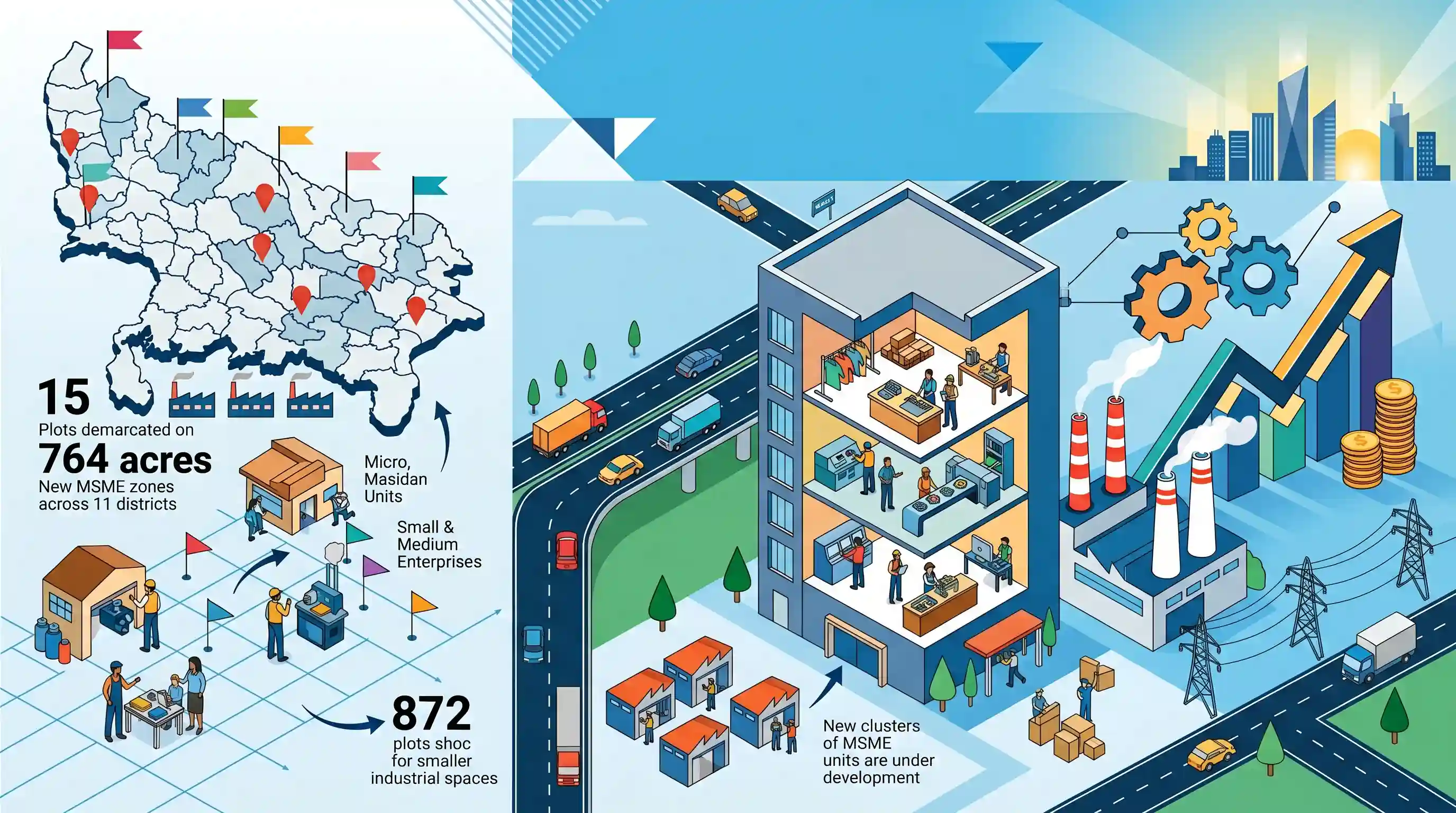
The Uttar Pradesh government has announced plans to establish 15 new industrial zones specifically tailored for the Micro, Small, and Medium Enterprises (MSME) sector across 11 districts. Covering over 764 acres, these zones will offer 872 plots, addressing the robust demand for smaller industrial spaces. The development is aligned with the state's broader objective of becoming a $1-trillion economy. Complementary efforts by the Yamuna Expressway Industrial Development Authority (YEIDA) include the creation of new MSME units and a Flatted Factory Complex in Greater Noida to provide ready-to-use production spaces for entrepreneurs.
Key Points
- The Uttar Pradesh government has initiated the establishment of 15 industrial zones dedicated to the MSME sector across 11 districts.
- The new industrial zones will cover an area of 764.31 acres and feature 872 plots, largely aimed at satisfying the high demand for smaller industrial plots.
- This initiative is a strategic step towards fulfilling Uttar Pradesh's ambitious goal of achieving a $1-trillion economy.
- The Yamuna Expressway Industrial Development Authority (YEIDA) is also actively establishing MSME units and a Flatted Factory Complex to enable immediate commencement of production by entrepreneurs.
Important Terms
Micro, Small, and Medium Enterprises (MSME)

Enterprises categorized by investment and turnover; in India, MSMEs are the backbone of the industrial sector, contributing significantly to GDP, exports, and employment.
UPSC context
GS Paper III: Indian Economy. Key for discussions on inclusive growth, employment generation, and industrial policies.
Yamuna Expressway Industrial Development Authority (YEIDA)
A statutory body established under the UP Industrial Development Act, 1976, responsible for urban planning and industrial growth along the 165 km Yamuna Expressway.
UPSC context
GS Paper III: Infrastructure and Industrial Growth. Relevant for regional planning and large-scale infrastructure projects like Jewar Airport.
UP State Industrial Development Authority (UPSIDA)
Uttar Pradesh's premier agency for industrial infrastructure, managing over 150 industrial areas to provide land and basic amenities for entrepreneurs and investors.
UPSC context
GS Paper III: Economy. Tests knowledge of state-level institutional frameworks for ease of doing business and industrialization.
Flatted Factory Complex
A multi-storey industrial building where multiple manufacturing units operate independently, sharing common infrastructure like power, elevators, and security; ideal for land-scarce urban zones.
UPSC context
GS Paper III: Infrastructure/Industry. An innovative model for MSME expansion and efficient land use in industrial geography.
$1-Trillion Economy Goal (UP)
Uttar Pradesh's strategic target to triple its Gross State Domestic Product (GSDP) by 2029-30 through investment-led growth, infrastructure expansion, and sectoral reforms.
UPSC context
GS Paper III: Economic Development. Significant for comparative state economics and federalism-linked growth targets.
Prelims Trap
MSMEs are classified solely by investment in plant and machinery, maintaining separate thresholds for manufacturing and service sectors.
The 2020 revision introduced a composite criteria requiring BOTH investment and turnover limits, and entirely removed the distinction between manufacturing and services.
Static Concepts Connected
What is the revised (2020) classification criteria for MSMEs in India?
- Composite Criteria: Classification now uses both investment in plant/machinery AND annual turnover, rather than investment alone.
- Sector Parity: The distinction between manufacturing and service enterprises was eliminated; both follow identical threshold limits.
- Micro Limits: Investment up to ₹1 crore and annual turnover up to ₹5 crore.
What is the Micro and Small Enterprises Cluster Development Programme (MSE-CDP)?
- Shared Infrastructure: Funds the creation of Common Facility Centers (CFCs) like testing labs, effluent treatment plants, and design centers.
- Economies of Scale: Helps fragmented small units share high capital costs, boosting their tech adoption, sustainability, and global competitiveness.
Cross-Topic Patterns
MSME Clusters + ODOP Integration
Establishing district-level zones naturally integrates with the One District One Product (ODOP) initiative, providing localized infrastructure to scale up traditional crafts and boost rural exports.
Urban Planning + Flatted Factories
Flatted Factory Complexes address severe land acquisition bottlenecks in densely populated states, shifting the focus of industrial geography from horizontal expansion to vertical integration.

Expect a Mains question linking decentralized MSME clusters, like flatted factories, to balanced regional development and rural employment.
Linked PYQs · 3
Linked PYQs · 3
- 2023MainsGS3
Faster economic growth requires increased share of the manufacturing sector in GDP, particularly of MSMEs. Comment on the present policies of the Government in this regard.
- 2021MainsGS3
“Investment in infrastructure is essential for more rapid and inclusive economic growth.” Discuss in the light of India's experience.
- 2023PrelimsGS1
Consider the following statements with reference to India: 1. According to the 'Micro, Small and Medium Enterprises Development (MSMED) Act, 2006', the 'medium enterprises' are those with investments in plant and machinery between ₹ 15 crore and ₹ 25 crore. 2. All bank loans to the Micro, Small and Medium Enterprises qualify under the priority sector. Which of the statements given above is/are correct?
