RBI Push for Central Bank Digital Currency and Tokenisation
Source:The Hindu ↗
Why It Matters
The evolution and policy push towards Central Bank Digital Currencies (CBDCs) represent a critical milestone in India's digital economy transformation, impacting monetary policy transmission, cross-border payments, and financial inclusion.
Summary
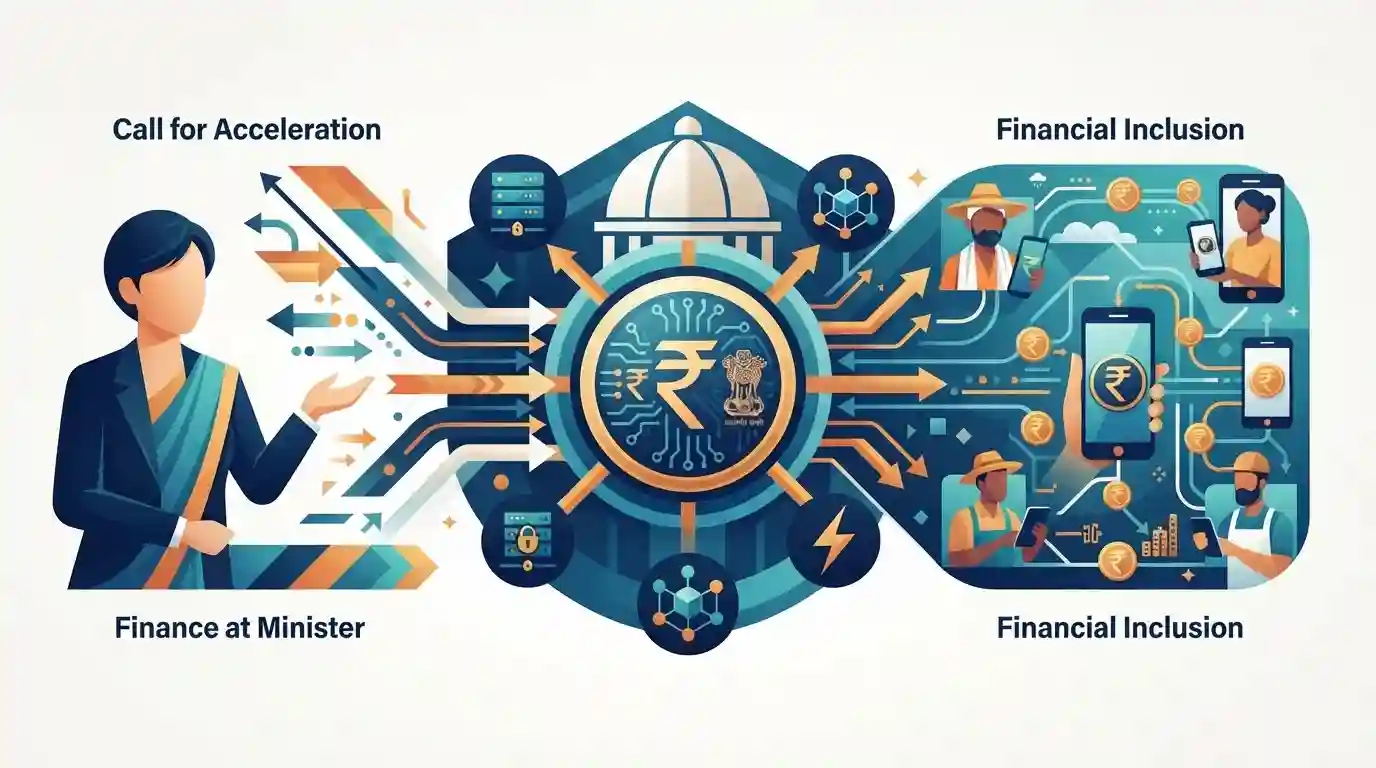
The Finance Minister has called upon the Reserve Bank of India to accelerate the implementation and enhance the technical capabilities of the Central Bank Digital Currency (CBDC), or digital rupee, aligning with a broader push for tokenisation to modernise India's financial architecture.
Key Points
- Finance Minister urged the Reserve Bank of India (RBI) to advance the deployment and sharpen the capabilities of the Central Bank Digital Currency (CBDC), or Digital Rupee.
- The push comes amid a wider tokenisation drive aimed at enhancing efficiency, security, and traceability in financial transactions.
- The initiative seeks to expand the scope and adoption of digital currency within the Indian financial ecosystem to complement physical fiat currency and existing digital payment systems.
Important Terms
Central Bank Digital Currency (CBDC) / Digital Rupee

A legal tender issued in digital form by a central bank, representing a direct liability of the central bank, functioning as a safer and efficient electronic alternative to physical cash.
UPSC context
GS Paper 3 (Indian Economy - Mobilization of Resources, Digital Banking). Tests understanding of modern digital financial infrastructure and central bank initiatives.
Reserve Bank of India
India's central banking institution that controls the monetary policy of the Indian rupee, regulates the banking system, and issues currency.
UPSC context
GS Paper 3 (Indian Economy). Tests knowledge of apex monetary institutions, inflation control, and financial sector regulation.
Ministry of Finance
A vital ministry of the Government of India concerned with economic policy, taxation, financial legislation, and the national budget.
UPSC context
GS Paper 2 & 3 (Polity & Economy). Tests understanding of macro-fiscal policy formulation, public finance, and institutional governance.
Prelims Trap
Digital Rupee is a private digital asset operating on blockchain networks similar to cryptocurrencies.
Aspirants often confuse CBDC with commercial bank digital money or UPI. CBDC is a direct liability of the RBI and legal tender, whereas UPI is a payment message system over existing bank accounts.
Static Concepts Connected
What are the structural features and classifications of Central Bank Digital Currency (CBDC) in India?
- Legal Status: Sovereign liability issued by the Reserve Bank of India in digital form, enjoying legal tender status.
- Dual Architecture: Divided into Wholesale (CBDC-W) for interbank settlements and Retail (CBDC-R) for general public and business use.
- Vs UPI Rails: Unlike UPI, which facilitates transfers between existing commercial bank accounts, CBDC itself is a standalone digital currency asset.
Cross-Topic Patterns
CBDC + G20 Financial Inclusion Cross-Border Payments
India's domestic digital infrastructure initiatives like the Digital Rupee and account aggregator frameworks parallel cross-border discussions on CBDC interoperability under G20 financial architecture goals.
Tokenisation + Securities Market Ledger Systems
The push for asset tokenisation alongside CBDC deployment directly intersects with SEBI's regulatory sandbox for distributed ledger technology and securities settlement.

Expect statement-based questions distinguishing CBDC legal tender status from commercial bank money and UPI payment rails.
Linked PYQs · 2
Linked PYQs · 2
- 2023MainsGS3
What is the status of digitalization in the Indian economy? Examine the problems faced in this regard and suggest improvements.
- 2022MainsGS3
Is inclusive growth possible under market economy ? State the significance of financial inclusion in achieving economic growth in India.
