Governance Challenges and Leadership Crisis in Skill Development Body
Source:Indian Express ↗
Why It Matters
The stability of implementing agencies like NSDC is crucial for the success of massive government schemes like PMKVY. Governance issues within such PPP models serve as critical case studies for GS Paper 2 (Governance) and directly impact human resource development topics in GS Paper 3.
Summary
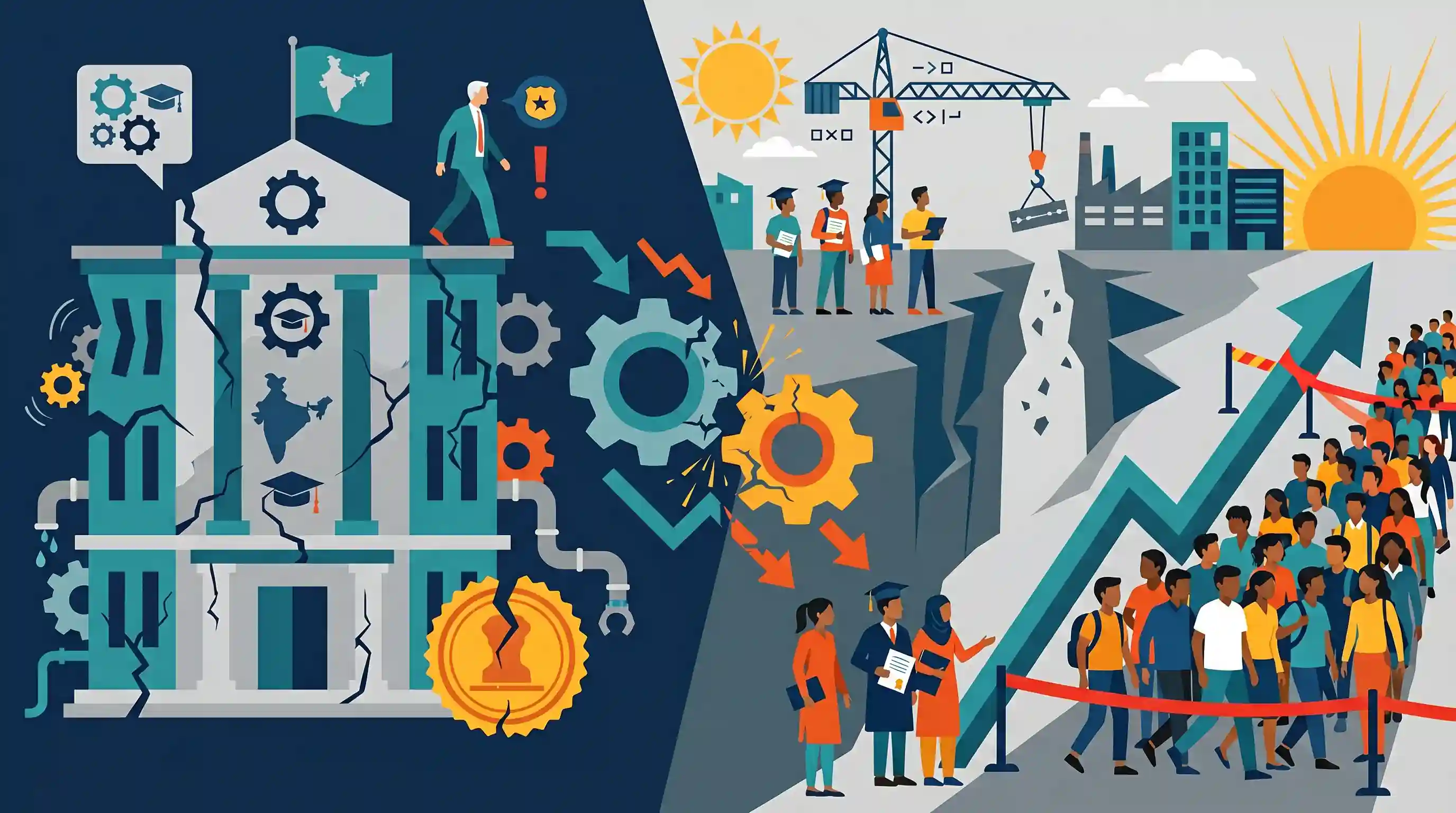
The National Skill Development Corporation (NSDC), the pivotal agency responsible for implementing the Pradhan Mantri Kaushal Vikas Yojana (PMKVY), is facing significant internal instability following the exit of its CEO and an associated police complaint. This administrative flux raises critical concerns regarding corporate governance and accountability within Public-Private Partnership (PPP) entities executing flagship government schemes. Furthermore, the disruption threatens to impede India's broader objectives of bridging the employability gap, resolving structural unemployment, and effectively harnessing its demographic dividend.
Key Points
- The National Skill Development Corporation (NSDC), the nodal agency for implementing PMKVY, is experiencing internal administrative flux.
- The turmoil involves the exit of the NSDC CEO and the filing of a police complaint, highlighting potential governance or operational anomalies within the organization.
- Such disruptions in a key Public-Private Partnership (PPP) entity threaten the effective rollout of skill development initiatives required to harness India's demographic dividend.
- The situation underscores the need for robust corporate governance and accountability mechanisms in agencies executing flagship government schemes.
Important Terms
Pradhan Mantri Kaushal Vikas Yojana (PMKVY)

India's flagship skill training scheme launched in 2015 to upskill youth for industry-relevant jobs. It provides free training, certification, and recognition of prior learning (RPL) to enhance employability.
UPSC context
GS Paper 2 (Government Policies) and GS Paper 3 (Employment/Human Resources). Tests knowledge of welfare schemes and implementation.
National Skill Development Corporation (NSDC)
A not-for-profit Public-Private Partnership (PPP) company established in 2008 to catalyze the skill development ecosystem. The government holds 49% stake, while the private sector holds 51%.
UPSC context
GS Paper 2 (Quasi-judicial/Regulatory Bodies) and GS Paper 3 (Investment Models). Tests institutional framework for economic development.
Demographic Dividend
The economic growth potential resulting from a shift in a population's age structure, where the working-age population (15-64) is significantly larger than the dependent population.
UPSC context
GS Paper 1 (Population) and GS Paper 3 (Employment). Tests ability to link population dynamics to economic strategy.
Ministry of Skill Development and Entrepreneurship (MSDE)
The nodal Indian ministry created in 2014 to coordinate and oversee all skill development efforts, apprenticeship training, and entrepreneurship initiatives across the country.
UPSC context
GS Paper 2 (Human Resources/Ministries). Tests understanding of administrative structures governing social sector initiatives.
Public-Private Partnership (PPP)
A long-term collaborative agreement between a government agency and a private sector entity to deliver a public service or project, sharing risks and resources.
UPSC context
GS Paper 3 (Investment Models). Tests critical analysis of collaborative governance and infrastructure financing.
Sector Skill Councils (SSC)
Industry-led autonomous bodies promoted by NSDC that establish National Occupational Standards (NOS) and qualification packs to ensure skill training meets specific industry demands.
UPSC context
GS Paper 3 (Skill Development). Tests knowledge of the decentralized, industry-linked implementation of skilling programs.
Corporate Governance
The system of rules, practices, and processes by which a company is directed and controlled, ensuring transparency, accountability, and ethical management within organizations.
UPSC context
GS Paper 4 (Ethics and Human Interface) and GS Paper 2 (Accountability). Tests ethics in administration and institutional integrity.
Prelims Trap
"NSDC is a statutory body wholly owned by the Government of India."
Aspirants often assume flagship scheme implementers are statutory/wholly-owned. NSDC is actually a Section 8 company with a 51% private-sector majority stake.
Static Concepts Connected
What is the structure of the National Skill Development Corporation (NSDC)?
- Legal Status: It is a not-for-profit public limited company incorporated under Section 8 of the Companies Act.
- Ownership: It operates as a Public-Private Partnership (PPP). The Government of India holds 49%, and the private sector holds 51%.
- Primary Role: Acts as a catalyst in skill development by providing funding to enterprises, companies, and organizations that provide skill training.
What characterizes 'Structural Unemployment' in the Indian economy?
- Core Mismatch: Arises from a fundamental mismatch between the skills possessed by the workforce and the skills demanded by employers.
- Resolution: Cannot be fixed by simply injecting money into the economy; it requires long-term educational reforms and vocational skilling programs like PMKVY.
Cross-Topic Patterns
Governance of PPPs in welfare schemes
The crisis at NSDC highlights the tension between private majority ownership (51%) and the required accountability mechanisms for public funds in social sector PPPs.
Demographic Dividend vs Demographic Disaster
Administrative bottlenecks in skilling directly exacerbate structural unemployment, risking India's narrow window to capitalize on its demographic dividend before the population ages.

Expect a Prelims statement testing NSDC's unique PPP ownership structure (49% Gov / 51% Private) disguised as a statutory body.
Linked PYQs · 5
Linked PYQs · 5
- 2018PrelimsGS1
With reference to Pradhan Mantri Kaushal Vikas Yojana, consider the following statements: 1. It is the flagship scheme of the Ministry of Labour and Employment. 2. It, among other things, will also impart training in soft skills, entrepreneurship, financial and digital literacy. 3. It aims to align the competencies of the unregulated workforce of the country to the National Skill Qualification Framework. Which of the statements given above is/are correct?
- 2023MainsGS2
Skill development programmes have succeeded in increasing human resources supply to various sectors. In the context of the statement analyse the linkages between education, skill and employment.
- 2016MainsGS2
Demographic Dividend in India will remain only theoretical unless our manpower becomes more educated, aware, skilled and creative." What measures have been taken by the government to enhance the capacity of our population to be more productive and employable?
- 2014MainsGS3
While we flaunt India's demographic dividend, we ignore the dropping rates of employability. What are we missing while doing so? Where will the jobs that India desperately needs come from? Explain.
- 2023MainsGS3
Most of the unemployment in India is structural in nature. Examine the methodology adopted to compute unemployment in the country and suggest improvements.
