China-Nepal Border Floods Highlight Himalayan Climate Risks
Source:The Hindu ↗
Why It Matters
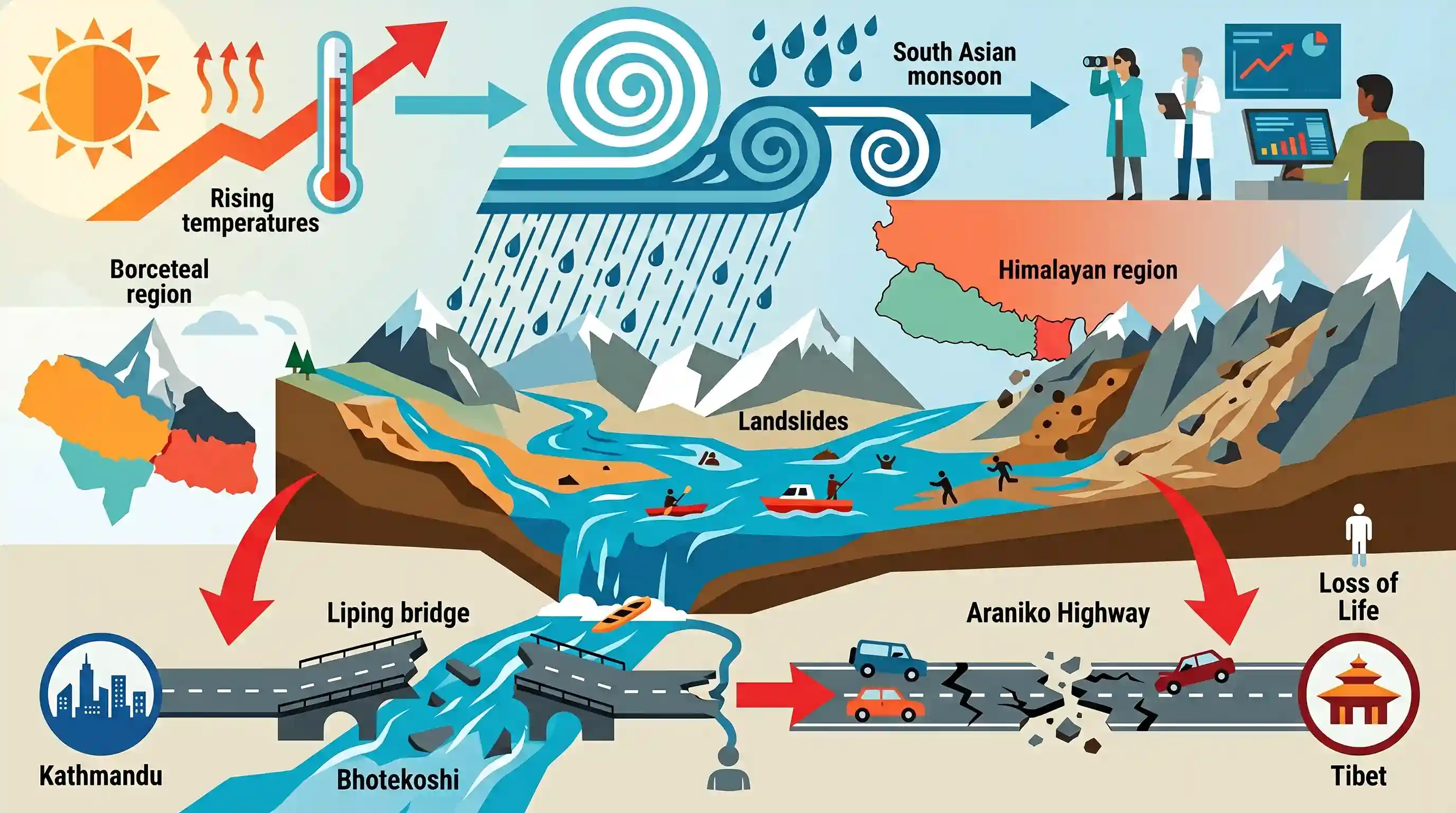
The incident underscores the growing risk of climate-induced disasters in the fragile Himalayan ecosystem. It is relevant for UPSC aspirants to understand the impact of global warming on the South Asian monsoon and the resulting cascading hazards like landslides and floods, which directly affect infrastructure, border security, and disaster management strategies.
Summary
Severe floods along the Nepal-China border have left at least eight people dead and 31 missing after water swept through a Himalayan mountain valley. The floods caused significant destruction to cross-border infrastructure, including sweeping away the Liping bridge over the Bhotekoshi river and damaging the Araniko Highway that links Kathmandu to Tibet. Experts from the World Meteorological Organization (WMO) and the International Centre for Integrated Mountain Development (ICIMOD) highlight that rising global temperatures and climate change are intensifying the South Asian monsoon, leading to extreme rainfall and a surge in water-induced disasters like floods, landslides, and debris flow in the fragile Himalayan region.
Key Points
- A massive flood in a Himalayan mountain valley along the Nepal-China border has resulted in at least 8 deaths and left 31 people missing.
- The disaster destroyed critical infrastructure, including the Liping bridge over the Bhotekoshi river, which serves as a major connection between Nepal and Tibet.
- Parts of the Araniko Highway, a vital artery linking Kathmandu to Tibet, were heavily damaged by the floodwaters.
- Experts from the WMO and ICIMOD state that rising global temperatures due to climate change are intensifying the South Asian monsoon, leading to extreme rainfall.
- The Himalayan region is becoming increasingly vulnerable to complex, cascading water-induced disasters such as floods, landslides, and debris flows.
Important Terms
International Centre for Integrated Mountain Development (ICIMOD)

A regional intergovernmental center serving eight Hindu Kush Himalayan (HKH) countries (including India) to promote sustainable mountain development and regional cooperation through knowledge sharing on climate and water.
UPSC context
GS Paper 3: Environmental conservation and Himalayan ecosystem. Relevant for regional cooperation and transboundary disaster risk reduction in the HKH region.
World Meteorological Organization (WMO)
A specialized United Nations agency responsible for international cooperation on atmospheric science, climatology, hydrology, and geophysics, providing global standards for weather forecasting and climate monitoring.
UPSC context
GS Paper 2: International institutions. Essential for understanding global climate reports (e.g., State of Global Climate) and disaster early warning systems.
South Asian Monsoon
A massive seasonal wind reversal system (Southwest and Northeast) that drives over 70% of South Asia's rainfall, vital for the region's agriculture, economy, and water security.
UPSC context
GS Paper 1: Important Geophysical phenomena. A core topic for understanding Indian climate, agricultural cycles, and the "real finance minister" of India.
Debris Flow
A specific type of mass movement where a fluid-like slurry of loose soil, rock, and organic matter mixed with water flows rapidly downslope, often triggered by intense rainfall.
UPSC context
GS Paper 3: Disaster Management. Tested in the context of landslide types and mitigation strategies in fragile hilly terrains like the Himalayas.
Araniko Highway
A 114-km strategic roadway connecting Kathmandu to the China-Nepal border at Kodari, serving as a vital overland trade and transit link between Nepal and Tibet.
UPSC context
GS Paper 2: India and its neighborhood. Significant for analyzing China-Nepal connectivity projects and their strategic implications for India's "Neighborhood First" policy.
Bhotekoshi River
A transboundary river originating in Tibet (as Poiqu) and flowing into Nepal; it is a major tributary of the Sun Koshi and part of the larger Koshi river system.
UPSC context
GS Paper 1: Geography of India and neighborhood. Important for understanding transboundary river systems, hydropower potential, and vulnerability to Glacial Lake Outburst Floods (GLOFs).
Prelims Trap
"ICIMOD is an intergovernmental organization comprising all SAARC member nations."
ICIMOD focuses strictly on the Hindu Kush Himalayan region. It includes China and Myanmar (non-SAARC) but excludes Sri Lanka and Maldives (SAARC).
Static Concepts Connected
What is the mandate and membership of the ICIMOD?
- Core Mandate: It is an intergovernmental knowledge center based in Kathmandu, Nepal, aimed at securing a better future for the people and environment of the Hindu Kush Himalaya.
- 8 Member Nations: Afghanistan, Bangladesh, Bhutan, China, India, Myanmar, Nepal, and Pakistan.
How do Glacial Lake Outburst Floods (GLOFs) trigger cascading disasters?
- Primary Trigger: Rapid release of water from a moraine- or ice-dammed glacial lake, often triggered by avalanches, earthquakes, or extreme rainfall.
- Cascading Effect: The massive initial water surge destabilizes slopes downstream, triggering massive secondary landslides, debris flows, and flash floods that destroy infrastructure like highways and dams.
- Vulnerability Amplifier: The Himalayas face 'elevation-dependent warming', melting glaciers faster and creating highly unstable lakes at high altitudes.
Cross-Topic Patterns
Transboundary rivers & disaster diplomacy
The Bhotekoshi (Koshi basin) flood highlights how upstream climate events in Tibet directly impact and destroy critical downstream geostrategic infrastructure in Nepal, forcing a need for transboundary disaster data sharing.
Elevation-dependent warming & Monsoon shifts
Higher altitudes in the Himalayas warm faster than the global average. This alters South Asian monsoon dynamics, directly amplifying extreme rainfall and landslide risks in these fragile ecosystems.

Expect a multi-statement Prelims question mixing ICIMOD membership (note China/Myanmar included) with transboundary river origins.
Linked PYQs · 5
Linked PYQs · 5
- 2017MainsGS3
'Climate change' is a global problem. How India will be affected by climate change? How Himalayan and coastal states of India will be affected by climate change?
- 2021MainsGS1
Differentiate the causes of landslides in the Himalayan region and Western Ghats.
- 2016MainsGS1
The Himalayas are highly prone to landslides. Discuss the causes and suggest suitable measures of mitigation.
- 2013MainsGS1
Bring out the causes for more frequent occurrence of landslides in the Himalayas than in the Western Ghats.
- 2021MainsGS3
Describe the various causes and the effects of landslides. Mention the important components of the National Landslide Risk Management Strategy.
