Centre Expedites PM KISAN Instalment for Flood Hit States
Source:The Hindu ↗
Why It Matters
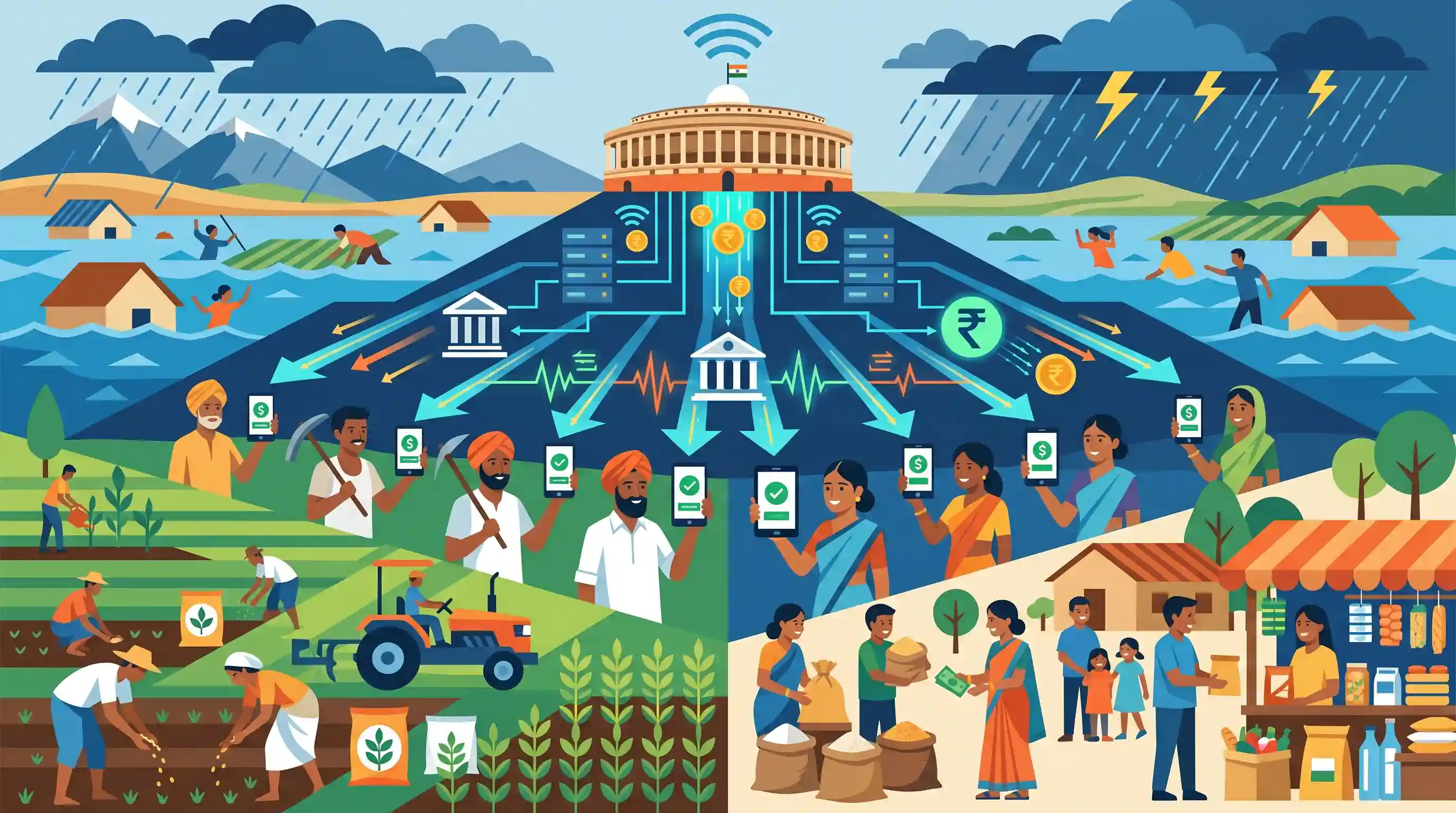
Demonstrates the dual utility of the PM-KISAN scheme: as a continuous agricultural income support (DBT), and as an agile disaster-relief mechanism capable of quickly reaching farmers during extreme weather events.
Summary
The Union government is expediting the 21st instalment of the PM-KISAN scheme to assist farmers in flood-affected Punjab, Himachal Pradesh, and Uttarakhand. By transferring ₹2,000 directly to approximately 27 lakh farmers, the government aims to provide immediate liquidity for household needs and agricultural inputs like seeds and fertilizers. The rapid deployment demonstrates how Direct Benefit Transfer (DBT) infrastructure can double as an effective mechanism for disaster relief.
Key Points
- The Union government is expediting the 21st instalment of the PM-KISAN scheme for farmers in flood-hit Punjab, Himachal Pradesh, and Uttarakhand.
- Approximately 27 lakh farmers will receive the ₹2,000 instalment directly into their bank accounts to help procure seeds and fertilizers for the upcoming season.
- Broader financial assistance of ₹1,500 crore (HP), ₹1,600 crore (Punjab), and ₹1,200 crore (Uttarakhand) has also been sanctioned to help states manage flood recovery.
- The move highlights the utility of Direct Benefit Transfer (DBT) networks in quickly mobilizing targeted disaster relief directly to vulnerable populations.
Important Terms
Pradhan Mantri Kisan Samman Nidhi (PM-KISAN)

A Central Sector Scheme providing ₹6,000 annually in three installments to all landholding farmer families to supplement financial needs for agricultural inputs and domestic expenses.
UPSC context
GS Paper 2 (Welfare Schemes) and GS Paper 3 (Agriculture/Subsidies); tests understanding of direct income support and cooperative federalism.
Direct Benefit Transfer (DBT)
A governance mechanism that transfers subsidies and welfare benefits directly into beneficiaries' Aadhaar-linked bank accounts to reduce leakages, eliminate intermediaries, and ensure transparency.
UPSC context
GS Paper 2 (E-governance) and GS Paper 3 (Economy); crucial for topics on corruption, financial inclusion, and public service delivery.
Union Ministry of Agriculture and Farmers Welfare
The apex central body responsible for formulating agricultural laws, implementing welfare schemes like PM-KISAN, and coordinating disaster-related agricultural input subsidies with state governments.
UPSC context
GS Paper 2 (Government Ministries); relevant for institutional framework and policy implementation in the agriculture sector.
Central Sector Scheme
A type of scheme 100% funded by the Union Government and implemented by the central machinery, unlike Centrally Sponsored Schemes where costs are shared with states.
UPSC context
GS Paper 2 (Government Policies); tests technical knowledge of fiscal federalism and administrative responsibility.
NDRF/SDRF
Funds established under the Disaster Management Act, 2005, to provide immediate relief for natural calamities, with primary responsibility at the state level (SDRF) and central augmentation (NDRF).
UPSC context
GS Paper 3 (Disaster Management); essential for questions on disaster financing and the center-state relief mechanism.
JAM Trinity
The integration of Jan Dhan bank accounts, Aadhaar biometric ID, and Mobile numbers to create the technical infrastructure required for efficient and targeted digital welfare delivery.
UPSC context
GS Paper 3 (Economy/Inclusive Growth); key concept for digital infrastructure and financial inclusion strategies.
Prelims Trap
PM-KISAN is restricted to small and marginal farmers owning up to 2 hectares of cultivable land.
While initially launched only for small and marginal farmers, PM-KISAN was expanded in 2019 to cover ALL landholding farmer families, regardless of land size (subject to exclusion criteria).
Static Concepts Connected
How are agricultural subsidies classified under the WTO Agreement on Agriculture (AoA)?
- Green Box: Subsidies that do not distort trade, or cause minimal distortion (e.g., direct income support like PM-KISAN, agricultural research). No limits are placed on these.
- Amber Box: Trade-distorting subsidies linked to production quantities or prices (e.g., MSP, fertilizer subsidies). These are subject to 'de minimis' reduction commitments.
- Blue Box: Amber Box subsidies with conditions designed to reduce distortion, typically by linking payments to production-limiting programs.
What is the difference between a Central Sector Scheme and a Centrally Sponsored Scheme?
- Central Sector: 100% funded and implemented by the Union government (e.g., PM-KISAN). These typically cover subjects falling under the Union List.
- Centrally Sponsored: Partially funded by the Centre but implemented by State governments (e.g., MGNREGA). These generally pertain to subjects in the State or Concurrent lists.
Cross-Topic Patterns
DBT as Disaster Resilience Infrastructure
The JAM trinity has evolved from a welfare delivery tool into critical disaster management infrastructure, providing instant liquidity bypassing disrupted physical supply chains during floods or pandemics.
Cash Transfers vs. Input Subsidies
As climate extremes disrupt crop cycles, unconditional cash transfers offer farmers better agility to adapt and recover compared to rigid input subsidies (like fertilizer or power) that lock them into specific patterns.

Expect a 2026 multi-statement question linking PM-KISAN's WTO Green Box status, farmer exclusion criteria, and DBT disaster-relief utility.
Linked PYQs · 3
Linked PYQs · 3
- 2023MainsGS3
What are the direct and indirect subsidies provided to farm sector in India? Discuss the issues raised by the World Trade Organization (WTO) in relation to agricultural subsidies.
- 2015MainsGS3
In what way could replacement of price subsidy with Direct Benefit Transfer (DBT) change the scenario of subsidies in India ? Discuss.
- 2024MainsGS3
What is disaster resilience? How is it determined? Describe various elements of a resilience framework. Also mention the global targets of Sendai Framework for Disaster Risk Reduction (2015–2030).
