Floating Solar Energy in India Potential and Challenges
Source:Indian Express ↗
Why It Matters
Directly relevant to India's 2030 renewable energy targets, land-use management, and innovations in clean energy infrastructure under GS Paper III.
Summary
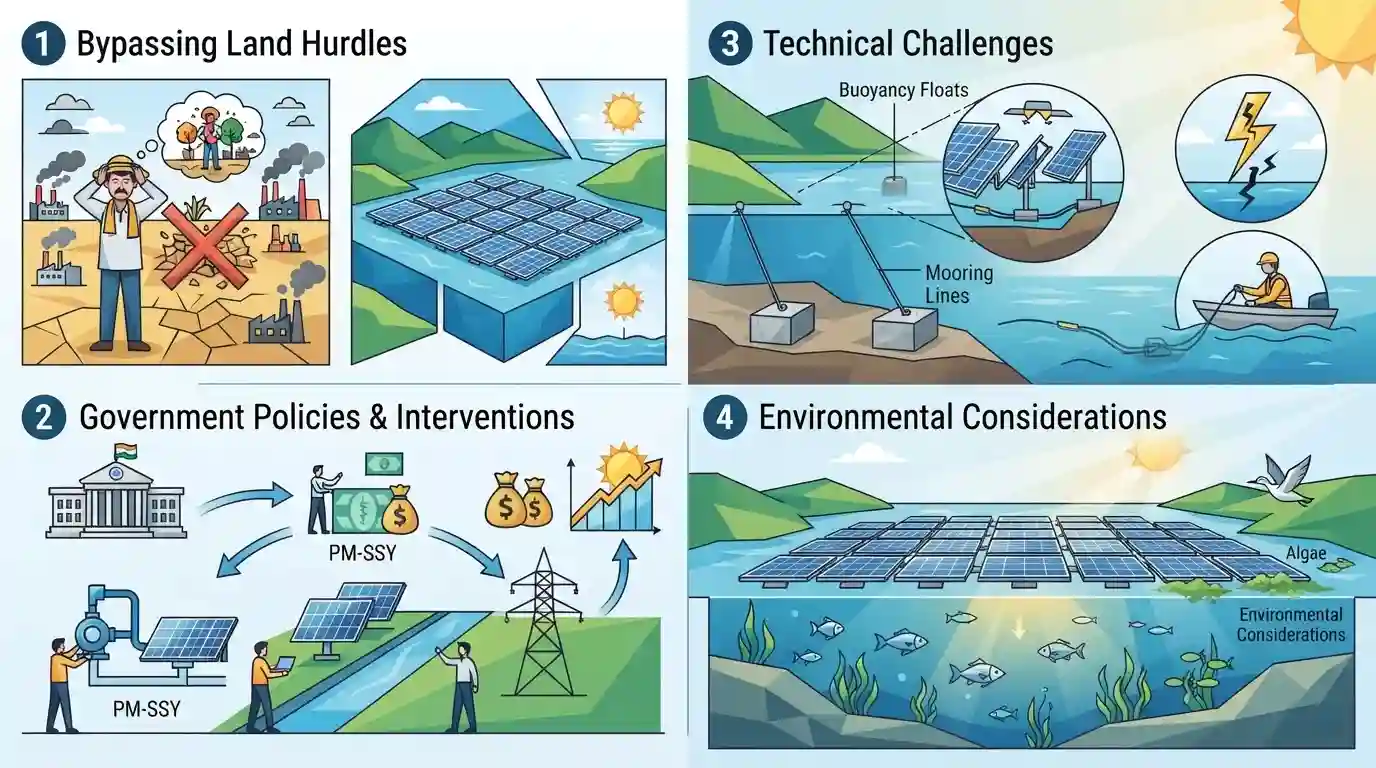
An analysis of floating solar technology in India, examining its potential to bypass land acquisition hurdles through installation on water bodies, the role of government schemes like PM-SSY, and the technical and environmental challenges associated with floating photovoltaics.
Key Points
- Floating solar photovoltaic (FPV) systems are gaining traction in India as a land-saving alternative to traditional ground-mounted solar panels.
- The PM-SSY scheme and allied renewable initiatives aim to expand clean energy generation across water bodies like reservoirs, lakes, and dams.
- Floating solar installations help reduce water evaporation and benefit from cooler ambient temperatures, which enhance panel efficiency.
- Key challenges include high initial capital costs, structural durability issues against winds and waves, and potential ecological impacts on aquatic ecosystems.
Important Terms
PM-SSY Scheme

A flagship Indian government scheme launched by the Ministry of New and Renewable Energy to promote decentralized solar power plants, solar water pumps, and agricultural solarization.
UPSC context
UPSC Prelims/Mains (GS Paper III - Infrastructure: Energy): Tests knowledge of government interventions promoting renewable energy and agricultural sustainability.
PM Surya Ghar Muft Bijli Yojana
A major residential rooftop solar subsidy scheme providing up to 300 units of free monthly electricity and central financial assistance to 1 crore households.
UPSC context
UPSC Prelims/Mains (GS Paper III - Government Policies & Interventions): Evaluates awareness of citizen-centric clean energy and power subsidy frameworks.
Ministry of New and Renewable Energy
The central nodal ministry of the Government of India responsible for formulating and implementing policies, research, and schemes for renewable energy sources.
UPSC context
UPSC Prelims/Mains (GS Paper III - Energy Infrastructure): Important for institutional frameworks governing India's transition to 500 GW non-fossil capacity by 2030.
Prelims Trap
Floating solar installations have zero environmental impact since they utilize artificial reservoirs instead of forest or agricultural land.
Aspirants often assume FPV eliminates all environmental reviews; however, installations on large water bodies require rigorous ecological impact assessments regarding aquatic flora, dissolved oxygen, and fish breeding.
Static Concepts Connected
What are the major environmental and efficiency advantages of Floating Solar Photovoltaics (FPV)?
- Evaporation reduction:: Reduces water evaporation by shading reservoirs, crucial for drought-prone regions.
- Enhanced efficiency:: Water body microclimates keep panels cooler, boosting photoelectric conversion efficiency by 5-10% compared to land-based units.
- Land conservation:: Bypasses contentious land acquisition hurdles, preserving fertile agricultural land for food security.
Cross-Topic Patterns
Floating Solar + Water Resource Management
Floating solar on reservoirs utilizes existing state irrigation infrastructure, intersecting water resource management under Article 262 and the Jal Jeevan mission's water security goals.
Land Acquisition Hurdles + Renewable Energy Spatial Fix
Land acquisition bottlenecks for ground-mounted solar mirror industrial corridor land disputes, making water bodies an alternative spatial fix for renewable targets.

Expect an assertion-reasoning question linking FPV efficiency gains from water cooling to land-saving potential vs. ecological trade-offs.
Linked PYQs · 2
Linked PYQs · 2
- 2022MainsGS3
Do you think India will meet 50 percent of its energy needs from renewable energy by 2030 ? Justify your answer. How will the shift of subsidies from fossil fuels to renewables help achieve the above objective ? Explain.
- 2020MainsGS3
Describe the benefits of deriving electric energy from sunlight in contrast to the conventional energy generation. What are the initiatives offered by our Government for this purpose?
