Political Debate Over India Withdrawing Bid to Host COP33
Source:The Hindu ↗
Why It Matters
Highlights the political and diplomatic nuances of India's role in global climate negotiations under the UNFCCC. Hosting a COP is a major indicator of climate leadership; withdrawing the bid draws critical attention to India's current mitigation targets, implementation of carbon markets, and its future responsibilities under the Paris Agreement framework.
Summary
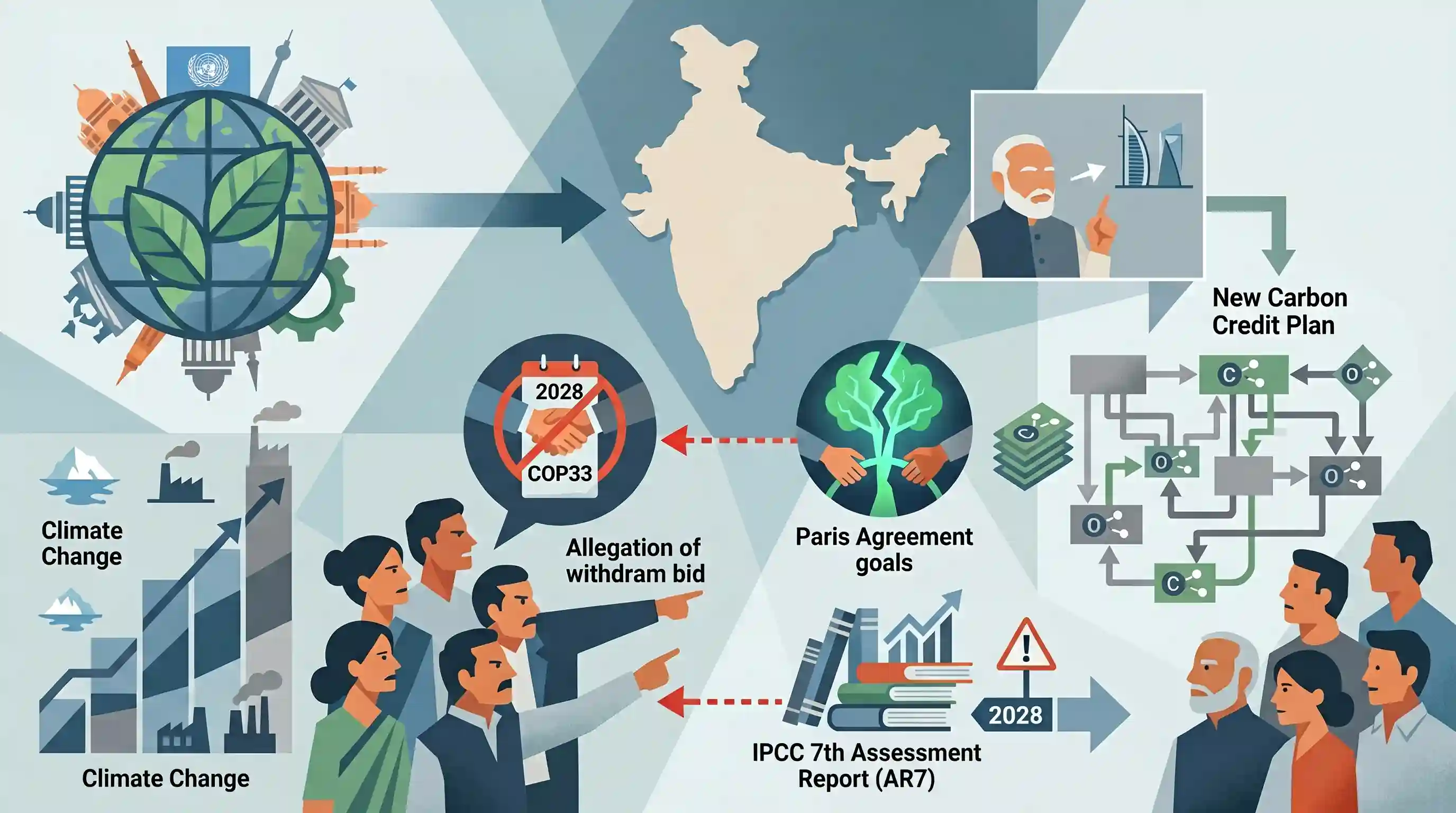
The Congress party has criticized the central government for allegedly withdrawing India's bid to host the 33rd UN Climate Change Conference (COP33) in 2028. The bid was initially announced by PM Narendra Modi at COP28 in Dubai. Congress leader Jairam Ramesh argued that this backpedaling reflects a lack of commitment to the Paris Agreement's goals, particularly as the IPCC's 7th Assessment Report (AR7) is expected by 2028 and will likely demand significant scaling up of carbon mitigation efforts. Additional concerns were raised regarding ambiguity in India's new carbon credit plan.
Key Points
- The Indian government has reportedly withdrawn its bid to host the 33rd UN Climate Change Conference (COP33) in 2028, a proposal originally announced by PM Modi during COP28 in Dubai.
- Opposition leaders criticized the move, claiming it exposes a lack of true commitment to the Paris Agreement's climate goals and a reluctance to increase carbon mitigation targets.
- The withdrawal comes ahead of the expected 2028 publication of the IPCC's 7th Assessment Report (AR7), which will likely demand stricter global climate commitments.
- Concerns were also highlighted regarding a lack of clarity surrounding India's new domestic carbon credit plan.
Important Terms
United Nations Framework Convention on Climate Change (UNFCCC)

A 1992 international treaty aimed at stabilizing greenhouse gas concentrations to prevent dangerous human interference with the climate system. It serves as the parent framework for the Paris Agreement and Kyoto Protocol.
UPSC context
GS III (Environment); foundational for understanding global climate governance and India's international obligations.
Conference of the Parties (COP)
The supreme decision-making body of the UNFCCC, where member nations meet annually to negotiate climate action. India recently withdrew its bid to host the 33rd session (COP33) in 2028.
UPSC context
GS III (Climate Change); central to tracking global diplomacy and India's leadership in the Global South.
Paris Agreement
A legally binding 2015 treaty aiming to limit global warming to well below 2°C, preferably 1.5°C. It relies on "bottom-up" climate action plans submitted by every signatory nation.
UPSC context
GS III (Environmental Pollution); the primary driver of India’s current domestic climate targets and "Panchamrit" pledges.
Intergovernmental Panel on Climate Change (IPCC)
The UN scientific body providing objective assessments of climate change. Its reports, based on global peer-reviewed research, form the technical foundation for policy decisions in UNFCCC negotiations.
UPSC context
GS III (Environment); important for understanding the scientific consensus used to justify mitigation and adaptation policies.
Carbon Credit Trading Scheme (CCTS)
A market-based mechanism under the Energy Conservation (Amendment) Act, 2022, allowing entities to trade certificates for verified emission reductions. It transitions India from energy-efficiency targets to direct carbon intensity reductions.
UPSC context
GS III (Conservation); vital for analyzing India’s strategy to achieve Net Zero by 2070 and industrial decarbonization.
Seventh Assessment Report (AR7)
The IPCC’s seventh assessment cycle (2023–2029) which will produce comprehensive reports on climate science, adaptation, and mitigation. Its findings will inform the 2028 Global Stocktake under the Paris Agreement.
UPSC context
GS III (Environment); represents the most current scientific data used to measure global progress toward climate goals.
Prelims Trap
The UNFCCC Secretariat selects the COP host country based on its climate mitigation performance.
COP hosting rotates among five recognized UN regional groups. The group members must reach a consensus to nominate a host; it is not a direct, merit-based selection by the UN.
Static Concepts Connected
How does India's Carbon Credit Trading Scheme (CCTS) differ from the PAT scheme?
- Metric Focus: PAT targeted specific energy consumption (SEC) improvements, whereas CCTS targets direct greenhouse gas (GHG) emission intensity reductions.
- Tradable Unit: PAT issued Energy Saving Certificates (ESCerts), while CCTS issues tradable Carbon Credit Certificates (CCCs).
- Statutory Backing: Both derive their legal authority from the Energy Conservation Act, 2001 (as amended in 2022).
What is the relationship between IPCC Assessment Reports and the Global Stocktake?
- Global Stocktake (GST): A mechanism under the Paris Agreement to evaluate collective global progress towards climate goals every five years.
- Scientific Foundation: IPCC Assessment Reports (like AR6 for GST1, and the upcoming AR7 for GST2) serve as the primary scientific foundation informing the Stocktake's conclusions.
Cross-Topic Patterns
Climate diplomacy vs Domestic transition
India's ambitious international climate posture (Panchamrit, hosting bids) is increasingly scrutinized alongside domestic execution frameworks, such as the operational ambiguity of its newly launched Carbon Credit Trading Scheme (CCTS).
IPCC AR7 and Global Stocktake 2 (GST2)
The strategic alignment of the IPCC's 7th Assessment Report (AR7) publication in 2028 with the second Global Stocktake (GST2) will form the scientific baseline for the next round of NDCs.

Expect a multi-statement Prelims question comparing the new Carbon Credit Trading Scheme (CCTS) with the legacy PAT scheme under the BEE.
Linked PYQs · 3
Linked PYQs · 3
- 2025PrelimsGS1
Consider the following statements : Statement I: Article 6 of the Paris Agreement on climate change is frequently discussed in global discussions on sustainable development and climate change. Statement II: Article 6 of the Paris Agreement on climate change sets out the principles of carbon markets. Statement III : Article 6 of the Paris Agreement on climate change intends to promote inter-country non-market strategies to reach their climate targets. Which one of the following is correct in respect of the above statements?
- 2025MainsGS3
Write a review on India's climate commitments under the Paris Agreement (2015) and mention how these have been further strengthened in COP26 (2021). In this direction, how has the first Nationally Determined Contribution intended by India been updated in 2022?
- 2021MainsGS3
Describe the major outcomes of the 26th session of the Conference of the Parties (COP) to the United Nations Framework Convention on Climate Change (UNFCCC). What are the commitments made by India in this conference?
