Severe Storms and Urban Flooding in the Gulf
Source:The Hindu ↗
Why It Matters
This event provides a stark real-world example of how climate change is altering global weather patterns, causing extreme rainfall in arid zones. It highlights the systemic risks of climate-induced urban flooding, a recurring theme in UPSC questions on Disaster Management and Environmental Ecology.
Summary
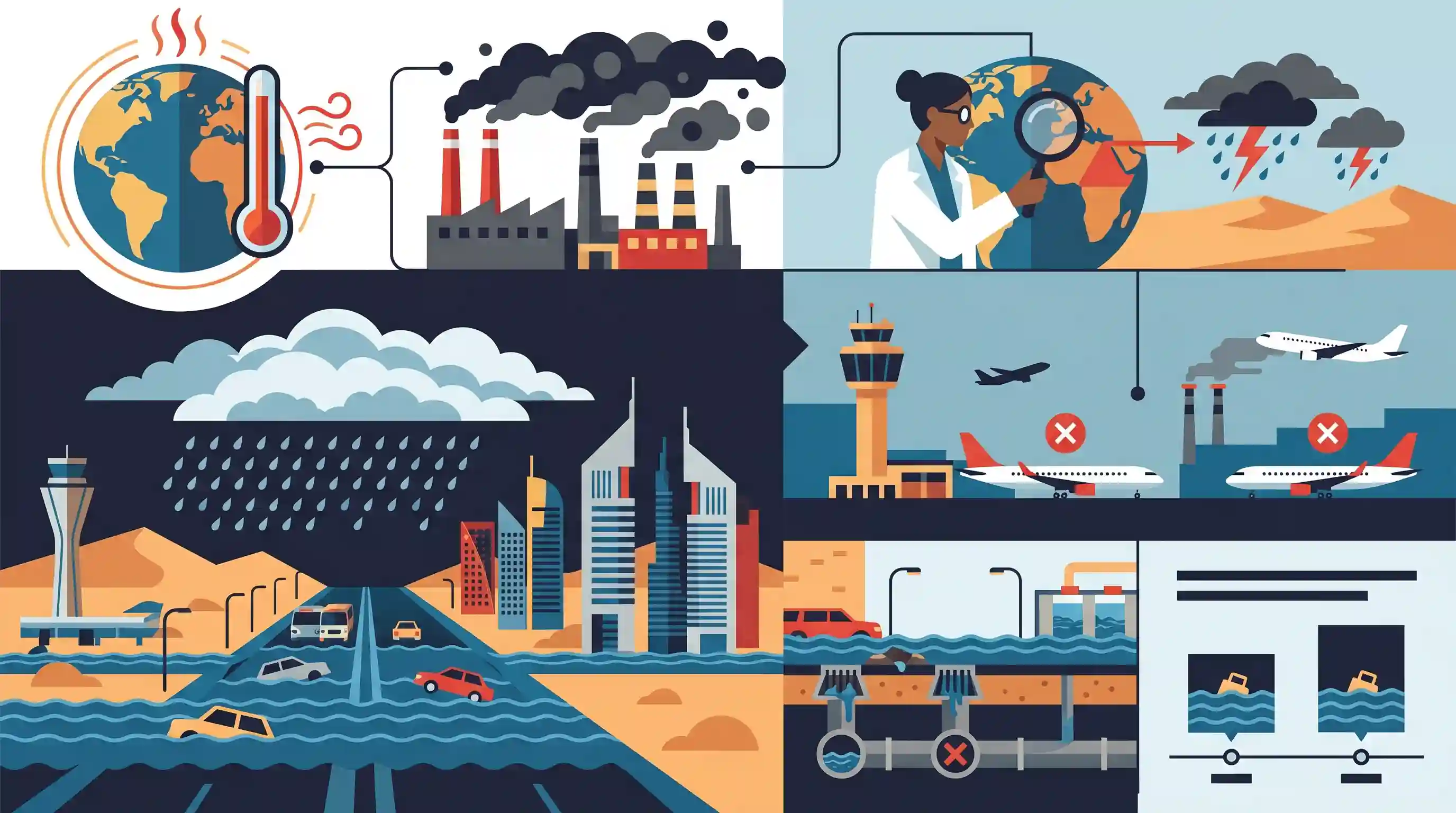
A severe and unusual winter storm brought heavy rainfall to the UAE and Qatar, leading to flooded roads and major flight disruptions in cities like Dubai and Sharjah. Climate scientists from the World Weather Attribution group point out that such extreme, rare weather anomalies in arid regions are increasingly being exacerbated by global warming and fossil fuel emissions. The recurring nature of these floods—following similar historic rains in April 2024—exposes significant gaps in the urban infrastructure and disaster preparedness of these desert metropolises.
Key Points
- A rare, intense storm system struck the UAE and Qatar, causing severe urban flooding, road closures, and flight cancellations across major hubs like Dubai and Sharjah.
- The downpour evoked memories of the record-breaking April 2024 rainfall, highlighting an increasing frequency of severe weather events in the historically arid Gulf region.
- The World Weather Attribution group concluded that global warming driven by fossil fuel emissions 'most likely' intensified these extreme rain events.
- The crisis underscores the vulnerability of modern urban infrastructure in desert regions, which lack adequate drainage systems for heavy inundation, pointing to a need for climate-resilient urban planning.
Important Terms
World Weather Attribution (WWA)

An international scientific collaboration that quantifies how human-induced climate change influences the intensity and likelihood of specific extreme weather events shortly after their occurrence.
UPSC context
GS Paper 3 (Environment); relates to the scientific quantification of climate change impacts for policy and litigation.
Urban Flooding
Inundation of property in built-up environments caused by rainfall exceeding drainage capacity, often exacerbated by unplanned urbanization and impervious surfaces like concrete.
UPSC context
GS Paper 3 (Disaster Management); tests knowledge of urban planning failures and mitigation strategies like Sponge Cities.
National Center of Meteorology (NCM)
The UAE's official federal body responsible for meteorological monitoring, weather forecasting, and early warning systems. It also manages seismic observations and cloud seeding operations.
UPSC context
GS Paper 3 (Disaster Management); an example of specialized institutional frameworks for early warning in arid regions.
Extreme Weather Events
Weather phenomena significantly different from historical patterns for a given location or season in terms of intensity, duration, or frequency (e.g., unprecedented rainfall or heatwaves).
UPSC context
GS Paper 1 (Geography) and GS Paper 3 (Environment); focuses on changing global weather patterns due to warming.
Climate Attribution Science
A branch of meteorology that uses observational data and climate models to determine the extent to which human-induced climate change has altered the probability of a specific disaster.
UPSC context
GS Paper 3 (Environment/Science & Tech); essential for linking individual weather disasters to long-term global warming trends.
Cloud Seeding
A weather modification technique that involves dispersing substances like salt or silver iodide into clouds to encourage precipitation.
UPSC context
GS Paper 3 (Science & Tech); relevant for debates on human-induced weather modification versus natural extreme rainfall events.
Prelims Trap
"Recent extreme floods in Gulf nations are primarily generated by continuous cloud seeding operations over the desert."
Cloud seeding requires pre-existing clouds and only enhances precipitation by 10-15%. Massive storm systems are macro-atmospheric anomalies driven by global warming, not localized geoengineering.
Static Concepts Connected
What are the primary chemical agents and mechanisms used in cloud seeding?
- Warm clouds: Uses hygroscopic salts (calcium or sodium chloride) to encourage water droplets to collide and grow larger, inducing rain.
- Cold clouds: Uses glaciogenic agents like Silver Iodide (AgI) or dry ice to freeze supercooled water, forming heavier ice crystals that fall.
- Key limitation: Cannot generate rain from a clear sky; it strictly requires pre-existing moisture-bearing clouds to function.
How does the Clausius-Clapeyron relationship explain extreme rainfall in deserts?
- Core principle: It establishes that the water-holding capacity of the atmosphere increases by approximately 7% for every 1°C rise in global temperature.
- Extreme weather link: This excess moisture leads to short, highly intense bursts of precipitation rather than distributed rainfall, easily overwhelming arid region infrastructure.
Cross-Topic Patterns
Urban floods: Dubai vs Indian megacities
Concretization drives urban flooding globally. Dubai's crisis mirrors Chennai's, highlighting the universal need for 'Sponge City' models—utilizing bioswales and permeable pavements—to manage low-frequency, high-intensity rainfall.
Attribution science and Climate Finance
The World Weather Attribution group's rapid quantification of human-induced extreme events provides the exact scientific backing needed to operationalize the UNFCCC Loss and Damage Fund for vulnerable nations.

Expect a Prelims question contrasting localized cloud seeding (AgI) with macro climate moisture capacity (Clausius-Clapeyron relation).
Linked PYQs · 3
Linked PYQs · 3
- 2024MainsGS3
Flooding in urban areas is an emerging climate-induced disaster. Discuss the causes of this disaster. Mention the features of two such major floods in the last two decades in India. Describe the policies and frameworks in India that aim at tackling such floods.
- 2016MainsGS1
Major cities of India are becoming more vulnerable to flood conditions. Discuss.
- 2022MainsGS3
Discuss global warming and mention its effects on the global climate. Explain the control measures to bring down the level of greenhouse gases which cause global warming, in the light of the Kyoto Protocol, 1997.
